Agregátor RSS
Postavte si Lego verzi konzole, na které začínal ježek Sonic. Na poličce ji můžete mít už v červnu
Kategorie: IT News
New Linux PamDOORa Backdoor Uses PAM Modules to Steal SSH Credentials
Cybersecurity researchers have disclosed details of a new Linux backdoor named PamDOORa that's being advertised on the Rehub Russian cybercrime forum for $1,600 by a threat actor called "darkworm."
The backdoor is designed as a Pluggable Authentication Module (PAM)-based post-exploitation toolkit that enables persistent SSH access by means of a magic password and specific TCP port combination. Ravie Lakshmananhttp://www.blogger.com/profile/[email protected]
Kategorie: Hacking & Security
Linux Firewall Rules Management Challenges Kubernetes Security
A Linux server running a few predictable services is relatively easy to secure.
Kategorie: Hacking & Security
CVE-2025-68670: discovering an RCE vulnerability in xrdp
In addition to KasperskyOS-powered solutions, Kaspersky offers various utility software to streamline business operations. For instance, users of Kaspersky Thin Client, an operating system for thin clients, can also purchase Kaspersky USB Redirector, a module that expands the capabilities of the xrdp remote desktop server for Linux. This module enables access to local USB devices, such as flash drives, tokens, smart cards, and printers, within a remote desktop session – all while maintaining connection security.
We take the security of our products seriously and regularly conduct security assessments. Kaspersky USB Redirector is no exception. Last year, during a security audit of this tool, we discovered a remote code execution vulnerability in the xrdp server, which was assigned the identifier CVE-2025-68670. We reported our findings to the project maintainers, who responded quickly: they fixed the vulnerability in version 0.10.5, backported the patch to versions 0.9.27 and 0.10.4.1, and issued a security bulletin. This post breaks down the details of CVE-2025-68670 and provides recommendations for staying protected.
Client data transmission via RDPEstablishing an RDP connection is a complex, multi-stage process where the client and server exchange various settings. In the context of the vulnerability we discovered, we are specifically interested in the Secure Settings Exchange, which occurs immediately before client authentication. At this stage, the client sends protected credentials to the server within a Client Info PDU (protocol data unit with client info): username, password, auto-reconnect cookies, and so on. These data points are bundled into a TS_INFO_PACKET structure and can be represented as Unicode strings up to 512 bytes long, the last of which must be a null terminator. In the xrdp code, this corresponds to the xrdp_client_info structure, which looks as follows:
{ [..SNIP..] char username[INFO_CLIENT_MAX_CB_LEN]; char password[INFO_CLIENT_MAX_CB_LEN]; char domain[INFO_CLIENT_MAX_CB_LEN]; char program[INFO_CLIENT_MAX_CB_LEN]; char directory[INFO_CLIENT_MAX_CB_LEN]; [..SNIP..] }The value of the INFO_CLIENT_MAX_CB_LEN constant corresponds to the maximum string length and is defined as follows:
#define INFO_CLIENT_MAX_CB_LEN 512When transmitting Unicode data, the client uses the UTF-16 encoding. However, the server converts the data to UTF-8 before saving it.
if (ts_info_utf16_in( // [1] s, len_domain, self->rdp_layer->client_info.domain, sizeof(self->rdp_layer->client_info.domain)) != 0) // [2] { [..SNIP..] }The size of the buffer for unpacking the domain name in UTF-8 [2] is passed to the ts_info_utf16_in function [1], which implements buffer overflow protection [3].
static int ts_info_utf16_in(struct stream *s, int src_bytes, char *dst, int dst_len) { int rv = 0; LOG_DEVEL(LOG_LEVEL_TRACE, "ts_info_utf16_in: uni_len %d, dst_len %d", src_bytes, dst_len); if (!s_check_rem_and_log(s, src_bytes + 2, "ts_info_utf16_in")) { rv = 1; } else { int term; int num_chars = in_utf16_le_fixed_as_utf8(s, src_bytes / 2, dst, dst_len); if (num_chars > dst_len) // [3] { LOG(LOG_LEVEL_ERROR, "ts_info_utf16_in: output buffer overflow"); rv = 1; } / / String should be null-terminated. We haven't read the terminator yet in_uint16_le(s, term); if (term != 0) { LOG(LOG_LEVEL_ERROR, "ts_info_utf16_in: bad terminator. Expected 0, got %d", term); rv = 1; } } return rv; }Next, the in_utf16_le_fixed_as_utf8_proc function, where the actual data conversion from UTF-16 to UTF-8 takes place, checks the number of bytes written [4] as well as whether the string is null-terminated [5].
{ unsigned int rv = 0; char32_t c32; char u8str[MAXLEN_UTF8_CHAR]; unsigned int u8len; char *saved_s_end = s->end; // Expansion of S_CHECK_REM(s, n*2) using passed-in file and line #ifdef USE_DEVEL_STREAMCHECK parser_stream_overflow_check(s, n * 2, 0, file, line); #endif // Temporarily set the stream end pointer to allow us to use // s_check_rem() when reading in UTF-16 words if (s->end - s->p > (int)(n * 2)) { s->end = s->p + (int)(n * 2); } while (s_check_rem(s, 2)) { c32 = get_c32_from_stream(s); u8len = utf_char32_to_utf8(c32, u8str); if (u8len + 1 <= vn) // [4] { /* Room for this character and a terminator. Add the character */ unsigned int i; for (i = 0 ; i < u8len ; ++i) { v[i] = u8str[i]; } v n -= u8len; v += u8len; } else if (vn > 1) { /* We've skipped a character, but there's more than one byte * remaining in the output buffer. Mark the output buffer as * full so we don't get a smaller character being squeezed into * the remaining space */ vn = 1; } r v += u8len; } // Restore stream to full length s->end = saved_s_end; if (vn > 0) { *v = '\0'; // [5] } + +rv; return rv; }Consequently, up to 512 bytes of input data in UTF-16 are converted into UTF-8 data, which can also reach a size of up to 512 bytes.
CVE-2025-68670: an RCE vulnerability in xrdpThe vulnerability exists within the xrdp_wm_parse_domain_information function, which processes the domain name saved on the server in UTF-8. Like the functions described above, this one is called before client authentication, meaning exploitation does not require valid credentials. The call stack below illustrates this.
x rdp_wm_parse_domain_information(char *originalDomainInfo, int comboMax, int decode, char *resultBuffer) xrdp_login_wnd_create(struct xrdp_wm *self) xrdp_wm_init(struct xrdp_wm *self) xrdp_wm_login_state_changed(struct xrdp_wm *self) xrdp_wm_check_wait_objs(struct xrdp_wm *self) xrdp_process_main_loop(struct xrdp_process *self)The code snippet where the vulnerable function is called looks like this:
char resultIP[256]; // [7] [..SNIP..] combo->item_index = xrdp_wm_parse_domain_information( self->session->client_info->domain, // [6] combo->data_list->count, 1, resultIP /* just a dummy place holder, we ignore */ );As you can see, the first argument of the function in line [6] is the domain name up to 512 bytes long. The final argument is the resultIP buffer of 256 bytes (as seen in line [7]). Now, let’s look at exactly what the vulnerable function does with these arguments.
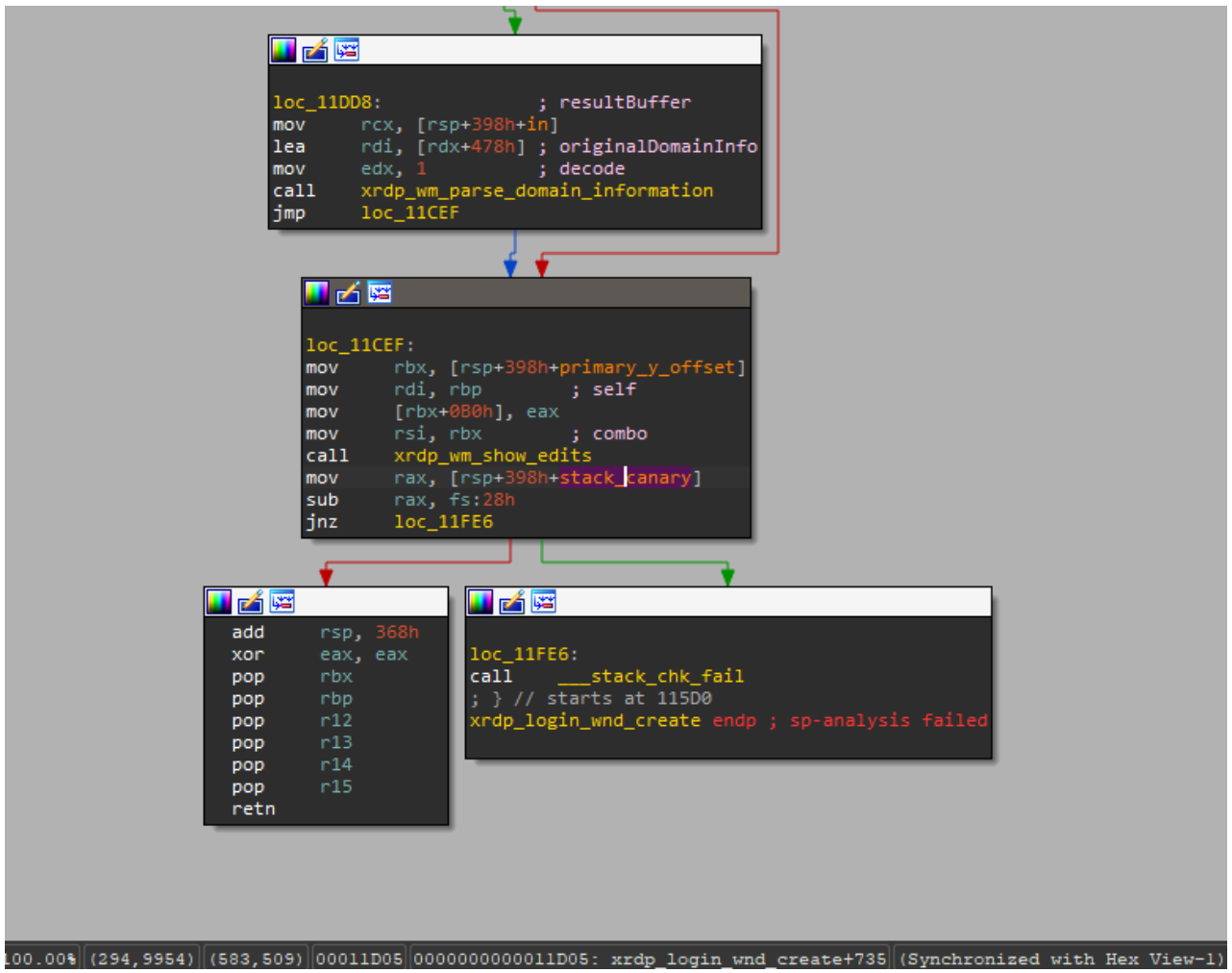
static int xrdp_wm_parse_domain_information(char *originalDomainInfo, int comboMax, int decode, char *resultBuffer) { int ret; int pos; int comboxindex; char index[2]; /* If the first char in the domain name is '_' we use the domain name as IP*/ ret = 0; /* default return value */ /* resultBuffer assumed to be 256 chars */ g_memset(resultBuffer, 0, 256); if (originalDomainInfo[0] == '_') // [8] { /* we try to locate a number indicating what combobox index the user * prefer the information is loaded from domain field, from the client * We must use valid chars in the domain name. * Underscore is a valid name in the domain. * Invalid chars are ignored in microsoft client therefore we use '_' * again. this sec '__' contains the split for index.*/ pos = g_pos(&originalDomainInfo[1], "__"); // [9] if (pos > 0) { /* an index is found we try to use it */ LOG(LOG_LEVEL_DEBUG, "domain contains index char __"); if (decode) { [..SNIP..] } / * pos limit the String to only contain the IP */ g_strncpy(resultBuffer, &originalDomainInfo[1], pos); // [10] } else { LOG(LOG_LEVEL_DEBUG, "domain does not contain _"); g_strncpy(resultBuffer, &originalDomainInfo[1], 255); } } return ret; }As seen in the code, if the first character of the domain name is an underscore (line [8]), a portion of the domain name – starting from the second character and ending with the double underscore (“__”) – is written into the resultIP buffer (line [9]). Since the domain name can be up to 512 bytes long, it may not fit into the buffer even if it’s technically well-formed (line [10]). Consequently, the overflow data will be written to the thread stack, potentially modifying the return address. If an attacker crafts a domain name that overflows the stack buffer and replaces the return address with a value they control, execution flow will shift according to the attacker’s intent upon returning from the vulnerable function, allowing for arbitrary code execution within the context of the compromised process (in this case, the xrdp server).
To exploit this vulnerability, the attacker simply needs to specify a domain name that, after being converted to UTF-8, contains more than 256 bytes between the initial “_” and the subsequent “__”. Given that the conversion follows specific rules easily found online, this is a straightforward task: one can simply take advantage of the fact that the length of the same string can vary between UTF-16 and UTF-8. In short, this involves avoiding ASCII and certain other characters that may take up more space in UTF-16 than in UTF-8, while also being careful not to abuse characters that expand significantly after conversion. If the resulting UTF-8 domain name exceeds the 512-byte limit, a conversion error will occur.
PoCAs a PoC for the discovered vulnerability, we created the following RDP file containing the RDP server’s IP address and a long domain name designed to trigger a buffer overflow. In the domain name, we used a specific number of K (U+041A) characters to overwrite the return address with the string “AAAAAAAA”. The contents of the RDP file are shown below:
alternate full address:s:172.22.118.7 full address:s:172.22.118.7 domain:s:_veryveryveryverKKKKKKKKKKKKKKKKKKKKKKKKKKKKKKKKKKKKKKKKKKKKKKKKKKKKKKKKKKKKKKKKKKKKKKKKKKKKKKKKKKKKKKeryveryveryveryveryveryveryveryveryveryveryveryveryveryveryveryveryveryveryveaaaaaaaaryveryveryveryveryveryveryveryveryveryveryveryverylongdoAAAAAAAA__0 username:s:testuserWhen you open this file, the mstsc.exe process connects to the specified server. The server processes the data in the file and attempts to write the domain name into the buffer, which results in a buffer overflow and the overwriting of the return address. If you look at the xrdp memory dump at the time of the crash, you can see that both the buffer and the return address have been overwritten. The application terminates during the stack canary check. The example below was captured using the gdb debugger.
gef➤ bt #0 __pthread_kill_implementation (no_tid=0x0, signo=0x6, threadid=0x7adb2dc71740) at ./nptl/pthread_kill.c:44 #1 __pthread_kill_internal (signo=0x6, threadid=0x7adb2dc71740) at ./nptl/pthread_kill.c:78 #2 __GI___pthread_kill (threadid=0x7adb2dc71740, signo=signo@entry=0x6) at./nptl/pthread_kill.c:89 #3 0x00007adb2da42476 in __GI_raise (sig=sig@entry=0x6) at ../sysdeps/posix/raise.c:26 #4 0x00007adb2da287f3 in __GI_abort () at ./stdlib/abort.c:79 #5 0x00007adb2da89677 in __libc_message (action=action@entry=do_abort, fmt=fmt@entry=0x7adb2dbdb92e "*** %s ***: terminated\n") at ../sysdeps/posix/libc_fatal.c:156 #6 0x00007adb2db3660a in __GI___fortify_fail (msg=msg@entry=0x7adb2dbdb916 "stack smashing detected") at ./debug/fortify_fail.c:26 #7 0x00007adb2db365d6 in __stack_chk_fail () at ./debug/stack_chk_fail.c:24 #8 0x000063654a2e5ad5 in ?? () #9 0x4141414141414141 in ?? () #10 0x00007adb00000a00 in ?? () #11 0x0000000000050004 in ?? () #12 0x00007fff91732220 in ?? () #13 0x000000000000030a in ?? () #14 0xfffffffffffffff8 in ?? () #15 0x000000052dc71740 in ?? () #16 0x3030305f70647278 in ?? () #17 0x616d5f6130333030 in ?? () #18 0x00636e79735f6e69 in ?? () #19 0x0000000000000000 in ?? ()Protection against vulnerability exploitation
It is worth noting that the vulnerable function can be protected by a stack canary via compiler settings. In most compilers, this option is enabled by default, which prevents an attacker from simply overwriting the return address and executing a ROP chain. To successfully exploit the vulnerability, the attacker would first need to obtain the canary value.
The vulnerable function is also referenced by the xrdp_wm_show_edits function; however, even in that case, if the code is compiled with secure settings (using stack canaries), the most trivial exploitation scenario remains unfeasible.
Nevertheless, a stack canary is not a panacea. An attacker could potentially leak or guess its value, allowing them to overwrite the buffer and the return address while leaving the canary itself unchanged. In the security bulletin dedicated to CVE-2025-68670, the xrdp maintainers advise against relying solely on stack canaries when using the project.
Vulnerability remediation timeline- 12/05/2025: we submitted the vulnerability report via https://github.com/neutrinolabs/xrdp/security.
- 12/05/2025: the project maintainers immediately confirmed receipt of the report and stated they would review it shortly.
- 12/15/2025: investigation and prioritization of the vulnerability began.
- 12/18/2025: the maintainers confirmed the vulnerability and began developing a patch.
- 12/24/2025: the vulnerability was assigned the identifier CVE-2025-68670.
- 01/27/2026: the patch was merged into the project’s main branch.
Taking a responsible approach to code makes not only our own products more solid but also enhances popular open-source projects. We have previously shared how security assessments of KasperskyOS-based solutions – such as Kaspersky Thin Client and Kaspersky IoT Secure Gateway – led to the discovery of several vulnerabilities in Suricata and FreeRDP, which project maintainers quickly patched. CVE-2025-68670 is yet another one of those stories.
However, discovering a vulnerability is only half the battle. We would like to thank the xrdp maintainers for their rapid response to our report, for fixing the vulnerability, and for issuing a security bulletin detailing the issue and risk mitigation options.
Kategorie: Hacking & Security, Viry a Červi
Lisa Su: Zahájili jsme dodávky vzorků Instinct MI400
Řada Instinct MI400 bude oproti předchozím poněkud specifická. AMD nechystá jeden návrh, na kterém postaví všechny produkty, ale několik konfigurací zaměřené na různé segmenty…
Kategorie: IT News
New Linux 'Dirty Frag' zero-day gives root on all major distros
A new Linux zero-day exploit, named Dirty Frag, allows local attackers to gain root privileges on most major Linux distributions with a single command. [...]
Kategorie: Hacking & Security
Velký test 27" monitorů na home office. Do 10 000 Kč pořídíte 4K, 100 Hz i napájení pro notebook
Dobrý kancelářský monitor může po práci posloužit mnoha členům rodiny pro zábavu, pomůže překonat dlouhý pracovní den a uleví zdraví.
Kategorie: IT News
AI clones: the good, the bad, and the ugly
AI is capable of mimicking a real person. It’s clear this capability exists, and the ethics of using AI for this purpose are often very clear. But increasingly, new applications are leading to ethically murky results.
The goodFor example, the CEO of a company, or a politician, could choose to create a clone using AI tools, creating a chatbot plus an avatar — a digital twin — that can interact with people on their behalf. Silicon Valley is big on the idea: Meta’s Mark Zuckerberg and LinkedIn co-founder Reid Hoffman are working on, or have already created, digital twins of themselves.
Cloned politicians include Pakistan’s Imran Khan, who used an authorized voice clone to campaign from prison, and New York City Mayor Eric Adams, who used voice-cloned robocalls to speak with constituents in languages like Mandarin and Yiddish.
This kind of use case is probably ethical — as long as the people interacting know that they’re dealing with a digital clone and not a real person.
The badThe flip side of ethical uses for AI-generated clones is the non-consensual (and therefore unethical) cases. And of these, there are already many. For instance:
- In 2019, the first widely documented case occurred when scammers used AI to mimic the voice and German accent of a parent company’s executive, successfully tricking the CEO of a UK energy firm into transferring €220,000 into a fraudulent account.
- In 2023, an Arizona mother, Jennifer DeStefano, was targeted by extortionists who used an AI clone of her 15-year-old daughter’s voice to demand a $1 million ransom.
- And in 2024, a finance worker at a multinational firm in Hong Kong was tricked into transferring $25 million after attending a video conference call featuring deepfake recreations of his CFO and several other colleagues.
Other unethical, non-consensual uses for AI cloning include deepfake videos, where a celebrity’s face is superimposed on a porn actor. In all the above examples, the ethics are clear. This is all very wrong.
But with China leading the way in the emergence of AI clones, the ethics are becoming far murkier.
And the uglyOne emerging trend involves workers using specialized software to build digital versions of their bosses or colleagues. The most prominent project driving this trend is Colleague Skill, which was posted in late March by its creator, a 24-year-old Shanghai-based engineer named Zhou Tianyi.
Colleague Skill and its forks and copycats, which tend to be open source, enable people to upload chat histories, emails, and internal documents to create a functional persona that mimics a specific coworker’s professional expertise and communication style. The technology stack includes tools like Claude, Kimi, ChatGPT, DeepSeek API, OCR (Tesseract), and sentiment analysis modules.
Colleague Skill uses a person’s past communications to build a talking replica of their personality. If you think of a regular AI as a general student who knows a little bit about everything, this tool acts like a specialized mask that forces the AI to behave like one specific individual.
In other words, it produces a chatbot with the knowledge and patterns of speech of a real person.
Colleague Skill started as a satirical commentary on AI-driven layoffs. But some employees began using it in earnest to clone their colleagues. There are several stated reasons for doing so, including retaining institutional knowledge and having an instant sounding board to “discuss” plans and ideas with.
A similar motivation is the use of AI to clone bosses, so employees can better predict how that boss might react to the employees’ work.
In most of these instances, according to reports out of China, the creation of the boss-bot or colleague clone is nonconsensual.
Is non-consensually basing a custom chatbot on a colleague or boss unethical?
And then it got personal (and weird)Tianyi, creator of Colleague Skill, later forked it into something called Ex-Partner Skill. The idea is to re-create a former partner with AI so the user can continue the relationship.
It operates on the same technical engine but applies it to a much more personal part of life. Users upload photos, social posts, chat logs and other content. The AI chatbot can then mimic the former partner’s tone, catchphrases, and subtle linguistic nuances, something that, “truly sounds like them — speaks with their catchphrases, replies in their style, remembers the places you went together.”
This allows a person to simulate conversations with someone who is no longer in their life.
If Colleague Skill is in a grey area, Ex-Partner Skill is in a darker grey area.
(Note: many of the original repositories for Ex-Partner Skill have been removed from public view in China or “sanitized” after regulatory pressure. But the framework reportedly continues to circulate in private developer circles, and similar tools are increasingly used for “digital resurrection.”)
Ethically, the concept feels like it exists on a wide spectrum somewhere between therapy at one end and revenge porn at the other. (It’s like revenge porn in the sense that when “content” consensually made by two people for one purpose is later used consensually by one person in a way that the other person might find objectionable.)
Or maybe it’s closer to the “deathbot” phenomenon, where an AI-generated simulation provides a fake version of the dearly departed. (In both cases, the user interacts with a digital twin of someone who is no longer present in one’s life.) In fact, some people in China are using Ex-Partner Skill as a deathbot for a deceased loved one.
The lack of consent feels like an ethical lapse. But we don’t consider it unethical to think about, remember, imagine conversations with, or journal about ex-partners — or dead family members.
Boosters of the Ex-Partner Skill idea say that conversations with digital exes are therapeutic. They point out that because it’s private, it’s not harassment or stalking or an invasion of privacy. Instead, they argue, it helps with personal reflection and emotional healing.
As for people who have died, according to Chinese media reports, some users say the tool gives them a sense of closure and allows them to say the things they wish they could have said to the real person. But is it really closure if one person is still obsessively trying to interact — or pretend to interact — with the other person?
It’s healthy to communicate. But it’s not communication when a person is by themselves talking to no one and sending messages to a person who never gets those messages.
While ex-bots are a thing these days in China, the trend is showing up elsewhere. Some Character.AI users outside of China have created chatbots based on ex-partners, even though the company has changed its Terms of Service to explicitly ban the creation of bots using the likenesses of private individuals without their permission.
The emergence of nonconsensual cloning of coworkers, bosses and ex-partners is a new challenge to our sense of right and wrong, and yet another way AI is challenging us to step up and figure out how to respond.
Kategorie: Hacking & Security
Vše, co víme o skládacím iPhonu. Bude menší než konkurenční Foldy a nechá zmizet rýhu v displeji
Kategorie: IT News
Čínský soud rozhodl, že zaměstnance nelze propouštět jen proto, že jejich práci převzala levnější AI
Čínské soudy zakázaly firmám propouštět pracovníky pouze kvůli nasazení AI • Nasazení nových technologií nepředstavuje nečekanou vnější okolnost • Zaměstnavatelé musí místo okamžitého vyhazovu nabídnout rekvalifikaci
Kategorie: IT News
Velký Battlemage ve hrách dotahuje GeForce RTX 5060 Ti
Dlouho očekávané GPU BMG-G31 alias velký Battlemage sice dorazilo, ale jen v podobě profesionálních karet s 32GB paměti, které se s cenou $950 hráčům nevyplatí. Cenovka ale herním testům nebrání…
Kategorie: IT News
Linux Kernel Dirty Frag LPE Exploit Enables Root Access Across Major Distributions
Details have emerged about a new, unpatched local privilege escalation (LPE) vulnerability impacting the Linux kernel.
Dubbed Dirty Frag, it has been described as a successor to Copy Fail (CVE-2026-31431, CVSS score: 7.8), a recently disclosed LPE flaw impacting the Linux kernel that has since come under active exploitation in the wild. The vulnerability was reported to Linux kernel maintainers
Kategorie: Hacking & Security
Linux Kernel Dirty Frag LPE Exploit Enables Root Access Across Major Distributions
Details have emerged about a new, unpatched local privilege escalation (LPE) vulnerability impacting the Linux kernel.
Dubbed Dirty Frag, it has been described as a successor to Copy Fail (CVE-2026-31431, CVSS score: 7.8), a recently disclosed LPE flaw impacting the Linux kernel that has since come under active exploitation in the wild. The vulnerability was reported to Linux kernel maintainers Ravie Lakshmananhttp://www.blogger.com/profile/[email protected]
Kategorie: Hacking & Security
Hry zadarmo, nebo se slevou: Diablo IV za tři stovky a správa obchodu s haraburdím zdarma
Na všech herních platformách je každou chvíli nějaká slevová akce. Každý týden proto vybíráme ty nejatraktivnější, které by vám neměly uniknout. Pokud chcete získat hry zdarma nebo s výhodnou slevou, podívejte se na aktuální přehled akcí!
Kategorie: IT News
V dubnu bylo ve Firefoxu opraveno celkově 423 bezpečnostních chyb
Mozilla před dvěma týdny na svém blogu oznámila, že díky Claude Mythos Preview bylo ve Firefoxu nalezeno a opraveno 271 bezpečnostních chyb. Včera vyšel na Mozilla Hacks článek s podrobnějšími informacemi. Z 271 bezpečnostních chyb mělo 180 chyb vysokou závažnost, 80 chyb střední závažnost a 11 chyb nízkou závažnost. Celkově bylo v dubnu ve Firefoxu opraveno 423 bezpečnostních chyb. Čísla CVE nemusí být přiřazována jednotlivým chybám. CVE-2026-6784 například představuje 154 bezpečnostních chyb.
Kategorie: GNU/Linux & BSD
Mozilla boasts Mythos boosted Firefox bug cull
Mozilla fixed 423 Firefox security bugs in April, a repair rate more than five times higher than the 76 fixes issued in March and almost 20 times higher than its 21.5 monthly average last year. The browser maker previously said Anthropic's ballyhooed Mythos Preview model found 271 of these in Firefox 150. Now, a trio of technical types has come forward to provide a bit more detail about what Mythos (and its less storied sibling Opus 4.6) actually found. But they also highlight something that may matter more than the model: the agentic harness – the middleware mediating between AI and the end user. Brian Grinstead, Firefox distinguished engineer, Christian Holler, Firefox tech lead, and Frederik Braun, head of the Firefox security team, observe that over the past few months, AI-generated security reports have gone from slop to rather more tasty. They attribute the transformation to better models and development of better ways of harnessing those models – steering them in a way that increases the ratio of signal to noise. But they also appear to be aware that there's some skepticism in the security community about Mythos. So they've decided to publicize selected wins in an effort to encourage others to jump aboard the AI bug remediation train. "Ordinarily we keep detailed bug reports private for several months after shipping fixes and issuing security advisories, largely as a precaution to protect any users who, for whatever reason, were slow to update to the latest version of Firefox," they said. "Given the extraordinary level of interest in this topic and the urgency of action needed throughout the software ecosystem, we’ve made the calculated decision to unhide a small sample of the reports behind the fixes we recently shipped." The post links to a dozen Firefox bugs with varying degrees of severity. The list includes, for example, a 20-year-old heap use-after-free bug (high severity) that a web page could trigger using the XSLTProcessor DOM API without any user interaction. Many of these bugs are sandbox escapes, they note, which are difficult to find using techniques like fuzzing. AI analysis, they say, helps provide broader security coverage. And they add that it has helped validate prior browser hardening work designed to prevent prototype pollution attacks – audit logs showed AI models making unsuccessful exploitation attempts using this technique. Following Anthropic's announcement of Project Glasswing – a program for companies to gain early access to Mythos because it's touted as too dangerous for public release – security experts expressed skepticism. For example, Davi Ottenheimer, president of security consultancy flyingpenguin, wrote in an April 13 blog post, "The supposedly huge Anthropic 'step change' appears to be little more than a rounding error. The threat narrative so far appears to be ALL marketing and no real results. The Glasswing consortium is regulatory capture dressed up poorly as restraint." He subsequently ran a test in which he strapped Anthropic's lesser models Sonnet 4.6 and Haiku 4.5 into a harness called Wirken with an auditing skill called Lyrik. The result was eight findings in two minutes at a cost of about $0.75, Ottenheimer claims, noting that two of the eight matched bugs Mythos had identified. Other security folk have also reported that bug hunting and exploit development can be quite productive with off-the-shelf models like Opus 4.6, which among other virtues costs about 5x less than Mythos. In an email to The Register, Ottenheimer said, "There's a fundamental philosophical failure in the Mozilla post. A reading and a measurement are not the same thing. I don't see a measurement, but they seem to want us to believe we're looking at one. "When they give us the 'behind the scenes math' it's circular, a trick. 'Mythos found 271 bugs' is what Mythos found, not what other tools could not find against the same code. Why leave it as an assumption if it can be proven?" Ottenheimer said Mozilla advocates that every project adopt a similar approach without proving the merits of that approach. "It's like saying if you don't drink Coca-Cola, you can't run a mile under six minutes, because that's what a guy sponsored by Coca-Cola just did," he said. "The bar moves on rhetoric, marketing, not proper evidence. That is the capture crew again." He notes that the merits of Mythos might be more convincing if Mozilla had reported they couldn't do this work without Mythos. And since they're not saying that, he suggests, it's worth asking why there's no transparent comparison of Mythos to other models. He points to Mozilla's admission that Opus 4.6 was already identifying "an impressive amount of previously unknown vulnerabilities." "Mozilla never quantifies what Opus 4.6 [did] before saying what Mythos added," he said. "So 271 attributed to Mythos doesn't fit the analysis. And there's a deeper reveal when they say 'we dramatically improved our techniques for harnessing these models.' The improvement may be entirely in the harness, not as much in the model. This maps to my own experience. A nail gun has advantages over the hammer, yet without being in the right hands the outputs are as bad or worse." ®
Kategorie: Viry a Červi
Canvas login portals hacked in mass ShinyHunters extortion campaign
The ShinyHunters extortion gang has breached education technology giant Instructure again, this time exploiting another vulnerability to deface Canvas login portals for hundreds of colleges and universities. [...]
Kategorie: Hacking & Security
New TCLBanker malware self-spreads over WhatsApp and Outlook
A new trojan named TCLBanker, which targets 59 banking, fintech, and cryptocurrency platforms, uses a trojanized MSI installer for Logitech AI Prompt Builder to infect systems. [...]
Kategorie: Hacking & Security
V čem je elektroauto lepší, horší? Pohled majitele „spalováku“ nejen v mezích ekologie
Jsem sice majitelem spalovacího auta, nicméně zvažuji a počítám i s jinými možnostmi. V diskuzích se často jitří emoce a opakují se mýty, které zbytečně odrazují. Každé auto má své výhody a nevýhody, elektroauto není výjimkou.
Kategorie: IT News
Linuxové jádro 7.2 dostane 10Gbit USB Ethernet Realtek, skončí AMD Elan
Vývoj jádra 7.1 je ve fázi RC, takže vše, co nestihlo začlenění, už míří do následné verze 7.2. Dnes se krátce podíváme na chystané změny pro GPU AMD či Intel a přiblížíme si končící staré platformy SoC od AMD.
Kategorie: GNU/Linux & BSD
- « první
- ‹ předchozí
- 1
- 2
- 3
- 4
- 5
- 6
- 7
- 8
- 9
- …
- následující ›
- poslední »