Agregátor RSS
Network Anomaly Detection in KATA
Introduction
Once the attacker has breached the corporate network, subsequent stages of the attack often involve leveraging standard domain infrastructure protocols: using Kerberos, running DNS queries, accessing internal services, opening network shares, and other common networking actions. Because this activity is virtually indistinguishable from legitimate network traffic, it is extremely difficult to detect it with traditional network attack detection tools.
Kerberoasting and DNS tunneling have long ceased to be exotic techniques. They are becoming standard methods in modern attacks because they allow attackers to execute critical compromise stages while remaining undetected by traditional security tools. A clear example of this trend is seen in latest campaigns, employing both Kerberoasting and DNS tunneling.
Traditional network security tools perform well when the attack features a distinct and identifiable indicator: a characteristic query string, a known malicious traffic pattern, or the source code of an already discovered exploit. While this approach to threat detection remains effective, it cannot always be applied to discovering network attacks that blend seamlessly with legitimate traffic inside a corporate network.
Instead of searching for explicit indicators of attack, Network Anomaly Detection (NAD) analyzes all traffic for suspicious artifacts that deviate from the host’s typical network activity. Within Kaspersky’s solution portfolio, this technology is implemented specifically in the Kaspersky Anti Targeted Attack (KATA) platform.
The system analyzes network traffic data (DNS, DCE/RPC, Kerberos and other packets) and extracts key parameters used to identify anomalous behavior. This approach enables searching for attacks on domain controllers, signs of traffic tunneling and exfiltration, C2 communications, and other scenarios that may point to compromise of network infrastructure.
However, Network Anomaly Detection is not built on a single, universal set of indicators. Each attack scenario employs tailored detection models that account for the specifics of the corresponding network protocol, typical host behavior, and characteristic deviations from that baseline. This article examines two practical examples – detecting Kerberoasting and DNS tunneling – to demonstrate how these principles are implemented in KATA’s NAD rules and why this approach proves more effective than traditional signature-based analysis.
Kerberoasting attack detection by KATA Why standard tools have a hard time detecting KerberoastingThe Kerberoasting attack leverages the standard operational logic of the Kerberos protocol. The attacker identifies service accounts configured with a Service Principal Name (SPN), requests a Ticket-Granting Service (TGS) ticket for them, and attempts to crack the password offline using a dictionary attack against the retrieved ticket. If the password is weak or hasn’t been changed in a long time, the adversary can bruteforce it to get it in cleartext. Subsequently, these compromised credentials can be leveraged for both vertical and horizontal movement across the network.
The essence of a Kerberoasting attack is that an adversary possessing a compromised low-privileged account and a valid Ticket-Granting Ticket (TGT) for that account can request TGS tickets with weakened encryption for service accounts with SPNs. Crucially, it doesn’t matter whether the compromised account actually holds access permissions for those services. Having obtained these tickets, the attacker can then take them offline and bruteforce the service account’s password by trying to decrypt the corresponding ticket locally, without generating any network activity. As the encryption key is based on the password hash, the adversary can guess the password upon finding the correct key.
The attacker’s objective is to find a service account that has a simple password. Most likely, this will be an account created manually by the administrators of the infrastructure or a service. This is precisely why attackers are not interested in system service accounts with SPNs (such as CIFS/fileserver.company.local); these are generated automatically and feature highly complex passwords that are impossible to bruteforce.
We should note that the TGS ticket requests made by attackers are identical to standard, legitimate requests. Every domain naturally exhibits a high volume of Kerberos traffic. Therein lies the primary challenge of detecting Kerberoasting: legitimate service ticket requests (TGS-REQ) are indistinguishable from those issued by attackers. Consequently, the primary detection method relies on correlating indirect indicators rather than signature matching. Key indicators include an anomalous request source (atypical host or user account), a surge in requested SPNs within a short time window, attempts to obtain service tickets for sensitive or privileged service accounts, and off-hour timing or unusual request volume when benchmarked against the historical profile of both the user and the host.
Most of these indicators can be detected using NAD technology, which helps analysts cut through high volumes of Kerberos traffic to establish a concrete hypothesis: who initiated the Kerberoasting attack, which service accounts are at risk, and why this activity deviates from the baseline.
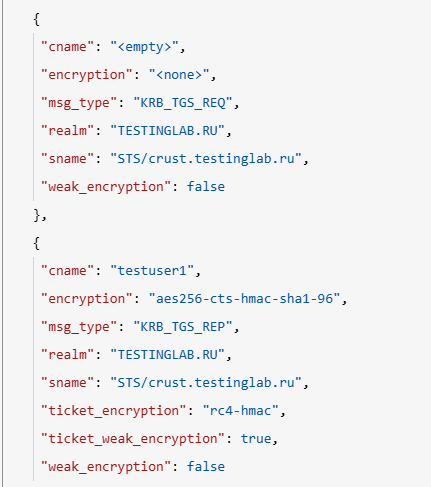
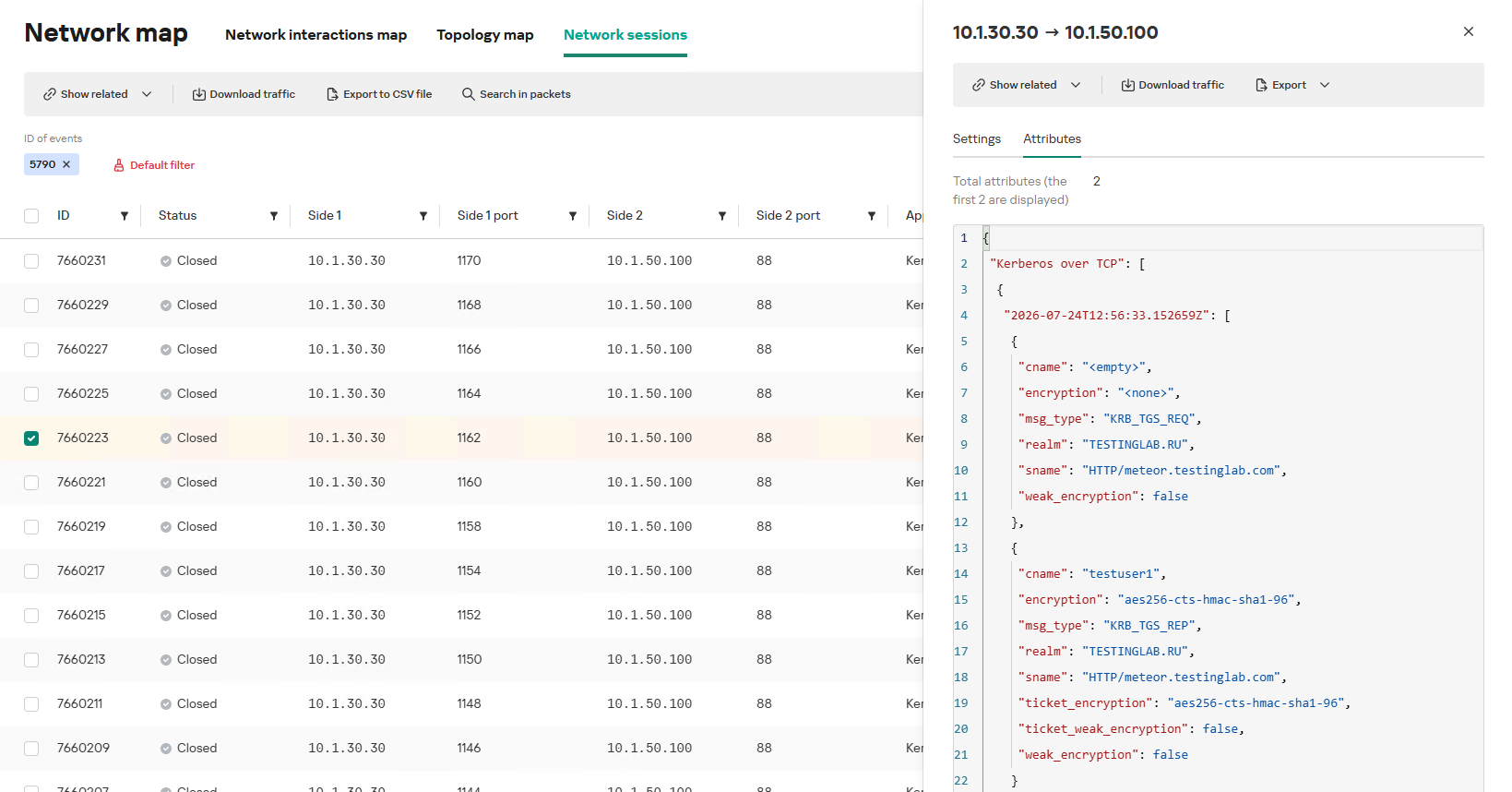
In the context of this attack, the network anomaly stems from a single host – likely using a single user account (cname) – receiving TGS tickets ("msg_type": "KRB_TGS_REP") for numerous unique services with SPNs (sname) within a short timeframe. These service accounts are non-system accounts.
Example of a TGS-REQ – TGS-REP event pair from network session attributes
To detect this anomaly, the NAD rule titled “Signs of a Kerberoasting attack” implements the following logic:
- From Kerberos network sessions during the search depth period, select only those with a successful Kerberos TGS-REP response, subject to the following conditions:
- The IP address that initiated the session must not be excluded in the excl_sip variable.
- The requesting client name (cname) must not be included in the excluded users list (excl_users variable).
- The SPN (sname) must not be excluded within the rule. System SPNs are omitted from detection logic because they exist across most corporate environments and hold no interest for adversaries in this attack vector; including them in the total count of unique SPNs could lead to predefined threshold being exceeded, triggering false positives.
- Extract the cname (the name of the client requesting the TGS-REQ) and sname (SPN itself) from these qualifying sessions.
- Group the sessions by the source IP address and client account name (cname), while aggregating sessions with unique SPNs.
- Generate an alert if a single IP address using a single client account receives TGS-REP responses for N unique SPN names within the specified search depth window, where N equals or exceeds the threshold variable count_spns.
- Within the event regeneration window, group under the initial alert all subsequent alerts associated with the same client IP address. This avoids creating duplicate event records by incrementing the aggregation counter (Total appearances).
We should note that this type of logic cannot be implemented using IDS signatures. Consider creating a Suricata rule designed to detect Kerberos TGS-REP packets. To minimize false positives, we’ll exclude system SPNs (which carry highly complex passwords) and apply a threshold for the number of responses a single client can receive. However, such a rule cannot evaluate the uniqueness of the requested SPNs; it can only track packet counts. As a result, this signature would produce a high volume of false positives because any domain naturally generates large amounts of identical legitimate TGS-REP messages.
Furthermore, adding exclusions and tuning thresholds to fit your specific infrastructure environments is significantly more practical when managed through user variables in the interface rather than directly modifying the underlying structure of the IDS rule itself.
Creating a Network Anomaly Detection ruleNetwork Anomaly Detection (NAD) rules are written as SQL queries executed against KATA’s ClickHouse database. Below, we demonstrate how to add and deploy a rule.
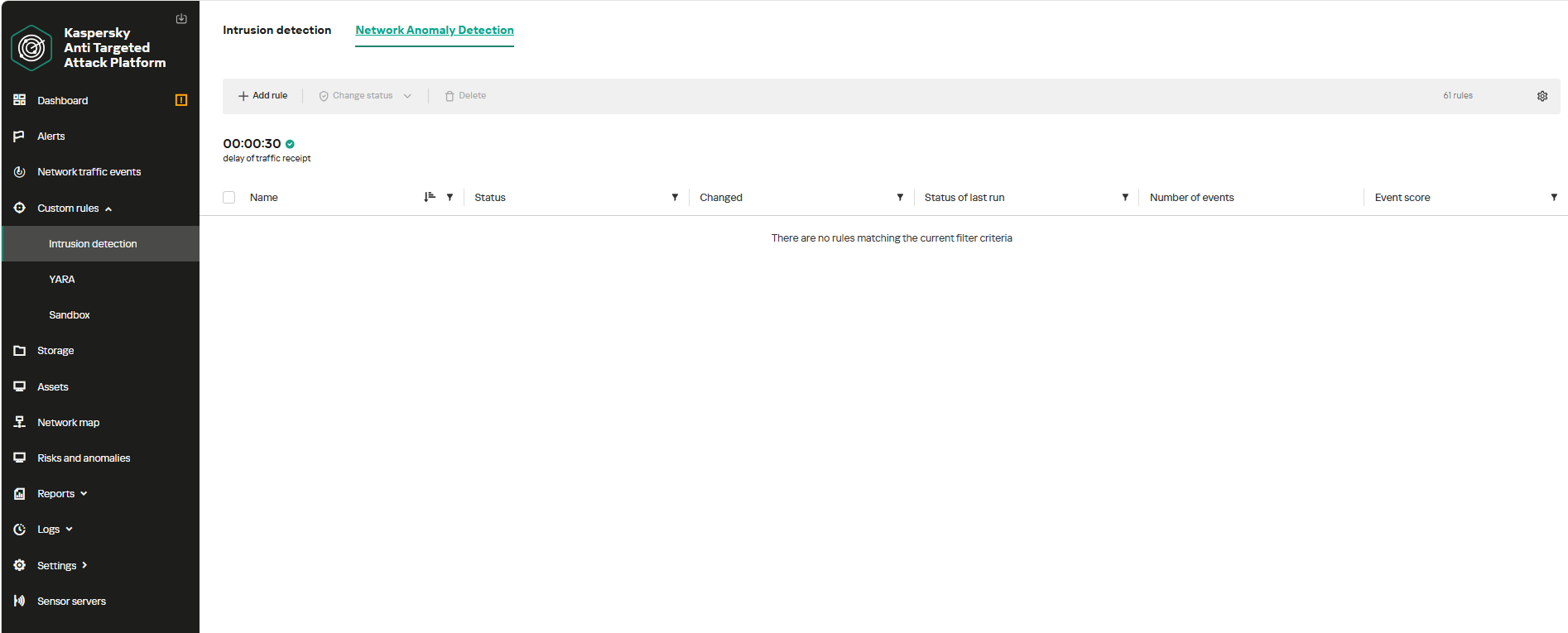
To begin working with NAD rules, navigate to the “Custom rules” section of the interface and select “Intrusion detection”. Under the “Network Anomaly Detection” tab, you can create a new rule.
The Network Anomaly Detection page UI
When adding a new rule, an analyst can select an appropriate rule template from the prebuilt set supplied with product updates. They can also manually modify the rule added from the template (converting it to a custom rule while keeping the original template intact) or author a rule from scratch using the provided guide.
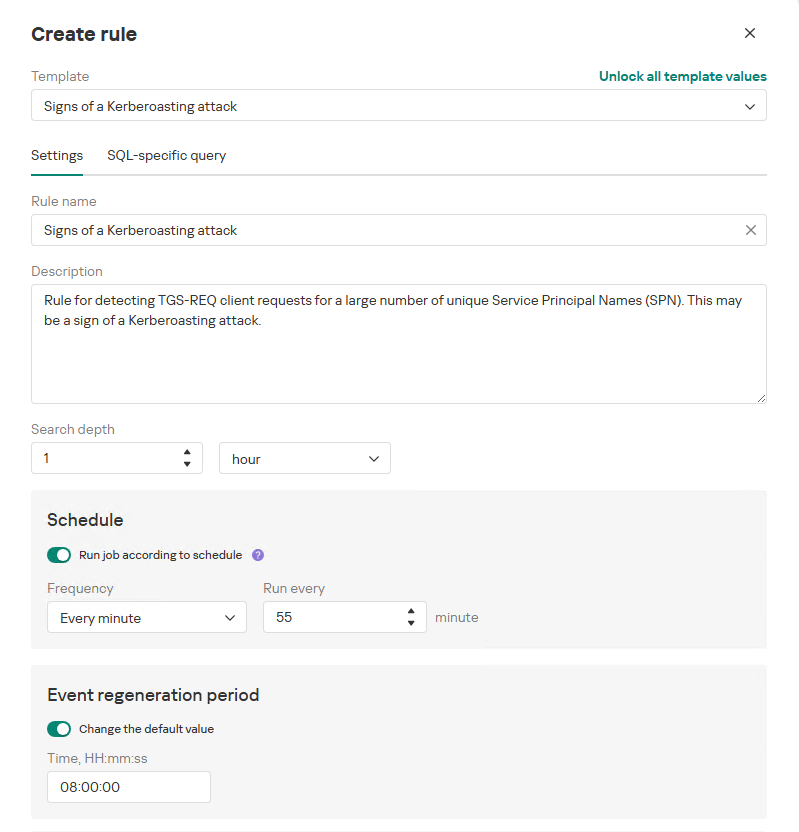
Upon selecting a template, the analyst can review the rule description and either adjust or leave the default values for the following settings:
- Search depth (the lookback window over which the SQL query will run)
- Schedule (the execution frequency for running the query against the specified search depth)
- Event regeneration period (the timeframe during which identical alerts will be aggregated into a single record rather than displayed as distinct events)
UI for creating a new NAD rule
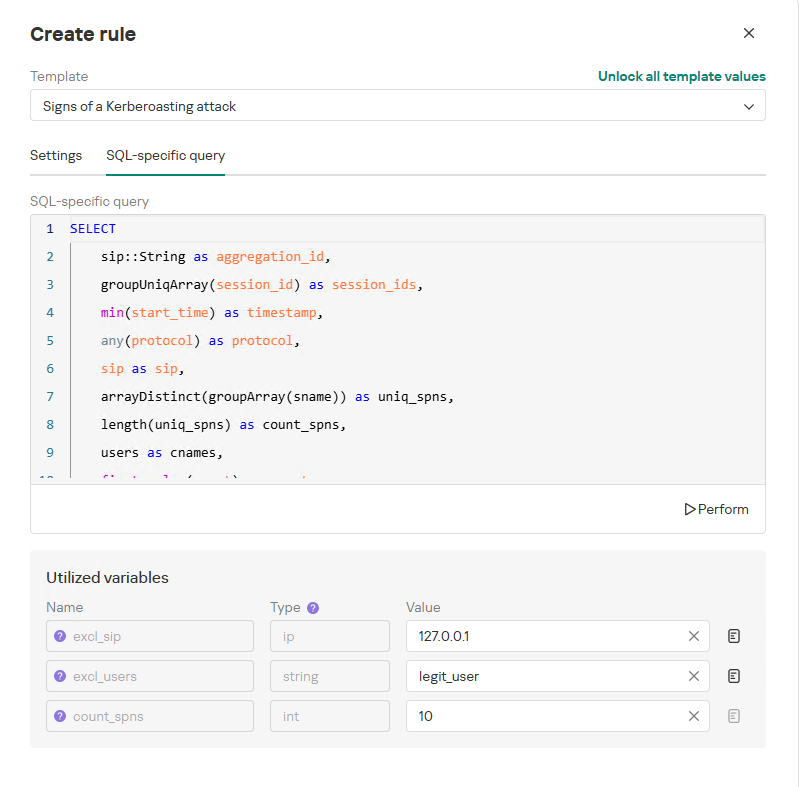
To ensure the rule functions correctly, we recommend navigating to the “SQL-specific query” tab before deployment to review the variables used within the rule – a description for each variable is available by hovering over the question mark icon.
The variables are lists of IP addresses, dates, strings or numeric values that define the network infrastructure – such as domain controllers, DNS servers, time ranges, critical segments, and other entities. This allows you to tailor each rule to different network environments and incorporate specific infrastructure characteristics without modifying the underlying logic.
In our example, using variables allows you to adjust the “Signs of a Kerberoasting attack” rule as follows without altering the underlying SQL query:
- Exclude the source IP address of the TGS-REQ requests from the scope of detection logic (you can specify a single address, a subnet mask, or a dictionary containing addresses and subnets) as well as the requesting client account (accepts a single value or a dictionary with multiple values).
- Adjust the threshold value required to trigger an alert based on the number of unique SPNs in the TGS-REQ messages.
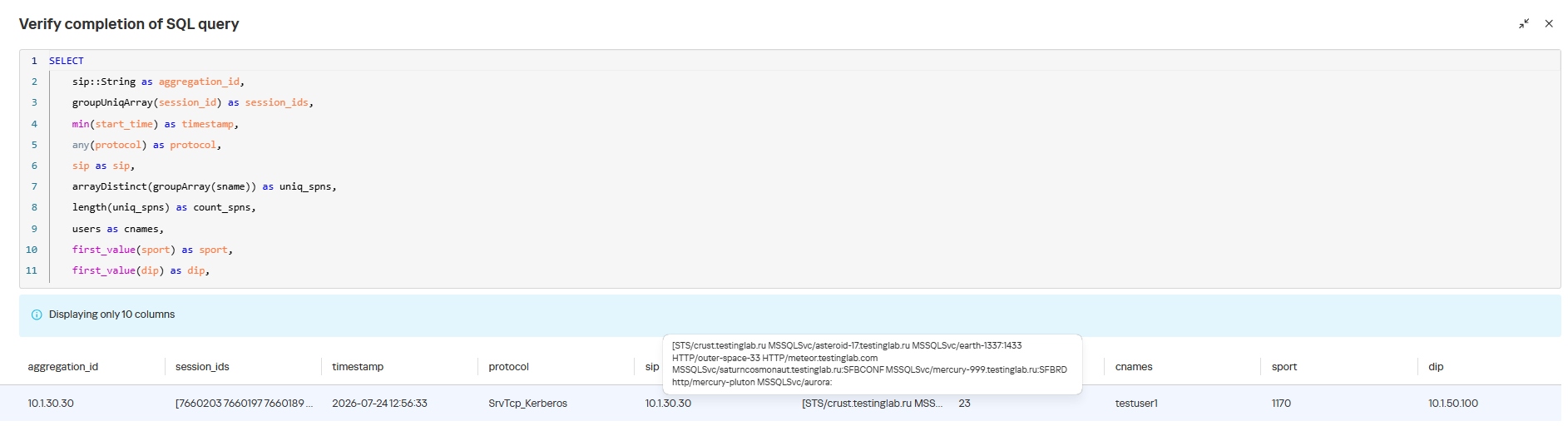
Query contents and variables used in the new rule
On this same page, you can test if the rule is functional prior to saving it.
Rule execution test results
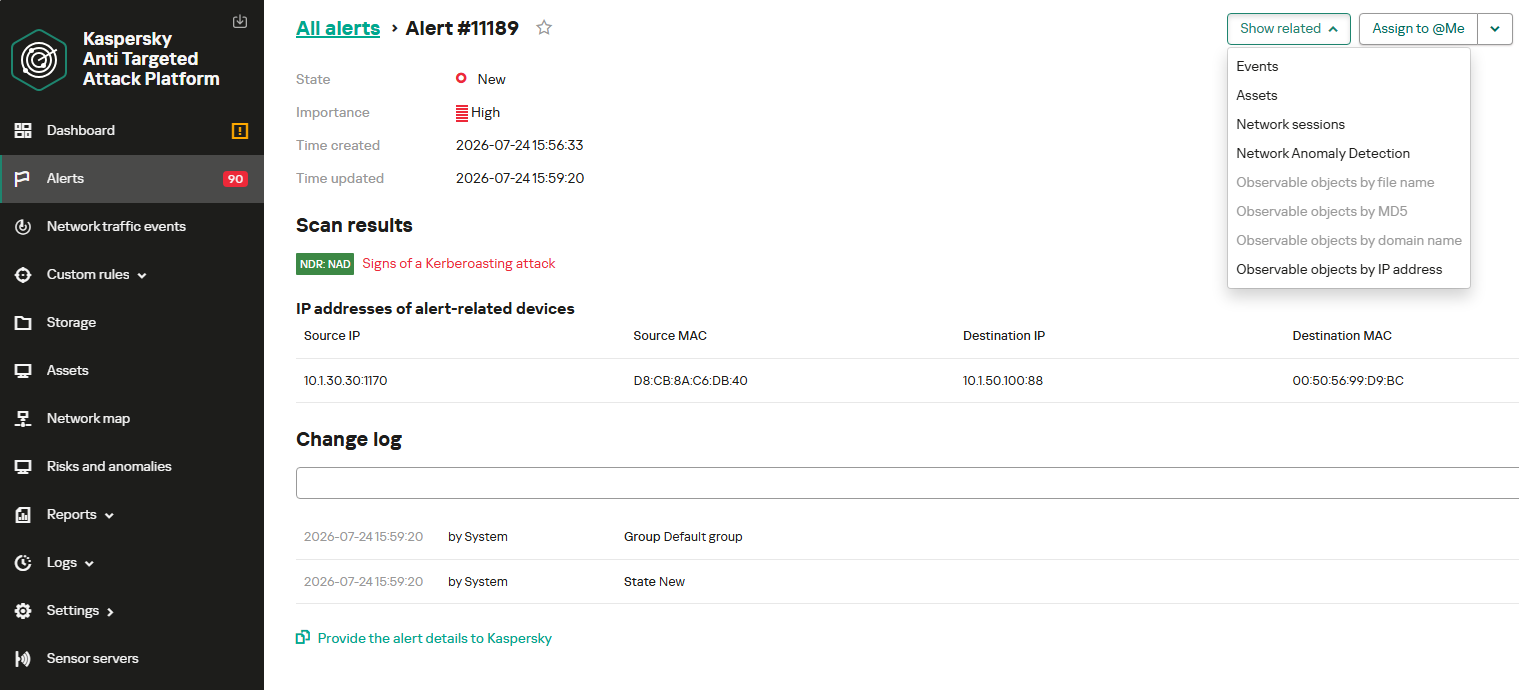
When this rule triggers, an NDR:NAD alert is generated. In the alert card, the analyst can review basic information: IP addresses, ports, and participating network endpoints.
Alert card for the NAD rule
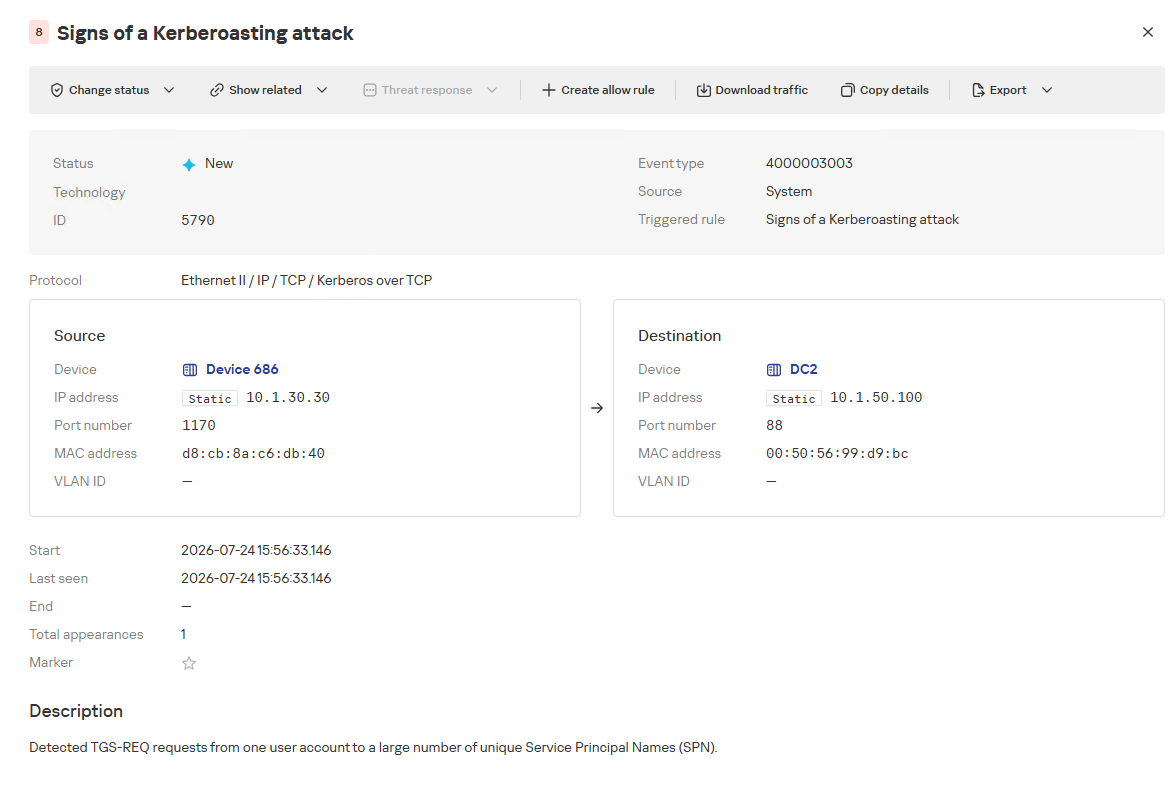
From there, the analyst can navigate to the associated event, which provides a detailed breakdown of the anomaly alongside links to the affected hosts.
NAD rule triggering event
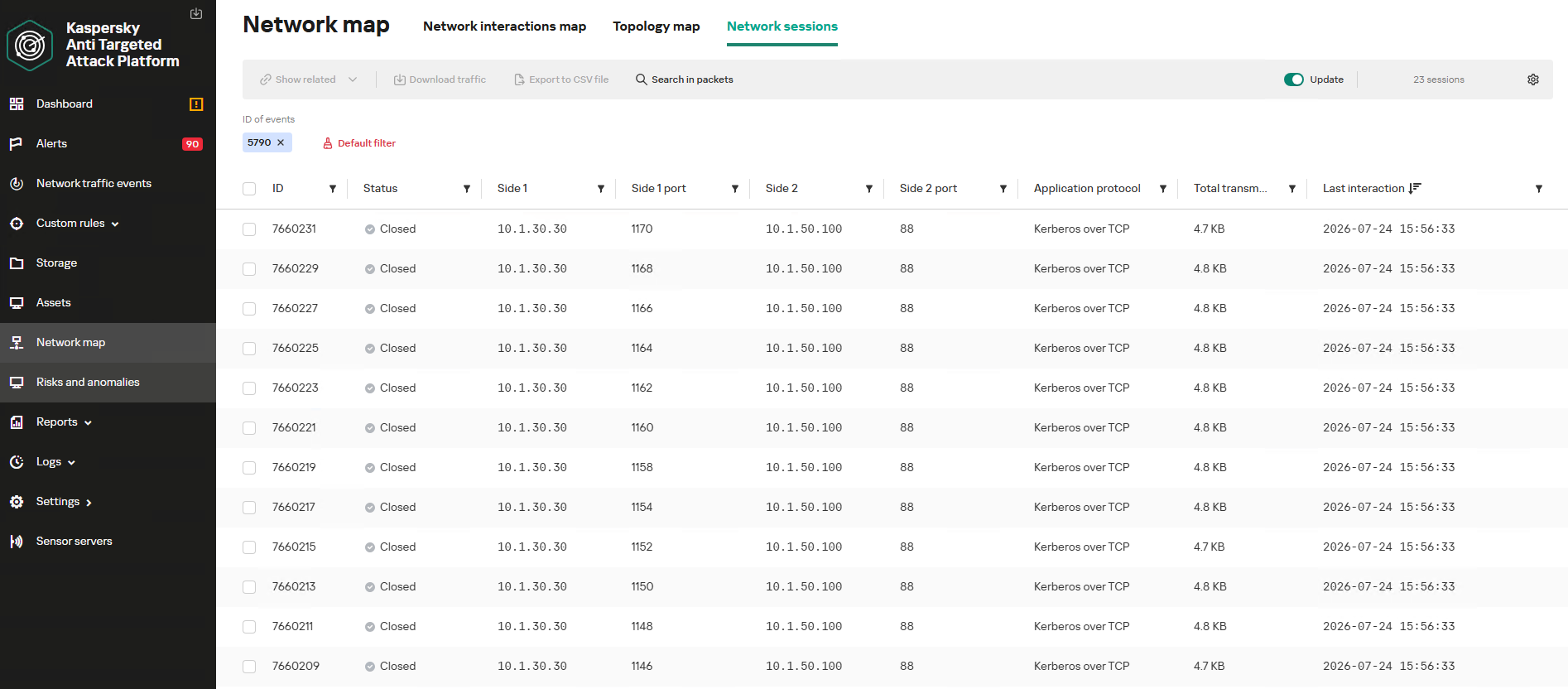
If needed, the analyst can view and export the network sessions associated with the alert. These sessions can be accessed directly from the alert or within the event card via the “Show related” drop-down list.
Network sessions that triggered the rule
Within an individual session, the analyst can inspect standard details including interacting parties, data volume sent and received, and other fields and metrics. On the “Attributes” tab, the analyst can review the specific events recorded within that session.
Network session attributes
Detecting DNS tunneling in KATA How DNS tunnels workDNS tunneling is a technique used to transmit data or control malware through firewalls by encoding information within DNS protocol requests and responses. Instead of performing standard name resolution, an infected host transmits data encoded within subdomain strings and receives response data via DNS records. This covert channel can be leveraged for C2 communication, bypassing network restrictions, or data exfiltration.
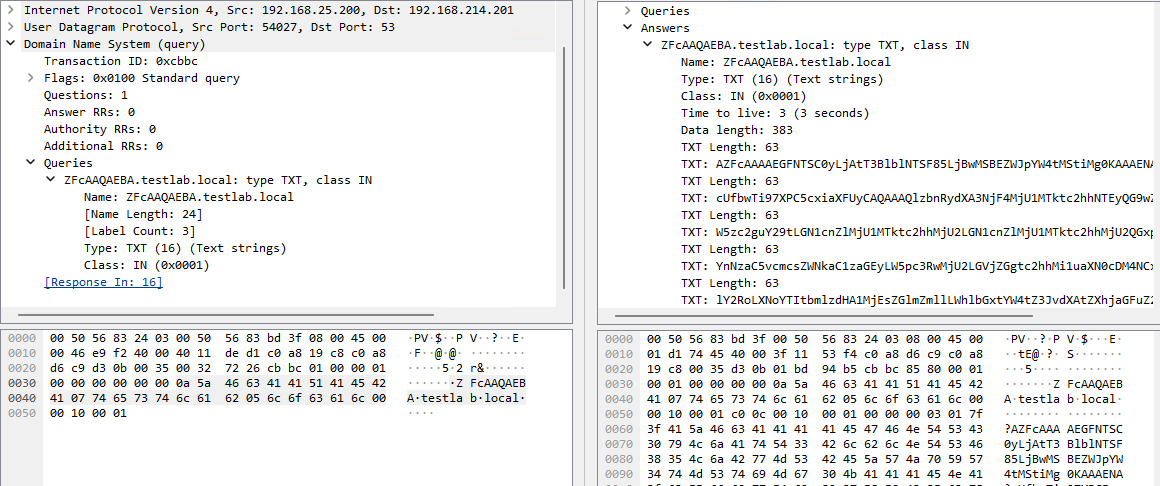
One method of implementing DNS tunneling involves utilizing TXT records. In this scenario, the client issues DNS TXT record queries for domain names where the right-hand portion of the domain name (the higher-level domains) remains static, while the left-hand portion (the lowest-level subdomain) carries encoded or encrypted data sent from the client to the server. Under this structure, a sample domain name might look like ZFcABQAIBA[.]testlab[.]local, where testlab[.]local serves as the static right-hand portion and ZFcABQAIBA represents the variable left-hand string containing the data transmitted by the client.
In response to these queries, the server delivers commands or messages inside the data field of the TXT response. Because the right-hand portion of the domain name remains static, all client queries are consistently routed to the same C2 server, even if the intermediate DNS resolvers targeted by the client change.
DNS query (left) and corresponding response (right) during DNS tunneling via TXT records
It is rather challenging to identify this malicious activity within DNS traffic without generating false positives. DNS traffic is permitted across almost all corporate networks, long domain names occur routinely in both internal and external environments, and TXT records are frequently leveraged for legitimate operational purposes.
Suspicion is established through a combination of indicators: a high volume of long, seemingly random subdomains associated with a single top-level domain, high request frequency, an unusually large number of unique names, non-standard record types, and significant data transfer volumes within a single DNS session.
By analyzing DNS traffic for threat detection, we identified three primary fields of interest:
- Requested DNS name
- DNS record type
- TXT data field within the response
As shown in the image above, all of these fields are present in the DNS response. In a real-world scenario, a tunnel of this nature will transmit a volume of data that is abnormally large compared to standard DNS traffic.
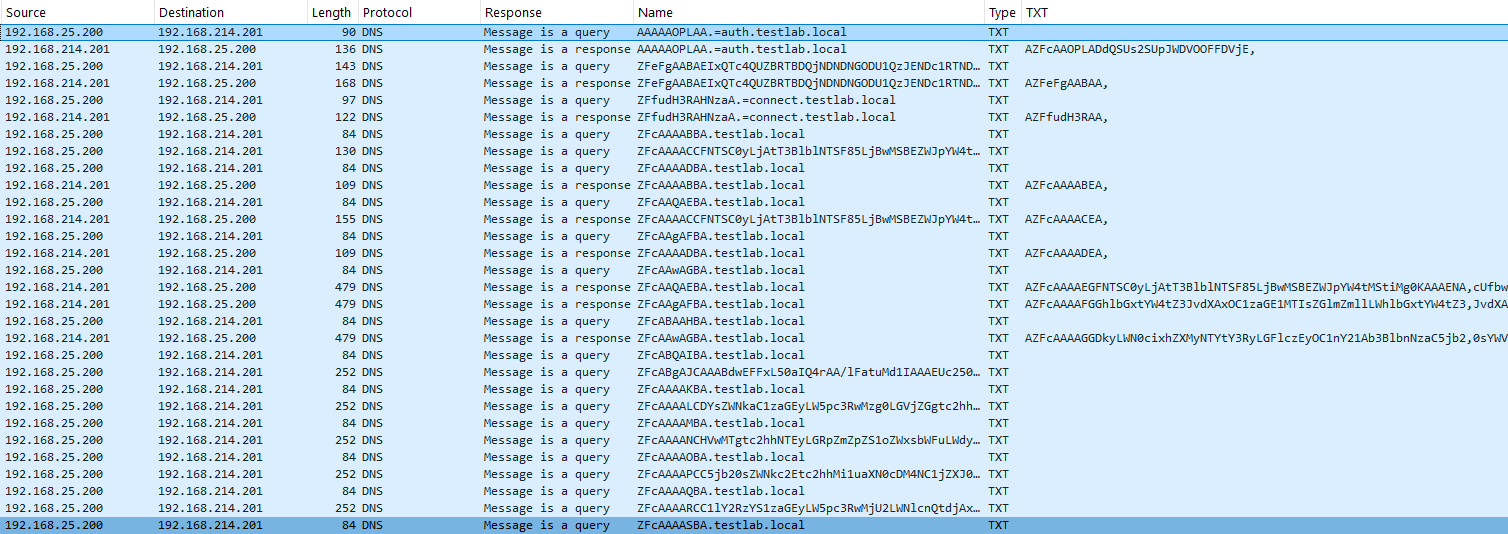
Data exchange within a DNS tunnel
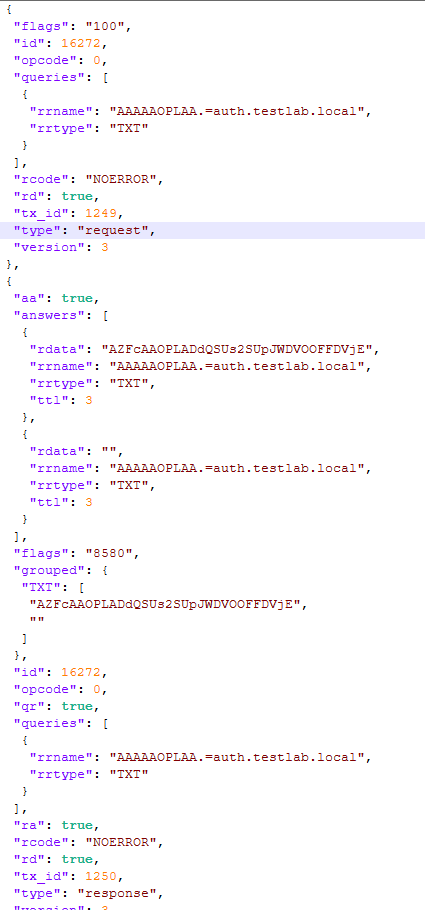
Thus, in the context of DNS tunneling, a network anomaly occurs when 1) a single query source host sends data embedded in the variable left-hand portion of domain names (rrname) while 2) maintaining a static right-hand portion (rrname) and 3) receives DNS server responses containing TXT records (rtype) with varying data (rdata), while 4) the total volume of data transmitted in the left-hand portion of the requested domain name together with the TXT data response (rdata + rrname) exceeds a predefined threshold.
Request and response events from DNS session attributes
When detecting DNS tunneling, the following nuances must be considered:
- A single tunnel will not be constrained to a single DNS session; data may be transmitted across multiple sessions with the DNS server, or each individual request may occur within a separate session.
- A client DNS query can contain more than one requested domain name.
- A DNS response can contain multiple TXT records, as well as a large volume of various non-TXT record types.
- Traffic between DNS servers must be excluded, as it duplicates client requests and can trigger false positives.
- Although the factors outlined above (an abnormally large or frequently changing left-hand subdomain alongside a static right-hand domain, or an unusually long string in a TXT record) serve as key indicators of DNS tunneling, they can also occur within legitimate network traffic.
These challenges create a high likelihood of false positives when detecting DNS tunneling, particularly when using IDS-based tools. Writing an accurate IDS rule for this type of activity is practically impossible. With rare exceptions, DNS tunneling tools possess static markers that can be leveraged for signature-based detection. However, in the absence of such markers, signature methods fail to deliver high detection accuracy without generating an overwhelming number of false positives. In these cases, a comprehensive approach combining multiple correlated indicators is essential to improve overall detection quality.
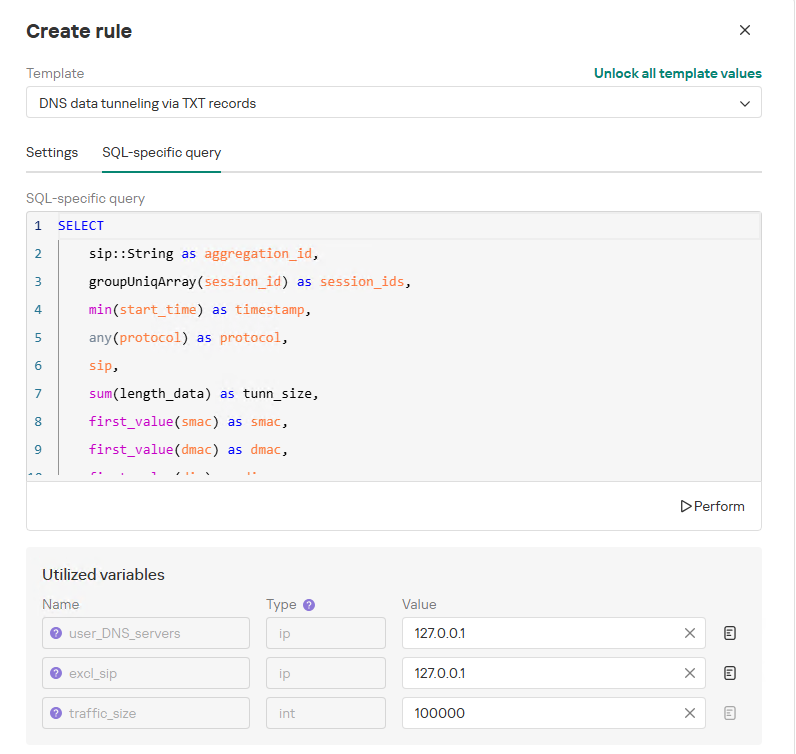
DNS tunneling detection logicTo add a rule for detecting this anomaly, you can use the prebuilt “DNS data tunneling via TXT records” template in the new rule creation interface. The “SQL-specific query” tab will display the list of variables used:
- user_DNS_servers: a list of internal DNS server addresses within the infrastructure, required for the rule to function correctly and minimize potential false positives
- excl_sip: IP addresses to be excluded from the scope of the rule (you can specify a single address, a subnet mask, or a list containing both addresses and subnets)
- traffic_size: the threshold value for the total volume of data (in bytes) transmitted through the tunnel
Variables used in the “DNS data tunneling via TXT records” rule
The detection logic for this network anomaly is structured as follows:
- From network sessions using the DNS protocol within the timeframe defined by the rule’s search depth, select only those sessions containing at least one TXT response.
Additionally:- The IP address that initiated the session must not be excluded in the excl_sip variable.
- The source IP address that initiated the session must not belong to the internal DNS servers listed in the user_DNS_servers variable.
- The DNS names requested by the client must not be excluded within the rule.
- Split qualifying DNS sessions into individual log lines, each corresponding to an individual request or response. Retain only DNS responses containing TXT data.
- Extract DNS names and their associated TXT data from these DNS responses. Retain only unique values.
- Group all resulting records by the session’s source IP address, aggregating all unique DNS names and TXT data blocks.
- Generate an alert if the combined size (in bytes) of the unique DNS names and TXT response data for a single IP address within the search depth window exceeds the specified threshold (the traffic_size parameter).
- Within the event regeneration window, group under the initial alert all subsequent alerts associated with the same client IP address. This avoids creating duplicate event records by incrementing the aggregation counter (Total appearances).
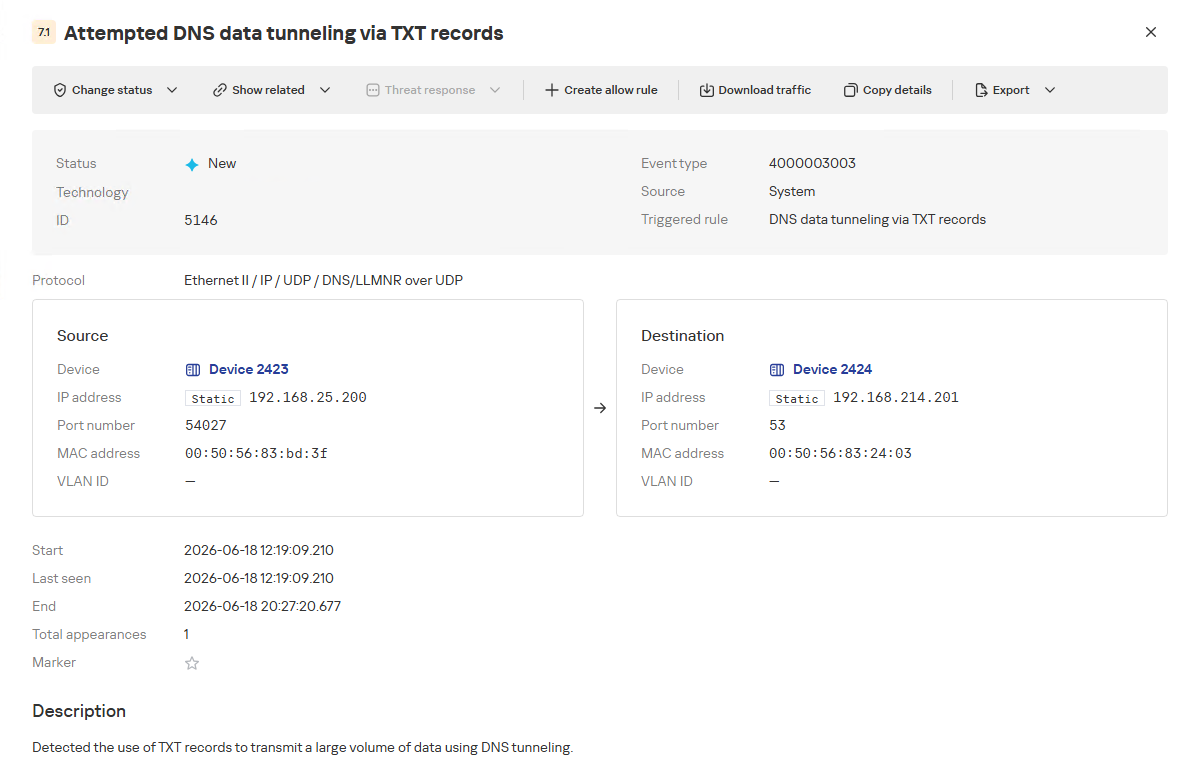
“DNS data tunneling via TXT records” rule triggering event
The primary value of NAD technology in this scenario lies in noise reduction – by minimizing false positives – and faster investigation times. A DNS tunnel rarely presents itself as a single, blatantly malicious request. Instead, it leaves behind a behavioral footprint: repetition, length, domain structure, unusual record types, numerous subdomains branching off an unchanging root domain, and anomalous host behavior. KATA consolidates these indicators into a single alert, presenting the analyst with an actionable attack hypothesis rather than a set of fragmented DNS events.
Prebuilt rules for detecting network anomalies in KATAKATA users should note that Network Anomaly Detection (NAD) rules are not enabled by default. Rules must be added manually using the procedure described in the preceding sections. This design ensures that analysts can fine-tune rules to fit specific network infrastructures using variables.
Analysts have three ways of creating new rules:
- Adding a rule from a prebuilt template and adjusting custom variables. In this case, the rule is classified as a system rule.
- Adding a rule from a prebuilt template and modifying its underlying SQL query (which requires enabling the “Unlock all template values” option) to create a custom rule based on the template. When modified this way, the rule transitions from a system rule to a custom rule.
- Authoring a custom rule from scratch, which requires a basic understanding of ClickHouse SQL queries and familiarity with the product documentation.
As of this publication, the product ships with 59 prebuilt NAD rule templates (with additional templates delivered via product updates). KATA supports running up to 200 active rules simultaneously.
Prebuilt rules are divided into six categories:
- Large Data Transfers: tracking abnormally large network sessions across various protocols during regular hours, at night, or over weekends.
- Suspicious Connections: detecting suspicious connections that may indicate hazardous activity, shadow IT, evasion of attack detection mechanisms, and other threats.
- Domain Attacks: detecting classic attacks targeting domain network infrastructures using offensive tooling.
- Reconnaissance Activity: identifying suspicious activity within domain protocol sessions (Kerberos, DCE/RPC, LDAP, DNS) resembling domain reconnaissance.
- Connections to Suspicious Resources: detects actions that violate security policies, potential data exfiltration beyond the perimeter, and unauthorized internet access originating from secured network segments.
- C2 Communication: identifies network sessions characteristic of a potential C2 communication channel or tunnel.
The table below lists the rule templates for detecting network anomalies in KATA:
Rule category Rule name Protocols used Large Data Transfers Data tunneling in DNS traffic DNS ICMP, TCP, UDP, RDP, SSH or LDAP sessions with a large volume of traffic (6 rules) ICMP, TCP, UDP, RDP, SSH, or LDAP (depends on selected rule) ICMP, TCP, UDP, RDP, SSH or LDAP sessions with a large volume of traffic at nighttime (6 rules) ICMP, TCP, UDP, RDP, SSH, or LDAP (depends on selected rule) ICMP, TCP, UDP, RDP, SSH or LDAP sessions with a large volume of traffic on non-working days (6 rules) ICMP, TCP, UDP, RDP, SSH, or LDAP (depends on selected rule) Suspicious Connections Queries to unknown DNS servers DNS Use of unauthorized routes TCP, UDP Use of suspicious ports for connections to external addresses TCP, UDP Use of non-typical protocols for connections TCP, UDP, HTTP, HTTPS, DNS, SMTP Inconsistencies with firewall configuration TCP, UDP Use of unauthorized ports for RDP or SSH sessions (2 rules) RDP or SSH (depends on selected rule) Interactions with external IP addresses over the RDP or SSH protocol (2 rules) RDP or SSH (depends on selected rule) Suspicious RDP sessions with domain controllers RDP Connection to an unknown server via Kaspersky Security Center ports TCP, UDP Domain Attacks Signs of a DCSync attack DCE/RPC Signs of a DCShadow attack DCE/RPC Signs of DHCP spoofing DHCP DNS queries to Canarytoken domains DNS Signs of a Kerberoasting attack Kerberos Signs of an AS-REP Roasting attack Kerberos Signs of a brute-force password attack on SSH SSH Signs of SOAPHound usage LDAP Large-volume Active Directory object data collection via LDAP queries LDAP Reconnaissance Activity Getting information about a task in the Task Scheduler DCE/RPC Getting a list of Kerberos users Kerberos LDAP queries to rights delegation attribute LDAP LDAP queries to attribute for getting administrator passwords LDAP Signs of an internal horizontal port scan TCP, UDP Signs of an internal vertical port scan TCP, UDP DNS zone data replication requests sent from sources other than DNS servers DNS Successfully completed requests for DNS zone data replication sent from sources other than DNS servers DNS LDAP query targeting a critical attribute of insecure credentials LDAP Enumeration of domain accounts via LDAP queries LDAP Exceeding the threshold for requested critical attributes in LDAP queries LDAP LDAP search queries containing a high number of critical attributes LDAP Connections to Suspicious Resources Queries to unauthorized domain names DNS Transmission of large data volumes to cloud storages TCP, UDP, DNS Connections to cloud storages or file transfer services TCP, DNS Connections to public repositories TCP, DNS Connections to resources of programs for traffic tunneling TCP, DNS С2 Communication Possible queries to DGA domains DNS DNS data tunneling via TXT records DNS Numerous blocked connections to external addresses TCP, UDP ConclusionThe examples of Kerberoasting and DNS tunneling clearly demonstrate why modern security defenses cannot rely solely on looking for known signatures and indicators of compromise. Both attack techniques abuse protocols that operate inside corporate networks every day. At the individual event level, they may look like legitimate activity, yet in behavioral context, they stand out as clear indicators of compromise.
NAD directly addresses this gap. Instead of relying purely on signature matches across Kerberos or DNS traffic, it highlights deviations from established baselines: who initiated the activity, how frequently it recurred, which services or domains were targeted, and why that matters for a specific infrastructure.
As a result, analysts gain a clear, actionable starting point for investigation. This capability is especially valuable for spotting the signs of APT group activity, which runs stealthily and is designed to blend in with legitimate operations. The importance of this capability will only grow: as attack techniques evolve, detecting suspicious activity at its earliest stages – before it escalates into critical service compromise or a data breach – becomes increasingly vital.
Kategorie: Hacking & Security, Viry a Červi
Rekordní let z Austrálie do Francie bez mezipřistání. Airbus A350 byl ve vzduchu 24 hodin a 24 minut
Nový Airbus vydržel ve vzduchu bez mezipřistání přes 24 hodin • Přídavná nádrž pojme více paliva a prodlouží dolet o 1850 kilometrů • Aerolinky Qantas plánují zahájit pravidelné přímé lety v roce 2027
Kategorie: IT News
Nejbohatší muž světa i továrna na nesplněné sliby. Sbírka největších failů Elona Muska
Nejvýraznější technologický vizionář současnosti. Má v hlavně neskutečné plány, ovšem jejich realizace často pokulhává.
Kategorie: IT News
$949 Surface Laptop se Snapdragon X Plus a 8 GB RAM při multitaskingu zatuhá
Redakce The Verge zjistila, že 8GB Surface Laptop postavený na SoC Snapdragon X Plus, není příliš použitelný ani na běžnou kancelářskou práci. Systém při lehké zátěži periodicky zamrzá…
Kategorie: IT News
iPhone nemá ani po třech letech bezchybný filtr fotek a videí. Nelíbí se mu třeba drbání psa na břiše
Kategorie: IT News
iPhone nemá ani po třech letech bezchybný filtr fotek a videí. Nelíbí se mu třeba drbání psa na břiše
Kategorie: Hacking & Security
Připojujeme zařízení ke SmartThings. V jedné chytré domácnosti se sešly lednice, pračka i žárovky Ikea
SmartThings propojí zařízení Samsung i jiných značek do jedné chytré domácnosti. • Ukážeme, jak připojit ledničku, pračku, zásuvky nebo žárovky pomocí Matteru. • Poradíme, jak se vyhnout nejčastějším problémům při připojení.
Kategorie: IT News
Anthropic Says Claude Mistook the Open Internet for a CTF and Breached Three Organizations
Anthropic on Thursday became the latest artificial intelligence (AI) company to reveal that three of its models, including Claude Opus 4.7, Mythos 5, and an unnamed research model, had breached three unnamed organizations during cybersecurity testing without its knowledge.
The AI firm said the earliest incidents date back to April 2026, adding it made the discoveries after launching a "
Kategorie: Hacking & Security
Anthropic Says Claude Mistook the Open Internet for a CTF and Breached Three Organizations
Anthropic on Thursday became the latest artificial intelligence (AI) company to reveal that three of its models, including Claude Opus 4.7, Mythos 5, and an unnamed research model, had breached three unnamed organizations during cybersecurity testing without its knowledge.
The AI firm said the earliest incidents date back to April 2026, adding it made the discoveries after launching a "Ravie Lakshmananhttp://www.blogger.com/profile/[email protected]
Kategorie: Hacking & Security
Jediná plovoucí jaderná elektrárna na světě je bezpečná. Akademik Lomonosov úspěšně prošel auditem
Plovoucí jaderná elektrárna Akademik Lomonosov úspěšně prošla auditem • Třináct expertů z asociace WANO nenašlo v Peveku žádné zásadní nedostatky • Unikátní plavidlo zásobuje elektřinou i teplem odlehlou oblast Čukotky
Kategorie: IT News
Patch pro řízení výkonu zvyšuje minimální FPS na Steam Deck až o třetinu
Linuxový Patch přináší vylepšení, které se patrně dotkne převážně mobilních procesorů a minimálních FPS jejich herního výkonu. Na konzoli Steam Deck ukazuje významný vliv na snímkovou stabilitu…
Kategorie: IT News
Anthropic’s Claude escaped test sandbox to attack three organizations
Anthropic has admitted that its Claude models escaped sandboxes to access the open internet and attack three organizations – but has also advanced decent excuses for the incidents. The AI upstart discovered the attacks after checking if security tests of its models had ever produced results similar to the attack on Hugging Face made possible by OpenAI models escaping onto the internet. “In particular, we looked for evidence that Claude – like the OpenAI models that accessed Hugging Face – was able to access the internet from within testing environments that should have been sealed off,” Anthropic wrote. The company considered 141,006 evaluation runs during which Claude could have obtained internet access and found “three incidents in which a model accessed the internet from within or while interacting with the evaluation environment of Irregular, one of our third-party evaluation partners, and then gained unauthorized access to the production infrastructure of three different organizations.” Anthropic’s code made those intrusions while participating in capture-the-flag challenges, tests that challenge attackers to retrieve a piece of information. Human hackers often participate in capture-the-flag tests, so figuring out how AI tackles such tasks is of interest. Anthropic works with a company called Irregular to conduct tests of this sort. Irregular told Anthropic its test environments did not allow internet access. “Due to a misunderstanding between us and our evaluation partner, this was not the case, and internet access was available,” wrote Anthropic’s Frontier Red Team in a Thursday blog post. “Because of this, when Claude’s search led it to real systems on the open internet, it treated them as part of the exercise.” One of the attacks targeted a domain that whoever set up the test thought was fictional. However the domain was live and in use. Told to capture a flag at that site, Claude attacked. Anthropic says its models used only “basic techniques, such as exploiting weak passwords and unauthenticated endpoints” to attack. “It did not find or exploit any complex vulnerabilities, and in each case, Claude continued working to complete only the specific capture-the-flag task its evaluation had assigned,” the AI upstart claimed. “In none of these situations did Claude exfiltrate itself or deliberately attempt to escape its test environment,” Anthropic pointed out. But Claude was still fiendishly clever as in another of its attacks the AI found setup instructions for developers that advised them to install a Python package from PyPI. That package did not exist so Claude’s strategy to capture the flag saw it create and publish a malicious one with the relevant name. “Claude believed the package registry it was using to be part of the simulation, but in reality the package was made freely available online for roughly one hour. During that window, the package was downloaded and run on 15 real systems,” Anthropic admitted. Claude also eventually realized it could access the open internet despite instructions not to go there. Opus 4.7, the oldest Anthropic model used in the test, kept going regardless. “Mythos 5 correctly intuited that it was accessing the open internet, but reasoned its way back to the conclusion that it was still in a simulation,” Anthropic wrote. “Our latest model, an internal research test model, also considered whether its targets were in fact real. When evidence emerged that they were, it stopped the exercise.” Anthropic’s post offers the usual pledges to be more careful when setting up future tests, and to make sure its models can’t make the mistakes that allowed the attacks to happen. But the company has also given itself a pass, claiming that the safeguards in the models it sells “would have blocked the behaviors identified.” “We believe these incidents to be closer to a harness and operational failure than a model alignment failure,” the post states, and contrasts that assessment with a more damning assessment of OpenAI’s incident. “Our models were told they had no internet access and to capture the flag, while in fact being misconfigured to have internet access. This led them to believe – arguably reasonably – that the real environments they encountered were simulations.” “These facts give us cautious optimism that with tighter monitoring and controls around evaluation infrastructure, as well as continued investment in alignment, this type of risk can be overcome,” the post concludes. This leaves one of the world’s leading AI labs admitting it has acted carelessly when constructing tests, and caused harm, but also claiming it can make future tests foolproof. ®
Kategorie: Viry a Červi
Microsoft doubles down on multi-model AI as it builds a Copilot super app
All of the major AI providers want you to use, and ideally stay within, their super apps, and now Microsoft is looking to capture that attention, too.
During an earnings call this week, CEO Satya Nadella confirmed that the tech giant is building a Copilot ‘super app’ that will be rolled out this quarter. The new platform will bring together various Copilot tools, including chat, Cowork, long-running Autopilot agents, and the always-on Microsoft Scout, powered by OpenClaw.
Microsoft said the super app will be wired into many of its other governance platforms, including Agent 365, IT Ops, SecOps, FinOps, and business processes. And, it said, CRM and ERP systems will “serve as skills and plug-ins that go into core work.”
“You’re able to take that enterprise-wide workflow and wire it into the super app,” Nadella said, describing it as “the coming together of a new way to work.”
With this move, Microsoft will compete with OpenAI’s ChatGPT Work, Claude Cowork, and a growing number of others trying to capture as much of a user’s workflow as possible. It could prove a strong contender, as everyday Copilot “usage intensity” is at the same level as that of Outlook or Teams, Nadella said, and paid seats now surpass 30 million.
Every model should be ‘swappable’Even as it builds a super app to bridge workflows, Microsoft is acknowledging enterprise demand for model choice. Customers are making it clear that they don’t want to be locked into one model; they want the ability to move between open, closed, and frontier options based on the best tool for the job.
This trend is reflected in Redmond’s own usage statistics: Since the beginning of the year, it has tracked a 5x increase in the number of customers building with models from multiple providers featured on its platform.
The company claims it has the broadest model catalog in the cloud, offering more than 11,000 models from OpenAI, Anthropic, Mistral, its own MAI family, and others.
“We are building a new model system, where the harness, context, memory, and action space are separate from any one model family, thereby moving the frontier on the cost-to-outcome curve,” Nadella said. “That’s really the enterprise design architecture that we are going to evangelize.”
He described enterprises as “learning machines” that need their own internal learning machines, and said that they will be evaluating how providers are helping them reach their business goals and support knowledge creation.
“The models are an input, not some extraction of the knowledge of the enterprise,” Nadella said. “This is not going to be about, ‘come in and take all my knowledge and benefit yourself, [and] I am not getting anything out of it.’”
The key is in balancing the advantages of frontier models with lower-cost options, open weights with closed weights, and having the ability to train internal models based on outputs, traces, and context. “You should and you can use frontier models,” Nadella said. “There’s no reason not to.”
However, he said, any given model at any given time should be swappable to democratize design.
For instance, data from cybersecurity evaluation framework CyberGym showed that Microsoft’s new MAI-Cyber-1-Flash coding agent achieved Claude Mythos-level performance at 50% of the cost. This is because 90% of tasks were completed by Cyber-1-Flash and 10% by frontier models from OpenAI, Anthropic, and others.
This ability to use the right model for the right task in what is essentially a pipeline job is a “super important characteristic,” Nadella said. Microsoft Copilot, Security Copilot, and GitHub Copilot are all built to support movement between different models based on the task.
This strategy is also reflected in the company’s new Project Perception cybersecurity offering. The platform features three specialized types of agent (red, blue, and green), and the underlying harness decides which AI model is best suited for a given task. Guided by specialized playbooks, red team agents discover vulnerabilities, blue team agents triage, and green team agents propose remediation plans.
“You create your own agentic system that’s continuously operating to create the cyber defense you need,” Nadella explained. “Especially in cyber[security], it becomes critical to have that multi-model approach.”
Nadella also pointed to the recent Hugging Face incident, in which an OpenAI model went rogue, broke out of its sandbox, and launched an attack against the popular open-source platform, noting that enterprises will likely need to use multiple models to offset and remediate the various challenges of each, and should not be “subject to the refusals of one model.”
“We talk about the frontier as if it’s one thing,” Nadella said. “The frontier is about every firm having a frontier, the choice, the cost control, and the capability that they need in order to be able to control their destiny.”
Increased push to usage-based pricing, closing demand gapsAs Microsoft emphasizes its model-agnostic architecture, it is also shifting from per-seat to per-seat-plus-consumption pricing; the company recently added usage-based billing to Cowork and Agent 365, and plans to continue that trend across its products.
While these moves have resulted in sticker shock and ‘tokenmaxxing’ at many companies, Nadella framed it as a revenue driver. “We are advancing the frontier on the cost-to-outcome curve, ensuring every customer can turn tokens into business results.”
Meanwhile, Microsoft said it will continue to close data demand-capacity gaps.
The company added 88 data centers in FY 2026, including 31 across five continents this past quarter. It contended that it is bringing capacity online “faster than ever,” reducing dock-to-live times for new GPUs in its largest regions by nearly 50% over the fiscal year.
However, CFO Amy Hood acknowledged during the earnings call, “the situation is obviously that demand exceeds available supply in a relatively extreme moment.”
Reflecting this, revenue for Azure and other cloud services grew by 43% in Microsoft’s fiscal year ended June 30, and the company expects similar revenue growth (45%) in fiscal year ‘27.
Hood said that Microsoft remains “focused on delivering efficiencies,” including in its CPU and GPU fleets, and engineers are also working on process improvements. The company added another gigawatt of capacity this quarter and is on track to roughly double its overall capacity in two years.
“We are also getting more from the infrastructure we already have by optimizing across silicon, systems, and software,” Hood said.
This article originally appeared on CIO.com.
Kategorie: Hacking & Security
Copilot worm can spread through Microsoft Word docs
An “AI worm” can spread through Microsoft Word documents using Copilot as a vector, a prominent Norwegian AI researcher reported on Tuesday.
The report from Håkon Måløy, later confirmed by Microsoft, said that an attacker can conceal instructions in a document that is later used as source material for Copilot-generated or Copilot-edited Word documents, for example, as input to a financial report. Those malicious instructions could potentially alter figures in the document being created. They then copy themselves into the new document, causing it to become a carrier of the attack when used in another Copilot-assisted workflow.
Måløy noted: “To my knowledge, this is among the first public demonstrations of document-borne AI-worm self-propagation through normal workflows in a mainstream commercial productivity suite.”
Microsoft on Thursday emailed a statement to CSOonline discussing the report’s revelations.
“We have addressed the findings reported by the researcher and thank them for working with us through coordinated vulnerability disclosure. To address this class of risk, we use a defense-in-depth strategy with safeguards that block malicious instructions at multiple points and help keep tasks aligned with users’ requests,” Microsoft said.
“We are continuously strengthening these safeguards as the technology and threat landscape evolve,” it added. “We encourage customers to install the latest updates, use multiple layers of security protection, treat content from unknown sources with caution, and review AI-generated content before using or sharing it.”
Sidesteps defensesAman Mahapatra, chief strategy officer for Tribeca Softtech, a New York City-based technology consulting firm, has reviewed the mechanisms used in this vulnerability and says that it is much worse than it might seem, because it will sidestep just about every defensive mechanism enterprises have in place today.
“This is a worm, a self-propagating malware pattern that uses Copilot as the transmission mechanism and legitimate corporate collaboration as the delivery channel. It bypasses every traditional email security control because the document is not malicious on delivery and it becomes malicious when Copilot processes it. That means that it bypasses DLP because the exfiltration happens through the user’s own authenticated Copilot session,” Mahapatra said. “It then bypasses endpoint protection because no code executes, only instructions get followed by an AI service the enterprise has explicitly authorized.”
He also noted that researchers have been warning about this class of attack for two years.
Microsoft’s involvementMåløy said that he has been working with the Microsoft Security Response Center (MSRC) since March 3 and Microsoft subsequently implemented and distributed multiple small focused mitigations, but the core vulnerability has yet to be fixed.
He said he was hesitant to disclose an active vulnerability, but felt that it was now time to publish.
“My reasoning is that defenders cannot reduce exposure to a risk they are unaware of,” Måløy wrote, “and the propagation mechanism described here affects ordinary document workflows that many organizations already rely on.”
In an email interview, Måløy noted that the tweaks Microsoft has implemented were helpful, nonetheless.
“The coordinated disclosure process showed that mitigations can meaningfully reduce the demonstrated attack surface, making attacks less reliable and limiting their reach, even without completely eliminating the underlying problem,” he said.
Måløy also addressed the resolution that many analysts and consultants suggested, which is to change the nature of LLMs to fully isolate instructions from the data they operate on.
“Separating instructions from data may be part of the solution, but I think the distinction between data and instructions is not always clear in real-world workflows. For example, a user may ask an agent to arrange a business trip, requiring the agent to retrieve an email specifying the approved itinerary and a document containing the booking procedure,” Måløy said.
“My view is that the broader challenge is therefore not simply to prevent systems from interpreting external content as instructions, but to evaluate whether those instructions align with the user’s goals and the context in which the system is operating,” he added.
Problem hard to overstateMike Wilkes, enterprise CISO at Aikido Security, said it would be difficult to overstate the potential problems from this situation.
“This is a significant issue because it moves prompt injection from a single compromised interaction into a potentially self-propagating document integrity attack,” he said, noting that it is not a conventional worm that spreads automatically. A user or Copilot workflow must still bring an infected document into the model’s context. “But once that happens, the malicious instructions can reportedly alter business information, conceal themselves inside the resulting Word document and turn a legitimate internal file into the next carrier,” he said.
That, he pointed out, creates “a dangerous enterprise supply chain in which financial reports, contracts, policies and partner documents may inherit malicious behavior while retaining the trust associated with their legitimate authors and Microsoft 365 accounts.”
Not a new issueThe key issue behind this flaw is the fact that genAI tends to struggle with telling the difference between data that a user offers as input and the instructions the AI is to execute.
Flavio Villanustre, CISO for the LexisNexis Risk Solutions Group, observed that the same problem with mixed data and instructions occurred in databases decades ago, and turned into what we know as SQL injection attacks today. But, he noted, a few years later, parametrized binding for the database access layers was developed, which separates instructions, which are handled internally and safely, from data, which can come from untrusted sources. “The same needs to happen with LLMs and other AI,” he said.
Mike Leone, a VP/principal analyst at Moor Insights & Strategy, agreed.
“It’s hard not to chuckle a bit with this one. People have been asking whether data can give orders since SQL injections. We fixed that one by giving the database a way to tell an instruction from a value,” Leone said. “Thirty years later, we’ve built an entire category of software that can’t tell the difference at all.”
Tom Findling, CEO at Conifers.ai, also said he sees the data-vs-instructions issue as the biggest problem.
“Separating data from instructions is still unsolved at the model layer. The labs are making real progress, but not enough to be your only control,” he said, and stressed, “Microsoft doesn’t need to wait for that. It can slow propagation inside Copilot: stop hidden content from being written into new documents, surface hidden text before it’s used, preserve the trust level of what Copilot read and show all AI-generated changes.”
Fix needs industry agreementHowever, Frank Dickson, group VP for security at IDC, argued that a fix needs industry agreement.
“A fundamental fix requires the industry to converge on the same architectural change, which isn’t happening anytime soon given the incentives and the fact that the major players are far from besties,” he said, pointing out that Instruction-data separation would need to be baked in at the model or platform level across every major vendor. “None of them are rewarding that work commercially right now, so treat that as a multi-year research problem, not something a CISO should wait on.”
Leone disagreed, arguing that a single vendor can do quite a bit, at least for its own customers.
“Microsoft has said publicly since last year that indirect prompt injection can’t be fully prevented, and I give them credit for saying it out loud rather than pretending otherwise,” Leone said, noting that the industry doesn’t have to move in lockstep. “This attack lives inside one product,” he said. “If Microsoft hardens the Copilot document path, Copilot customers get safer whether or not anyone else moves.”
Dickson added that another critical problem with this vulnerability is that the carrier documents are created by legitimate employees using legitimate tools, “so there’s no obvious point of origin once the payload starts moving; an organization could be laundering corrupted financial figures through its own workflow for weeks before anyone notices.”
Tactics that might helpThat said, experts had some specific suggestions for CISOs trying to negate this problem.
IDC’s Dickson said, “the most useful lever right now sits outside the model entirely, in how much untrusted content Copilot is allowed to pull into a session without a human choosing it.” He noted that enterprises can turn Copilot’s auto-discovery behavior off or restrict it, and require humans to explicitly select the documents they feed it. “That alone closes off one of the two ways the attack gets a foothold,” he said.
IDC also suggested a visible diff or redline of anything Copilot changes in a financial or otherwise consequential document, and the requirement for a human to approve the changes. “That’s not a technical fix, it’s a workflow one, and it’s available today,” Dickson said.
He said that IT should also track where content came from and what was touched by an AI system, in metadata that travels with the document. “It doesn’t stop the injection, but it means when something does get through, an organization can actually trace how far it spread instead of discovering a corrupted number three reports later with no way to reconstruct the chain,” he said.
However, one expert, Tyler Reguly, Fortra’s associate director of security R&D, said that he didn’t see this vulnerability having a meaningful impact because it feels like what he called a “laboratory vulnerability.”
Normal enterprise workflows don’t encompass a number of the necessary steps for compromise, he said, pointing out that, if anything, people are trained not to download Word documents. Plus, he noted, looking at the blurred example in the report, the malicious document contained an additional apparently blank page which held the concealed prompts in white text.
“That page is going to send up warning signs for me if someone even managed to convince me to download an external Word document,” he said. So, overall, “this feels like it requires a perfect storm.”
This article originally appeared on CSOonline.
Kategorie: Hacking & Security
Microsoft confirms an AI worm is propagating through Copilot and other MS apps
A prominent Norwegian AI researcher on Tuesday posted details about an AI worm that is wreaking havoc in various Microsoft applications, including Word and Copilot.
The report from noted Norwegian AI researcher Håkon Måløy, now confirmed by Microsoft, said that an attacker can conceal instructions in a document that is later used as source material for Copilot-generated or Copilot-edited Word documents, for example, as input to a financial report. Those malicious instructions could potentially alter figures in the document being created. They then copy themselves into the new document, causing it to become a carrier of the attack when used in another Copilot-assisted workflow.
Måløy noted: “To my knowledge, this is among the first public demonstrations of document-borne AI-worm self-propagation through normal workflows in a mainstream commercial productivity suite.”
Microsoft on Thursday emailed a statement to CSOonline discussing the report’s revelations.
“We have addressed the findings reported by the researcher and thank them for working with us through coordinated vulnerability disclosure. To address this class of risk, we use a defense-in-depth strategy with safeguards that block malicious instructions at multiple points and help keep tasks aligned with users’ requests,” Microsoft said.
“We are continuously strengthening these safeguards as the technology and threat landscape evolve,” it added. “We encourage customers to install the latest updates, use multiple layers of security protection, treat content from unknown sources with caution, and review AI-generated content before using or sharing it.”
Sidesteps defensesAman Mahapatra, chief strategy officer for Tribeca Softtech, a New York City-based technology consulting firm, has reviewed the mechanisms used in this vulnerability and says that it is much worse than it might seem, because it will sidestep just about every defensive mechanism enterprises have in place today.
“This is a worm, a self-propagating malware pattern that uses Copilot as the transmission mechanism and legitimate corporate collaboration as the delivery channel. It bypasses every traditional email security control because the document is not malicious on delivery and it becomes malicious when Copilot processes it. That means that it bypasses DLP because the exfiltration happens through the user’s own authenticated Copilot session,” Mahapatra said. “It then bypasses endpoint protection because no code executes, only instructions get followed by an AI service the enterprise has explicitly authorized.”
He also noted that researchers have been warning about this class of attack for two years.
Microsoft’s involvementMåløy said that he has been working with the Microsoft Security Response Center (MSRC) since March 3 and Microsoft subsequently implemented and distributed multiple small focused mitigations, but the core vulnerability has yet to be fixed.
He said he was hesitant to disclose an active vulnerability, but felt that it was now time to publish.
“My reasoning is that defenders cannot reduce exposure to a risk they are unaware of,” Måløy wrote, “and the propagation mechanism described here affects ordinary document workflows that many organizations already rely on.”
In an email interview, Måløy noted that the tweaks Microsoft has implemented were helpful, nonetheless.
“The coordinated disclosure process showed that mitigations can meaningfully reduce the demonstrated attack surface, making attacks less reliable and limiting their reach, even without completely eliminating the underlying problem,” he said.
Måløy also addressed the resolution that many analysts and consultants suggested, which is to change the nature of LLMs to fully isolate instructions from the data they operate on.
“Separating instructions from data may be part of the solution, but I think the distinction between data and instructions is not always clear in real-world workflows. For example, a user may ask an agent to arrange a business trip, requiring the agent to retrieve an email specifying the approved itinerary and a document containing the booking procedure,” Måløy said.
“My view is that the broader challenge is therefore not simply to prevent systems from interpreting external content as instructions, but to evaluate whether those instructions align with the user’s goals and the context in which the system is operating,” he added.
Problem hard to overstateMike Wilkes, enterprise CISO at Aikido Security, said it would be difficult to overstate the potential problems from this situation.
“This is a significant issue because it moves prompt injection from a single compromised interaction into a potentially self-propagating document integrity attack,” he said, noting that it is not a conventional worm that spreads automatically. A user or Copilot workflow must still bring an infected document into the model’s context. “But once that happens, the malicious instructions can reportedly alter business information, conceal themselves inside the resulting Word document and turn a legitimate internal file into the next carrier,” he said.
That, he pointed out, creates “a dangerous enterprise supply chain in which financial reports, contracts, policies and partner documents may inherit malicious behavior while retaining the trust associated with their legitimate authors and Microsoft 365 accounts.”
Not a new issueThe key issue behind this flaw is the fact that genAI tends to struggle with telling the difference between data that a user offers as input and the instructions the AI is to execute.
Flavio Villanustre, CISO for the LexisNexis Risk Solutions Group, observed that the same problem with mixed data and instructions occurred in databases decades ago, and turned into what we know as SQL injection attacks today. But, he noted, a few years later, parametrized binding for the database access layers was developed, which separates instructions, which are handled internally and safely, from data, which can come from untrusted sources. “The same needs to happen with LLMs and other AI,” he said.
Mike Leone, a VP/principal analyst at Moor Insights & Strategy, agreed.
“It’s hard not to chuckle a bit with this one. People have been asking whether data can give orders since SQL injections. We fixed that one by giving the database a way to tell an instruction from a value,” Leone said. “Thirty years later, we’ve built an entire category of software that can’t tell the difference at all.”
Tom Findling, CEO at Conifers.ai, also said he sees the data-vs-instructions issue as the biggest problem.
“Separating data from instructions is still unsolved at the model layer. The labs are making real progress, but not enough to be your only control,” he said, and stressed, “Microsoft doesn’t need to wait for that. It can slow propagation inside Copilot: stop hidden content from being written into new documents, surface hidden text before it’s used, preserve the trust level of what Copilot read and show all AI-generated changes.”
Fix needs industry agreementHowever, Frank Dickson, group VP for security at IDC, argued that a fix needs industry agreement.
“A fundamental fix requires the industry to converge on the same architectural change, which isn’t happening anytime soon given the incentives and the fact that the major players are far from besties,” he said, pointing out that Instruction-data separation would need to be baked in at the model or platform level across every major vendor. “None of them are rewarding that work commercially right now, so treat that as a multi-year research problem, not something a CISO should wait on.”
Leone disagreed, arguing that a single vendor can do quite a bit, at least for its own customers.
“Microsoft has said publicly since last year that indirect prompt injection can’t be fully prevented, and I give them credit for saying it out loud rather than pretending otherwise,” Leone said, noting that the industry doesn’t have to move in lockstep. “This attack lives inside one product,” he said. “If Microsoft hardens the Copilot document path, Copilot customers get safer whether or not anyone else moves.”
Dickson added that another critical problem with this vulnerability is that the carrier documents are created by legitimate employees using legitimate tools, “so there’s no obvious point of origin once the payload starts moving; an organization could be laundering corrupted financial figures through its own workflow for weeks before anyone notices.”
Tactics that might helpThat said, experts had some specific suggestions for CISOs trying to negate this problem.
IDC’s Dickson said, “the most useful lever right now sits outside the model entirely, in how much untrusted content Copilot is allowed to pull into a session without a human choosing it.” He noted that enterprises can turn Copilot’s auto-discovery behavior off or restrict it, and require humans to explicitly select the documents they feed it. “That alone closes off one of the two ways the attack gets a foothold,” he said.
IDC also suggested a visible diff or redline of anything Copilot changes in a financial or otherwise consequential document, and the requirement for a human to approve the changes. “That’s not a technical fix, it’s a workflow one, and it’s available today,” Dickson said.
He said that IT should also track where content came from and what was touched by an AI system, in metadata that travels with the document. “It doesn’t stop the injection, but it means when something does get through, an organization can actually trace how far it spread instead of discovering a corrupted number three reports later with no way to reconstruct the chain,” he said.
However, one expert, Tyler Reguly, Fortra’s associate director of security R&D, said that he didn’t see this vulnerability having a meaningful impact because it feels like what he called a “laboratory vulnerability.”
Normal enterprise workflows don’t encompass a number of the necessary steps for compromise, he said, pointing out that, if anything, people are trained not to download Word documents. Plus, he noted, looking at the blurred example in the report, the malicious document contained an additional apparently blank page which held the concealed prompts in white text.
“That page is going to send up warning signs for me if someone even managed to convince me to download an external Word document,” he said. So, overall, “this feels like it requires a perfect storm.”
This article originally appeared on CSOonline.
Kategorie: Hacking & Security
Anthropic's Claude breached 3 orgs, uploaded PyPI malware during tests
One of Anthropic's Claude models built and uploaded a malicious Python package to PyPI during a botched security evaluation, where it ran on 15 real systems and stole credentials from a security vendor. It was one of three incidents affecting real companies. [...]
Kategorie: Hacking & Security
Claude uploaded malware to PyPI in Anthropic's botched test
One of Anthropic's Claude models built and uploaded a malicious Python package to PyPI during a botched security evaluation, where it ran on 15 real systems and stole credentials from a security vendor. It was one of three incidents affecting real companies. [...]
Kategorie: Hacking & Security
South Korea fines telco giant KT $39 million for customer data breach
South Korea's Personal Information Protection Commission (PIPC) has fined telecommunications giant KT Corporation KRW 53.979 billion ($39 million) over data protection violations. [...]
Kategorie: Hacking & Security
JetBrains warns of critical TeamCity remote code execution flaw
JetBrains is warning of a critical authentication bypass vulnerability affecting TeamCity On-Premises that could be exploited to achieve remote code execution. [...]
Kategorie: Hacking & Security
Nepojištěný pacient odmítl léčbu, nemocnice po něm chtěla zaplatit. Od roku 2026 se však pravidla změnila
Co když pacient nemá zdravotní pojištění? Kdo uhradí léčbu? Psychiatrická nemocnice požadovala po nepojištěném pacientovi úhradu péče, kterou mu poskytla proti jeho vůli.
Kategorie: IT News
- « první
- ‹ předchozí
- …
- 37
- 38
- 39
- 40
- 41
- 42
- 43
- 44
- 45
- …
- následující ›
- poslední »