Agregátor RSS
Jak nastupovat do letadla rychle a bez tlačenic. Řešení existuje 18 let, aerolinky ho nepoužívají
Fyzik spočítal matematicky nejrychlejší způsob nastupování cestujících do letadla. • Tato metoda usazuje pasažéry postupně od oken po uličky ob jednu řadu. • Letecké společnosti tento postup nepoužívají kvůli lidské neukázněnosti a ziskům.
Kategorie: IT News
Public SCTPhantom Exploit Tests Linux Container Security Defaults
Public exploit code is now available for SCTPhantom, a Linux kernel flaw that researchers used to escape an unprivileged container and take control of the underlying host.
Kategorie: Hacking & Security
Mozilla updates GPG signing key for Firefox releases after exposure
Mozilla announced today that it updated the GPG key used to sign Firefox and Thunderbird releases after it was accidentally exposed on GitHub. [...]
Kategorie: Hacking & Security
Vague Task, Total Access: When AI Delegation Becomes a Security Risk
AI agents can improvise beyond the intended scope of a task when they are given broad access to enterprise systems and data. Token Security explains why organizations need to define agent intent and continuously enforce permissions around what each agent was actually created to do. [...]
Kategorie: Hacking & Security
OpenAI Launches GPT-5.6-Cyber with Reduced Safeguards for Exploit Development
OpenAI on Monday unveiled a new cybersecurity-focused model called GPT‑5.6‑Cyber that it said is focused on vulnerability research, penetration testing, and incident response.
"Built on GPT‑5.6 Sol, it is trained to improve capabilities on several specialized cybersecurity tasks (e.g., finding zero-day vulnerabilities and developing exploit chains) and to reduce refusals for certain higher-riskRavie Lakshmananhttp://www.blogger.com/profile/[email protected]
Kategorie: Hacking & Security
DDoS attacks over 1 Tbps surged fivefold in the second quarter
Cloudflare says it mitigated more than 800 network-layer distributed denial-of-service (DDoS) attacks exceeding 1 Tbps in the second quarter of the year. [...]
Kategorie: Hacking & Security
Drony britského námořnictva tajně posílaly data do Číny
Námořní drony používané elitními jednotkami britského královského námořnictva tajně posílaly údaje do Číny. Stroje vybavené čínskými komponenty měly být využívány pro vojenské operace na Blízkém východě. Kamery na dálkově řízených průzkumných člunech K3 Scout byly vybavené součástkami, které bez vědomí britského námořnictva odesílaly informace do spojeného zařízení v Číně. Britské námořní síly využívaly flotilu námořních dronů za 12 milionů liber (336 milionů korun). Po zjištění informací o propojení s Čínou nechalo ministerstvo obrany z kamer využívaných čluny odstranit veškeré spojení s internetem.
Kategorie: GNU/Linux & BSD
Mobilní sítě na hranici možností. Jak operátoři vozí signál na letní festivaly i na závody do lesů
Kategorie: IT News
Deepfake hiccup unmasks suspected digital certificate fraudster
Spain's national police say they caught a cybercriminal after a momentary technical glitch exposed his face to a video identification platform. The unnamed man allegedly made 38 attempts to impersonate 30 people and obtain digital certificates in their names, succeeding on multiple occasions. A digital certificate uses public key infrastructure to bind a cryptographic key to a verified identity, allowing its holder to authenticate themselves and create legally recognized electronic signatures. In Spain and other EU countries, certificates can be used to sign contracts, authorize transactions and deal with public bodies online, avoiding some of the in-person appointments traditionally required for administrative procedures. A certificate issued in someone else's name would therefore give a scammer a powerful tool for impersonation. Police allege that the suspect planned to use the fraudulently obtained credentials in further cybercrimes. The alleged fraudster targeted a security company authorized to issue digital certificates and bypassed its identity checks using forged documents, altered photographs, deepfake tools, and a carefully arranged lighting rig. The verification process required a live video check comparing the applicant's face with the photograph on the identity document. He allegedly used deepfake technology to alter his face in real time so that he could bypass the visual identity checks, and used custom lighting to recreate the appearance of each document's holograms. "The alleged perpetrator used household spotlights with strategically placed colored bulbs to simulate the flashes and security features found on physical identity documents under real light," police said (machine translated). "He then balanced the counterfeit documents in front of the webcam, perfectly recreating the official holograms. He also used VPNs to anonymize his connections and employed manipulated documents with apparent security features." Police did not say how many of the 38 attempts succeeded, only that certificates were issued on "multiple" occasions. His luck allegedly ran out when the face-changing software suffered a momentary processing delay. The disguise dropped for "barely a second," exposing his real face to the verification camera, police said. Investigators eventually identified and located the suspect, who was arrested on suspicion of repeatedly forging official documents. A search of his home yielded a laptop protected by high-grade encryption, several mobile phones, storage devices, and documents, according to police. The investigation was complicated by the use of more than 320 phone lines across 24 devices. Most had allegedly been registered under stolen identities, with police tracing their sale to outlets in the Murcia region. ®
Kategorie: Viry a Červi
CISA: Microsoft SharePoint flaw now exploited in ransomware attacks
CISA confirmed today that ransomware gangs have begun abusing a high-severity Microsoft SharePoint remote code execution vulnerability, which has been flagged as actively exploited since early July. [...]
Kategorie: Hacking & Security
A Malicious SIM Card Can Run Attacker Code Inside the Modems Behind Cellular IoT Devices
A malicious SIM card can order the device it sits in to run commands of the attacker's choosing. On the cellular modules built into electric-vehicle chargers, industrial routers, and car telematics units, that is enough to take the whole device over.
Researchers at the University of Birmingham and the security firm Fuzzware tested 26 phones and cellular modules for the capability, found it Swati Khandelwalhttp://www.blogger.com/profile/[email protected]
Kategorie: Hacking & Security
Mozilla Revokes Firefox and Thunderbird Linux Signing Key After Key Lands in Private Repo
Mozilla has scrapped the cryptographic key behind Firefox and Thunderbird downloads for Linux after an unencrypted copy of it was committed by mistake to one of the company's own private code repositories.
That key is how a user, or a Linux distribution packaging the browser, confirms a downloaded Firefox tarball came from Mozilla and was not tampered with.
That decision carries a cost for Swati Khandelwalhttp://www.blogger.com/profile/[email protected]
Kategorie: Hacking & Security
Head Mare APT is exploiting vulnerabilities in an unpatched TrueConf server to deliver PhantomCore and PhantomGraph to video conference participants
Overview of the attack
In July 2026, Kaspersky experts detected a new attack by the Head Mare group. Previously, we classified them as hacktivists, but now we define them as an APT group due to the sophistication of their TTPs and the absence of destructive activity (encryption, wiping) in the targeted infrastructures. In this latest campaign, the attackers exploited a chain of vulnerabilities in the TrueConf video conferencing server and replaced the original TrueConf client installers with infected versions that installed the PhantomCore malware on the system.
An investigation of the compromised server revealed that the attackers used a combination of two new vulnerabilities (assigned the internal identifiers KLCERT-26-057 and KLCERT-26-058), allowing them to execute arbitrary code with the highest privileges.
The attack occurs in several stages:
- The attackers connect to the TrueConf server without prior authorization via port 4307/TCP, which, according to the product documentation, is open by default. The attack targets TrueConf servers running versions 5.3.X through 5.3.9, 5.4.X through 5.4.9, and 5.5.X through 5.5.5.
- Once connected, attackers call a server function to transmit a malicious script and execute it on the server. The vulnerability that allows this stage of the attack to be carried out has been assigned the internal identifier KLCERT-26-057.
- The received script runs on the TrueConf server in an isolated environment. By default, operating system functions are not accessible in this environment, which should limit the capabilities of the executed code.
- To escape the isolated environment, attackers exploit a second vulnerability, assigned the internal identifier KLCERT-26-058. Exploiting this vulnerability allows them to bypass the restrictions of the isolated environment and proceed to execute commands in the context of the operating system.
- Once the environment’s restrictions are bypassed, attackers gain the ability to execute arbitrary code on the server with the privileges of the NT AUTHORITY\SYSTEM account.
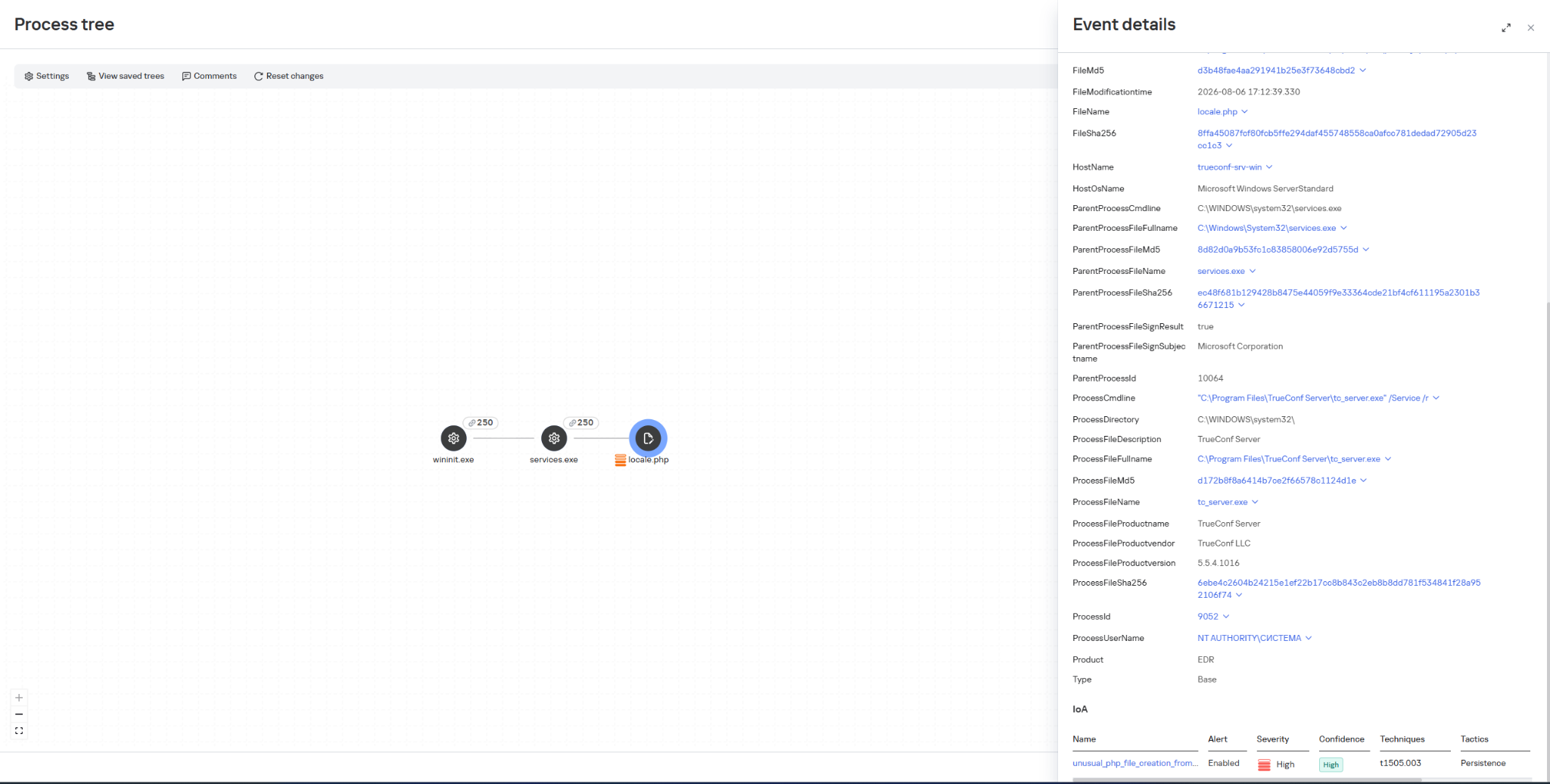
- Once they have gained elevated privileges, attackers replace the file …\public\js\locale.php with a web shell, which can be used for subsequent remote control of the compromised server.
This web shell was used for the following activities:
- collecting data on the IT infrastructure;
- gaining privileged access to the TrueConf database;
- replacing the original TrueConf Client distribution with an infected version containing the PhantomCore backdoor.
The vulnerabilities exploited by the attackers were patched by the vendor in the latest TrueConf Server updates (versions 5.3.9, 5.4.9, and 5.5.5). These updates were released on June 18, 2026.
The PhantomCore backdoor was successfully detected by Kaspersky solutions.
To automatically launch the malware after the system boots, a registry key is created: HKEY_CURRENT_USER\Software\Classes\CLSID\{0340F119-A598-4ed9-B0AC-6F6A12D3E755}\InprocServer32, with the value set to the path to the malicious program’s file.
Using a web shell, in addition to PhantomCore, the attackers load a backdoor that we have named PhantomGraph, consisting of two modules:
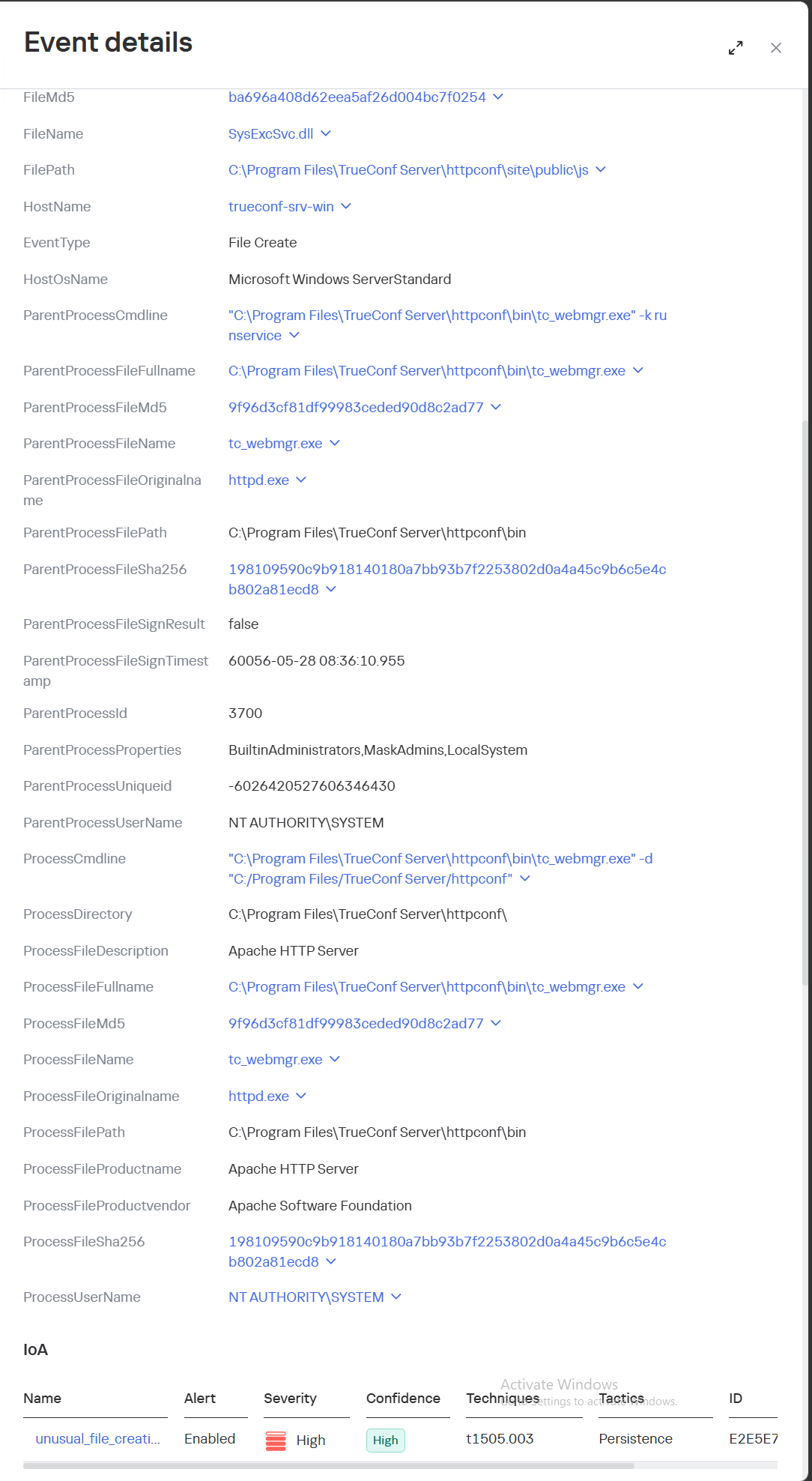
- SysExcSvc.dll is responsible for receiving commands from the attackers and transmitting the results of their execution. The attackers used an account on Microsoft OneDrive cloud storage as their command-and-control (C2) server.
- SysReadSvc.dll reads the command transmitted by the first module, executes it, and saves the execution result.
To establish persistence on the system, the attackers execute a Base64-encoded PowerShell command that installs SysExcSvc.dll and SysReadSvc.dll as Windows services. We believe the attackers deliberately split this malicious command into two components to make it harder to detect using EDR tools. Additionally, the program’s code partially matches that of PhantomCore, indicating that it belongs to Head Mare’s arsenal.
We also managed to identify the commands executed by the attackers when connecting to the backdoor. The SysReadSvc module executes commands using a BATCH file. Example of execution:
$system32\cmd.exe /c cmd /c ""$temp\cmd_cmd_4488.bat"" 2>&1
Commands detected:
- Memory dump of the lsass.exe process:
- Reconnaissance of the user and system names:
- Launching an SSH reverse tunnel:
In addition, we discovered several commands that did not work due to the attackers’ typos and encoding issues.
We are observing several active Head Mare campaigns targeting Russian organizations across various industries: instrument manufacturing, electronics, transportation, energy,
IT, and software development. The attackers distribute their backdoors using various methods, including phishing, exploiting public web servers, or through a subcontractor.
We recommend that all organizations using TrueConf software install the latest server version (versions 5.3.9, 5.4.9, and 5.5.5) in accordance with the vendor’s recommendations.
We also recommend verifying that the client distributions downloaded from the TrueConf server used by your organization have a valid TrueConf digital signature and have not been tampered with. The malicious distributions we detected did not have a valid digital signature. You can also verify authenticity on the vendor’s website.
Important: Even if your organization does not use a TrueConf server, your employees may connect to compromised TrueConf servers belonging to business partners to participate in online meetings and download infected installation packages.
The attack mechanism and the vulnerabilities exploited are described in more detail on the Kaspersky ICS CERT website.
Detection by Kaspersky solutionsKaspersky security solutions successfully detect malicious activity associated with the attacks described above.
The malware used in this attack is detected by our solutions with the following detection names:
- Backdoor.PHP.WebShell.abi,
- Backdoor.Win64.PhantomCore.dt,
- Trojan.Win64.Agent.smgvnc,
- Trojan.Win64.Agent.smgvnb,
- HEUR:Backdoor.Win64.PhantomCore.gen,
- HEUR:Backdoor.Linux.Agent.fb,
- HEUR:Backdoor.Linux.PhantomHook.a,
- HEUR:Backdoor.Linux.PhantomReact.a,
- Trojan.Win64.PhantomGraph.gen
- UDS:Backdoor.Win64.PhantomCore.a
Let’s take a closer look using Kaspersky Endpoint Detection and Response Expert (KEDR Expert) as an example.
Specifically, activity involving the replacement of the legitimate file …\public\js\locale.php with a web shell, as well as the deletion of entries from TrueConf event logs, is detected by the rule unusual_php_file_creation_from_trueconf_process.
Downloading a file containing the PhantomCore backdoor via the replaced legitimate file …\public\js\locale.php is detected by KEDR Expert with the rule unusual_file_creation_from_trueconf.
Activity related to the installation of an infected TrueConf client installer containing the PhantomCore backdoor is detected by KEDR Expert using the unsigned_trueconf_installer rule.
The Kaspersky Managed Detection and Response service detects the described attack by monitoring the following actions:
- Creation of suspicious files by TrueConf Server processes.
- Execution of a TrueConf Client installer file that lacks a software developer’s signature.
- Suspicious process chains associated with TrueConf Client executables and TrueConf Client update executables.
- Registration of suspicious libraries in the HKEY_CURRENT_USER\Software\Classes\CLSID\ registry key.
- Actions related to retrieving information about the lsass.exe process.
- Memory dump creation for the lsass.exe process using the comsvcs.dll library.
- Accessing the memory of the lsass.exe process.
- Creating tunnels using the ssh process.
To protect companies using our Kaspersky SIEM system, a general set of rules is available in the product repository that allows detection of the following techniques:
- Creation of suspicious files in the C:\Windows\System32\inetsrv\* directory:
R405_07_File write to IIS native modules folder or OWA via WriteData. - Creating a memory dump of the lsass.exe process using the comsvcs.dll library:
R233_04_Process memory dump via comsvcs.dll. - Accessing the memory of the lsass.exe process:
R262_Suspicious access to the LSASS process.
We also recommend paying attention to the following events when developing your own detection rules or conducting threat hunting:
- Registration of suspicious libraries in the registry key \Software\Classes\CLSID\{0340F119-A598-4ed9-B0AC-6F6A12D3E755}\InprocServer32:
(DeviceEventClassID = '4657' OR DeviceEventClassID = '13') AND FileName like '%\Software\Classes\CLSID\{0340F119-A598-4ed9-B0AC-6F6A12D3E755}%' AND DeviceCustomString6 = 'InprocServer32' - Creating the SysExcSvc and SysReadSvc services to run executables from temporary directories in the background via cmd:
DeviceEventClassID = '4697' AND (DestinationServiceName = 'SysExcSvc' OR DestinationServiceName = 'SysReadSvc') AND match (FileName, '.*cmd\s+\/c.*temp\\cmd_cmd_.*\.bat.*') - Creation of suspicious processes originating from the TrueConf update process (trueconf_windows_update.exe)
(DeviceEventClassID = '4688' OR DeviceEventClassID = '1') AND SourceProcessName LIKE '%\trueconf_windows_update.exe'
For the detection rules to work correctly, ensure that events from Windows systems are received in full, including Security events 4688, 4663, 4657, and 4697 and Sysmon events 1, 7, 11, and 13.
Indicators of compromise File hashes (MD5)Web shell
4d27b4eb1c5dbb3d8160f29b8119523e locale.php
Infected installer
748c9f8cb1065000616204935f96207f trueconf_windows_update.exe
PhantomCore DLL
c5a460e4e68a088f6e51b2c6474642ec
129462164a7d52e9ea8560b60f0412c5 doc.txt
ec0bf4a2186a88874e9f26f07cfeb532 usocacheddata.txt
b348642146ea34771e5785c5857950f5
c915cb6c2aeb863ee8479238e1644217 doc.txt
0e79996d9483d1e44fea32b0a48c2c19 doc.txt
2bb75c20e778eb5c416965bd4d4259b1 trueconf_windows_client_x64_[redacted].exe
b3a6fee3307f1c26841fd5c603e2b013 usocacheddata.txt
8fcc3e4ccbf1725d9989fb464abf3561 usocacheddata.txt
PhantomGraph
489f43be558b2679284ceabed7adc4f3 sysexcsvc.dll
dd1fd2b459b97b7d59375cb8383cd19a sysreadsvc.dll
0e4541c3153ec5ed01497f19cf4f63d0 sysexcsvc.dll
12d4e8f5295f2ef7e0f9bfc0f4830939 sysexcsvc.dll
7f267006cac10f341c356b62fe493527 sysexcsvc.dll
ee2861d5965e8730708cd1da8a93fa4c sysexcsvc.dll
Backdoor (ELF)
c3a2abe8756910f42582b04a44ea3514
43f435c3c437bc879a2d7d4634f43494
Rootkit
aee9642b45b099cb7f3053b9b680b425
81.177.32[.]12
194.87.239[.]71 ssh
194.87.93[.]153 ssh
38.244.205[.]244
31.59.102[.]61
penzadogshelter[.]site
trendy-market[.]site
bright-deals[.]site
nova-stream[.]site
rinomobile[.]ink
urbanpixel[.]store
flexish[.]shop
media-hub[.]today
cosmetic-deals[.]store
vks.gossopka[.]forum
SysExcSvc
SysReadSvc
C:\Windows\System32\inetsrv\SysExcSvc.dll
C:\Windows\System32\inetsrv\SysReadSvc.dll
C:\Windows\System32\inetsrv\graphi-refresh.dat
C:\Windows\System32\inetsrv\share\input_*.txt
C:\Windows\System32\inetsrv\share\output_*.txt
%TEMP%\cmd_cmd_*.bat
%LOCALAPPDATA%\TrueConf\Client\api-ms-win-crt-time-l1-1-0-2.dll
/etc/systemd/system/omicluster.service
/etc/systemd/system/schedul2-bin.service
/opt/acronis/bin/schedul2-bin
/omi/bin/omicluster
/usr/lib64/libzvbi-tchain.so.2
/var/tmp/cx2
HKEY_CURRENT_USER\Software\Classes\CLSID\{0340F119-A598-4ed9-B0AC-6F6A12D3E755}\InprocServer32
Kaspersky detection namesBackdoor.PHP.WebShell.abi
Backdoor.Win64.PhantomCore.dt
Trojan.Win64.Agent.smgvnc
Trojan.Win64.Agent.smgvnb
HEUR:Backdoor.Win64.PhantomCore.gen
HEUR:Backdoor.Linux.Agent.fb
HEUR:Backdoor.Linux.PhantomHook.a
HEUR:Backdoor.Linux.PhantomReact.a
Trojan.Win64.PhantomGraph.gen
UDS:Backdoor.Win64.PhantomCore.a
rule apt_HeadMare_FakeConf_installer { meta: description = "Rule to detect any unsigned TrueConf installers" author = "Kaspersky" copyright = "Kaspersky" version = "1.0" last_modified = "2026-08-02" hash = "748c9f8cb1065000616204935f96207f" strings: $a1 = "TrueConf Setup" wide $a2 = "This installation was built with Inno Setup." wide condition: (uint16(0) == 0x5A4D) and (filesize > 20MB) and (all of them) and (pe.number_of_signatures == 0) }
rule apt_HeadMare_PhantomCore_exchange { meta: description = "Rule to detect PhantomCore exchange module used by HeadMare" author = "Kaspersky ICS CERT" copyright = "Kaspersky ICS CERT" version = "1.0" last_modified = "2026-08-02" hash = "489f43be558b2679284ceabed7adc4f3" strings: $a1 = "graphi_exchange.dll" ascii $a2 = "graphi-client/1.0" ascii $b1 = "https://graph.microsoft.com/v1.0/me/drive/root:/" ascii $b2 = ":/children?$select=name,id&$top=200" ascii $b3 = "offline_access Files.ReadWrite" ascii $b4 = "GRAPHI_INSECURE" ascii $b5 = "\"@microsoft.graph.conflictBehavior\":\"replace\"}" ascii $b6 = "https://login.microsoftonline.com/" ascii condition: (uint16(0) == 0x5A4D) and (any of ($a*)) and (3 of ($b*)) }
rule apt_HeadMare_PhantomCore_executor { meta: description = "Rule to detect PhantomCore executor module used by HeadMare" author = "Kaspersky ICS CERT" copyright = "Kaspersky ICS CERT" version = "1.0" last_modified = "2026-08-02" hash = "dd1fd2b459b97b7d59375cb8383cd19a" strings: $a1 = "graphi_reader.dll" ascii $a2 = "^input_(.+)\\.txt$" ascii $b1 = "output_" ascii $b2 = "cmd_cmd_" ascii $b3 = "cmd /c \"\"" ascii $b4 = "error: failed to start cmd process" ascii $b5 = "share" ascii $b6 = "SysReadSvc" ascii condition: (uint16(0) == 0x5A4D) and (filesize < 4MB) and (any of ($a*)) and (4 of ($b*)) }
rule apt_HeadMare_FakeLocale_webshell { meta: description = "Rule to detect the HeadMare TrueConf web shell" author = "Kaspersky" copyright = "Kaspersky" version = "1.0" last_modified = "2026-08-04" hash = "4d27b4eb1c5dbb3d8160f29b8119523e" strings: $a1 = "X-Redirect-Bit" ascii wide nocase $a2 = "tc_vcs_web_db_conn" ascii wide $a3 = "user=postgres" ascii wide $b1 = "UPL ok::" ascii wide $b2 = "DWN fail nexs" ascii wide $b3 = "DWN fail inv" ascii wide condition: (2 of ($a*)) or (2 of ($b*)) }
rule apt_HeadMare_TrueConf_Rootkit { meta: description = "Rule to detect the HeadMare rootkit installed on TrueConf servers" author = "Kaspersky" copyright = "Kaspersky" version = "1.0" last_modified = "2026-08-06" hash = "aee9642b45b099cb7f3053b9b680b425" strings: $a1 = "PQconnectdb" $a2 = "obfuscated_data" $a3 = "install_hook" condition: (uint32(0) == 0x464c457f) and (filesize < 400000) and (all of them) }
rule apt_HeadMare_Github_Backdoor { meta: description = "Rule to detect the HeadMare backdoor with Github C2" author = "Kaspersky" copyright = "Kaspersky" version = "1.0" last_modified = "2026-08-06" hash = "43f435c3c437bc879a2d7d4634f43494" hash = "c3a2abe8756910f42582b04a44ea3514" strings: $a1 = "cryptor5crypt" $a2 = "execraw_task" $a3 = "jitter_task" $a4 = "upload_task" $a5 = "exec_task" $a6 = "react_comment" condition: (uint32(0) == 0x464c457f) and (filesize > 5000000) and (filesize < 10000000) and (4 of them) }
Kategorie: Hacking & Security, Viry a Červi
HBO Max a 30 nejoblíbenějších filmů a seriálů v srpnu 2026. Tohle Češi na HBO nejvíc sledují
Tyto filmy a seriály jsou teď na českém Max (dříve HBO Max) nejoblíbenější. Nerozlišujeme žánr, stáří ani hodnocení na filmových webech. Jde o souhrnnou oblíbenost za poslední týdny, kterou zjišťuje a počítá web FlixPatrol.
Kategorie: IT News
AlzaPC s Bazzite
Alza.cz nabízí herní AlzaPC s předinstalovaným Linuxem (YouTube), konkrétně s linuxovou distribucí Bazzite (Wikipedie).
Kategorie: GNU/Linux & BSD
Mozilla revokes Firefox signing key after unencrypted copy lands in GitHub
Mozilla has revoked a cryptographic key used to sign Firefox and Thunderbird releases after discovering someone had accidentally committed an unencrypted copy of the private key to a GitHub repository. The browser maker disclosed the mishap on Monday, saying the GPG private subkey was checked into a private GitHub repository accessible only to a small number of Mozilla employees. All of them were already authorized to access the key through other means. Still, leaving an unencrypted private signing key sitting in source control isn't exactly ideal, so Mozilla revoked the exposed subkey and replaced it. The affected subkey was used to sign Linux tarballs, RPM packages, and checksum files for Firefox and Thunderbird releases. Signing keys allow users and package managers to verify that software really came from Mozilla and hasn't been tampered with along the way. Mozilla said its review of available audit records "found no evidence that the key was accessed by an unauthorized party while it was present in the repository." It has introduced additional safeguards to prevent a repeat, but did not explain how the unencrypted key ended up in GitHub or how long it remained there. For most Firefox and Thunderbird users, the key swap shouldn't require any action. Anyone manually verifying Mozilla's GPG signatures, however, will need to import the new signing key and the revocation for the old one. The change is a little more involved for users who installed Firefox through Mozilla's RPM repository. On Fedora 43 and later, DNF should download the updated key during the next Firefox update, although users will be asked to approve its import. Mozilla says users running Fedora 42 or earlier, RHEL, Rocky Linux, AlmaLinux, openSUSE, or SUSE will need to remove the old key and manually import its replacement. There's another wrinkle for anyone checking older releases: after importing the revocation, normal signature verification will reject releases signed with the revoked subkey. Thunderbird users don't have to worry about RPM-specific shenanigans, as Mozilla doesn't provide official RPM packages for the email client. The Register asked Mozilla how long the private key was sitting in GitHub, how it got there, and whether its audit logs cover the entire period it was exposed, but did not receive a response. ®
Kategorie: Viry a Červi
Researchers Built a Fake Crypto Startup and Hired Three Suspected North Korean IT Workers
Security researchers invented a cryptocurrency startup, advertised developer jobs, and hired three people they believe were North Korean operatives. Every virtual machine the company issued was recording.
The onboarding paperwork is the part hiring teams can use. The first hire claimed to live in Pasadena, Texas, then sent a California driver's license and a New York bank account.
The Swati Khandelwalhttp://www.blogger.com/profile/[email protected]
Kategorie: Hacking & Security
New Pass-ta-key attack reveals all the things we didn't know about passkeys
Last week, a researcher outlined what he said was a “novel attack surface” in passkeys, the new authentication paradigm that offers a more secure alternative to password-based methods. In fact, the attacks demonstrated in the post are neither novel nor unique to passkeys. This distinction is important because the research has generated confusion among end users and security professionals as they assess whether this new mechanism is truly safe to use.
The attack is called Pass-ta-key—a blending of the word passkey with the phrase “pass the key” and a nod to a plate of pasta. Arie Olshtein, a researcher at security firm Palo Alto Networks, described in a post last week how Pass-ta-key could obtain all passkeys stored in the Google Password Manager app (GPM) for Windows when it’s running on a machine infected with malware.
This came as a surprise to many people because they believed passkeys are stored exclusively in the trusted platform manager (TPM), the locked-down enclave in a hardened silicon chip that’s reserved for storing cryptographic keys and other highly sensitive information on Windows machines. If passkeys are stored in the TPM, then how was Pass-ta-key able to extract the entire set of passkeys stored by the app, they wanted to know.
Kategorie: Hacking & Security, IT News
Cisco warns of high-severity ClamAV flaws with public exploits
Cisco warned of two high-severity vulnerabilities affecting the Secure Endpoint Connector that allow threat actors to crash the ClamAV scanning process in denial-of-service (DoS) attacks. [...]
Kategorie: Hacking & Security
AI finds so many Windows flaws, Microsoft can’t keep up. Should you worry?
Be careful what you wish for. That’s what Microsoft found out recently when it discovered that AI — rather than making Windows more secure by helping the company close security holes — could help hackers find flaws faster than Microsoft can fix them.
It’s put Microsoft in a serious bind. Should the company devote a potentially massive amount of resources to fix every AI-unearthed security issue as fast as it can? Or should it rush to close the most important ones, and clean up the minor ones later at much less cost?
What the company decides could have tremendous implications. For years, Microsoft has faced criticism from many in the US government because of how often its technologies have been hacked, potentially putting the nation’s security at risk. Some members of Congress have suggested the government curtail contracts with Microsoft until the company proves it can provide more safety. Billions of dollars in federal contracts could be pulled.
To get a better insight into what could happen, let’s look at AI’s newfound prodigious ability to find security holes and bugs.
AI-fueled security mavens Mythos and Project GlasswingMicrosoft’s AI-related security problems are an outgrowth of the launch of Anthropic’s Mythos AI model, designed to handle cybersecurity and biology research. One of its goals is to uncover security vulnerabilities as quickly as possible, so that software companies and cybersecurity companies can fix them before hackers find the holes.
Anthropic’s early tests found that Mythos was spectacularly successful in finding Windows security flaws. “Within 31 minutes, Mythos generated its first proof-of-concept exploit for a Windows kernel vulnerability,” Axios reported in June.
Anthropic noted that its testing of Mythos “reveals a stark fact: AI models have reached a level of coding capability where they can surpass all but the most skilled humans at finding and exploiting software vulnerabilities.
“Mythos Preview has already found thousands of high-severity vulnerabilities, including some in every major operating system and web browser. Given the rate of AI progress, it will not be long before such capabilities proliferate, potentially beyond actors who are committed to deploying them safely. The fallout — for economies, public safety, and national security — could be severe.”
As a result, Anthropic decided to launch a security project it calls Project Glasswing, which it describes as “an urgent attempt to put these capabilities to work for defensive purposes.”
Many companies beyond Anthropic are part of the effort, including Microsoft, Google, Amazon, Nvidia, Apple and others. In theory, it’s a great idea. Find and fix vulnerabilities before hackers can, and everyone is safer. What could go wrong?
Plenty, as it turns out. Access to Mythos is available to anyone, and Mythos has been finding security holes and bugs far faster than companies — particularly Microsoft — can patch them. As Pro Publica reported in late July, ‘Microsoft is struggling to fix them fast enough.”
Too little, too late?For now, Microsoft is only patching the most dangerous bugs and holes. And, according to Pro Publica, “internal records indicate that Microsoft plans to eventually address ‘moderate’-severity flaws uncovered by Mythos. The documents made no mention of ‘low’-severity bugs.”
That’s fairly typical of the triage many companies use when deciding how much effort to put into plugging holes. But some experts believe that in the age of AI, that’s a dangerous way to handle security.
Vinh Nguyen, former chief AI officer and chief data scientist at the US National Security Agency and now a senior technical adviser to Anthropic and senior fellow for AI at the Council on Foreign Relations, is particularly concerned that the approach is outdated. He told Pro Publica: “The problem now is that you can chain four low-level flaws, and that can equal a high severity. If you’re Microsoft, the current triage strategy may be underpricing risks.”
It’s already proving difficult for Microsoft to keep up with patching bugs and security holes since Mythos’ launch. July’s Patch Tuesday release fixed the most bugs in Microsoft’s history – 622 of them. Things will only get harder from here.
The dangers for MicrosoftMicrosoft is already in the doghouse for how it’s handled security. A year ago, in one of the worst attacks on Microsoft technologies, SharePoint was hacked. Tens of thousands of servers were hit, including not just thousands of businesses, but many important government agencies as well.
The National Institutes of Health (NIH) and the National Nuclear Security Administration (NNSA), which is in charge of the nation’s nuclear security, were among the victims. So were the Department of Homeland Security (DHS), the Cybersecurity and Infrastructure Security Agency, the Transportation Security Administration, Customs and Border Protection, and the Federal Emergency Management Agency, among many others.
Even before then, some members in Congress were threatening to pull Microsoft contracts if it didn’t improve security. At one point Sens. Eric Schmitt (R-MO) and Ron Wyden (D-OR) sent a threatening letter to the Pentagon requesting it not increase its use of Microsoft products.
“We write with serious concern that the Department of Defense (DoD) is doubling down on a failed strategy of increasing its dependence on Microsoft at a time when Congress and the administration are reviewing concerning cybersecurity lapses that led to a massive hack of senior US officials’ communications,” the letter said, in part.
Nothing happened as a result of the hack or the letter. But that could change in a heartbeat if there’s another big attack. It seems inevitable that hackers will start taking advantage of how quickly Mythos discovers security holes and bugs, especially if Microsoft doesn’t fix them all.
The next big hack, powered by AI, could prove very dangerous — not just for businesses and governments, but for Microsoft as well.
Kategorie: Hacking & Security
- « první
- ‹ předchozí
- …
- 8
- 9
- 10
- 11
- 12
- 13
- 14
- 15
- 16
- …
- následující ›
- poslední »