Viry a Červi
Nobody believes the 'criminals and scumbags' who hacked Canvas really deleted stolen student data
FEATURE When Instructure “reached an agreement” with data theft and extortion crew ShinyHunters this week, the education tech giant assured Canvas users after attackers claimed to have stolen data tied to 275 million students, teachers, and staff that their private chats and email addresses would not turn up on a dark-web marketplace, and that they would not be extorted over the incident. “We received digital confirmation of data destruction (shred logs),” Instructure assured the nearly 9,000 affected universities and K-12 schools. “We have been informed that no Instructure customers will be extorted as a result of this incident, publicly or otherwise.” Not a single responder that The Register spoke with believes this is true. “Do I believe they deleted the data? No. They're criminals and scumbags,” Recorded Future threat intelligence analyst Allan Liska, aka the Ransomware Sommelier, told us. “But, this is part of what Max Smeets calls ‘The Ransomware Trust Paradox,’” he added. “Ransomware groups have to, minimally, not post data they claimed to have deleted or no one will pay them in the future, but this is done knowing that the data is likely not deleted.” Halcyon Ransomware Research Center SVP Cynthia Kaiser, who previously spent two decades at the FBI, said she doesn’t think that anyone who studies ransomware groups’ operations believes the gang actually destroyed the stolen files. “‘We destroyed the data’ is a standard line from extortion groups once a payment is made or negotiations conclude, but time after time it has proven untrue,” Kaiser told The Register. “ShinyHunters in particular has a documented history of recycling, reselling, and re-leveraging stolen data across campaigns – data they claimed was contained from earlier intrusions has resurfaced on criminal forums months and years later.” Kaiser also doesn’t think this is the last threat that the schools will face from the Canvas breach. “Halcyon expects targeted phishing waves against staff, students, and parents over the next six to 12 months using leaked names, email addresses, and Canvas chat context to make the lures convincing,” she said. To be clear: Instructure execs never directly said the company paid the ransom, and we don’t know the exact amount of money the criminals demanded from the digital learning biz. We do know, however, that “reached an agreement” is corporate-speak for the victim paid up. Alliance Risk CEO David Vainer estimates the figure sits somewhere between $5 million and $30 million. Meanwhile, this latest extortion attack illustrates the impossible choice facing organizations entrusted with protecting people’s data when digital thieves breach their networks and steal sensitive information. “The FBI says don’t pay,” Doug Thompson, chief education architect at cybersecurity firm Tanium, told The Register. “But the operational reality at 3 a.m. during finals week or enrollment season can push institutions toward a very different calculation. Until that incentive structure changes, education is likely to remain unusually vulnerable to extortion pressure.” To pay, or not to pay? The US federal government, law enforcement agencies, and private-sector threat intelligence analysts all advise victims not to pay a ransom. “Paying ransoms rewards and incentivizes the criminals, funding their search for new victims, and I’ve long advocated before for a ban on ransomware payments,” Emsisoft threat analyst Luke Connolly told us. “But in the absence of regulation applying to all organizations, the stark reality is that Instructure faced a crisis, and they negotiated to try to minimize risk and harm.” No company wants to pay a ransom to its attackers, and most say they won’t – at least in principle – because they don’t want to fund criminal operations and incentivize the crooks. There’s also no guarantee that paying will guarantee the return of their data or prevent additional extortion attempts. CrowdStrike surveyed 1,100 global security leaders last summer, and of the 78 percent who said they experienced a ransomware attack in the past year, 83 percent of those that paid ransoms were attacked again. Plus 93 percent lost data regardless of payment. While data suggests that fewer organizations are paying criminals’ ransom demands - Chainalysis found the percentage of paying victims in 2025 dropped to an all-time low of 28 percent, despite attacks hitting record highs - when faced with extortion or a ransomware infection, the "to pay or not to pay" debate becomes much more complicated. “Most organizations still say publicly that they won't pay, and many genuinely don't, but when the alternative is mass downstream harm to students, parents, and thousands of customer institutions, the calculus shifts,” Kaiser said. “Pay-or-leak groups like ShinyHunters specifically engineer that calculus by creating intense financial and reputational pressure, and when demands go unmet, they escalate to direct harassment of victim companies, employees, and clients.” ShinyHunters did just that. The crew initially compromised Instructure in late April, and after the initial pay-or-leak deadline passed on May 6, ShinyHunters switched tactics to school-by-school extortion. They injected a ransom message into about 330 Canvas school login portals, causing Instructure to take the platform offline for a day - during final exams and Advanced Placement testing for many. Other ransomware scum have gone to horrifying extremes, posting pictures and addresses of preschool children in an effort to get a payday, leaking cancer patients’ nude photos and threatening them with swatting attacks. Mandiant Consulting CTO Charles Carmakal previously told The Register that ransomware infections have morphed into "psychological attacks” with crooks SIM swapping executives’ kids to pressure their parents into paying. Calculating risk In addition to responding to criminals directly harassing their students, patients, customers and employees, victim organizations also have to take into account potential lawsuits if the crooks dump individuals’ personal or health data, and the reputational hit from seeing all of this protected information published online. The decision about what to do in a ransomware attack revolves around risk reduction, Liska said. “Not paying a ransom means an increased risk of data exposure, which in this case could cause serious harm,” he told us. “While there is no good decision in most ransomware negotiations, the idea is to protect as many people as possible and that may mean that paying is the least bad option.” While he didn’t respond to or investigate the Instructure case, “protecting children's data is absolutely a critical factor in these types of decisions, especially when the attacks originate from one of the groups associated with The Com,” Liska added. The Com, a loosely knit group of primarily English speakers who are also involved in several interconnected networks of hackers, SIM swappers, and extortionists such as ShinyHunters and Scattered Lapsus$ Hunters, has been known to blackmail kids and teens into carrying out shootings, stabbings, and other real-life criminal acts. “These groups are known to coerce victims using threats of physical harm, including bricking and swatting," he said. "Not paying may have increased the risk of serious harm to the children whose data was exposed.” A representative of ShinyHunters contacted The Register to "deny any and all association, affiliation, and/or linkage with 'The Com' including 'Scattered Lapsus Hunters'" The rep said "There is no actual concrete evidence to support that we are associated, affiliated, or linked to the aforementioned. These are baseless allegations and industry propaganda surrounding 'The Com.'" The Shiny one admitted that some of their crew's tactics are similar to those the other gangs use but suggested it's lazy to assume a link. "If China or North Korea used vishing to infiltrate organizations networks would they also immediately become associated with “The Com?'" the representative asked. Ed sector 'more likely to pay' Instructure’s intrusion follows several other high-profile attacks against education-sector software providers. In December 2024, PowerSchool suffered a breach, affecting tens of millions of students. The company reportedly paid about $2.85 million in bitcoin in exchange for a video supposedly showing the attackers destroying the data. But about five months later, in May 2025, the ed-tech provider’s school district customers received individual extortion threats from either the same ransomware crew that hit PowerSchool or someone connected to the crooks. Earlier this year, ShinyHunters claimed it stole data from K-12 software provider Infinite Campus as part of a broader wave of Salesforce-related intrusions. “Education keeps emerging as one of the sectors where organizations are still more likely to pay under pressure,” Thompson said. In addition to students’ – especially minors’ – data containing highly sensitive personal details, and therefore presenting an attractive target for attackers, this is also driven in part by market pressure and economics. It’s costly and inconvenient for schools to switch learning management systems, and they are typically locked into multi-year contracts with these software vendors, according to Thompson. “The other issue is concentration,” he said. “A relatively small number of vendors hold data for enormous portions of the education system. PowerSchool, Infinite Campus, Canvas, Blackboard; those four hold records on something close to every American student, and hackers know it. Three of the four have been breached at a multi-million-record scale in the last 18 months.” Thompson said he expects to see additional attacks against major education platforms to follow. “The economics are good. Instructure paid. PowerSchool paid last year. Every other ed-tech vendor's board just had a conversation about what their number would be,” he told us. “The pattern is established.” According to Connolly, the universities and K-12 schools affected by the Canvas hack shouldn’t consider their data safe, regardless of Instructure’s assurances or the crooks' promises to delete it. “There will be future attacks, without a doubt.” ® Correction: The estimate of $5 million to $30 million comes from Alliance Risk CEO David Vainer.
Kategorie: Viry a Červi
Cops arrest man suspected of being Dream Market kingpin
A man police suspected of being the administrator of the former leading online drug bazaar Dream Market is facing charges in both his native Germany and the US following his arrest earlier this month. Prosecutors claim Owe Martin Andresen, 49, is the individual known by the “Speedstepper” alias, one of the few Dream Market admins identified by law enforcement in the 2019 attempts to shutter the platform. While other crime leaders on the platform have been convicted, it took the authorities years to identify their latest suspect, whom they believe was main admin of the website. Authorities said they tracked him down by monitoring crypto wallets, and tracking purchases of gold bars that the indictment claims were delivered to his home address. Other lower-level admins have long been convicted, including French national Gal Vallerius, who was sentenced to 20 years in prison a year after being arrested at Atlanta airport in 2017 on his way to attend the World Beard and Mustache Championships (yes, really). Andresen was arrested by German police on May 7 after the US indicted him in January, charging him with several counts of money laundering offenses. He faces similar charges in Germany. Authorities spent years gathering small pieces of evidence that eventually tied Andresen to Dream Market’s helm. After the platform shut down in 2019 amid mounting pressure from law enforcement, none of the suspected admins touched Dream’s infrastructure, including the operation’s known cryptocurrency wallets, which contained millions of dollars’ worth of tokens. Three years later, between November and December 2022, Andresen allegedly accessed these numerous wallets and transferred the contents into a single, consolidated one - a step only someone with access to Dream’s private key could carry out. Police believe this was Speedstepper. The next breadcrumb came almost a year later, when in August 2023, Andresen allegedly used an Atlanta-based cryptocurrency service provider to purchase gold bars from various international companies using the funds from the consolidated wallet. The indictment claims he had those gold bars shipped directly to his house in Germany, instead of choosing a more neutral, less compromising location. Between then and April 2025, German police believe they have identified several other money laundering schemes executed by Andresen, washing more than $2 million in the process. Upon his arrest on May 7, police searched Andresen’s residence “and two other locations,” at which officers found gold bars worth approximately $1.7 million, more than $23,000 in cash, as well as several bank accounts and crypto wallets containing roughly a combined $1.2 million. All of these proceeds are thought to stem from the funds generated by Dream Market and the various fees it charged for transactions and sellers to list their illicit wares. Dream Market operated between 2013 and 2019 and benefited greatly from the Alphabay and Hansa seizures, scooping up their users after playing second fiddle to both platforms for much of their respective reigns. According to US Attorney Theodore Hertzberg, at its peak, Dream had around 100,000 concurrent listings, most of which were for drugs. The US said the market was responsible for the trafficking of huge quantities of illegal narcotics, including more than 90kg of heroin, 450kg of cocaine, 25kg of crack cocaine, 45kg of methamphetamine, 13kg of oxycodone, and 36kg of fentanyl. “Andresen allegedly channeled commissions earned from selling illegal drugs, stolen personally identifiable information, counterfeit identification documents, and other items through cryptocurrency wallets and even converted his ill-gotten gains into gold bars,” said US Attorney Hertzberg. “Thanks to the close coordination between federal and German law enforcement, Andresen and his co-conspirators will no longer profit from the online sales of narcotics and fraud services, and Andresen will be prosecuted in both Germany and the United States as a result of his actions.” Andresen faces 12 federal charges - six counts each of international and domestic concealment money laundering - each carrying a maximum 20-year sentence. German authorities also charged Andresen with “several” counts of domestic money laundering, with each charge carrying a maximum five-year prison stint. ®
Kategorie: Viry a Červi
Kimsuky targets organizations with PebbleDash-based tools
Over the past few months, we have conducted an in-depth analysis of specific activity clusters of Kimsuky (aka APT43, Ruby Sleet, Black Banshee, Sparkling Pisces, Velvet Chollima, and Springtail), a prolific Korean-speaking threat actor. Our research revealed notable tactical shifts throughout multiple phases of the group’s latest campaigns.
Kimsuky has continuously introduced new malware variants based on the PebbleDash platform, a tool historically leveraged by the Lazarus Group but appropriated by Kimsuky since at least 2021. Our monitoring indicates various strategic updates to the group’s arsenal, including the use of VSCode Tunneling, Cloudflare Quick Tunnels, DWAgent, large language models (LLMs), and the Rust programming language. This expanding set of tools underscores the group’s ongoing adaptation and evolution.
Specifically, Kimsuky leveraged legitimate VSCode tunneling mechanisms to establish persistence and distributed the open-source DWAgent remote monitoring and management tool for post-exploitation activities. These activities affected various sectors in South Korea, impacting both public and private entities.
This article covers both previously undocumented attacks and a deeper technical analysis of incidents within this campaign that have been reported before — offering new insight beyond what has already been published.
Executive summary- Kimsuky obtains initial access to target systems by delivering spear-phishing emails containing malicious attachments disguised as documents. They also contact targets via messengers in some cases.
- Kimsuky uses a variety of droppers in different formats, such as JSE, PIF, SCR, EXE, etc.
- The droppers deliver malware mainly belonging to two big clusters: PebbleDash and AppleSeed. These clusters are considered the most technically advanced in the group’s toolset. The report covers the following PebbleDash malware: HelloDoor, httpMalice, MemLoad, httpTroy. It also covers AppleSeed and HappyDoor from AppleSeed cluster.
- For post-exploitation activities Kimsuky uses legitimate tools Visual Studio Code (VSCode) and DWAgent. For VSCode, the attacker uses GitHub authentication method.
- For hosting C2 infrastructure the group mainly uses domains registered at a free South Korean hosting provider. It also occasionally relies on hacked South Korean websites and tunneling tools, such as Ngrok or VSCode.
- Kimsuky mainly targets South Korean entities. However, PebbleDash attacks were also seen in Brazil and Germany. This malware cluster focuses on defense sector, while AppleSeed most often targets government organizations.
First identified by Kaspersky in 2013, Kimsuky has been active for over 10 years and is considered less technically proficient compared to other Korean-speaking APT groups. The group has targeted a wide range of entities and demonstrated capability in creating tailored spear-phishing emails. The group’s arsenal includes proprietary malware such as PebbleDash, BabyShark, AppleSeed, and RandomQuery, as well as open-source RATs like xRAT, XenoRAT, and TutRAT. This blog post examines the evolving PebbleDash-based malware (referred to as the PebbleDash cluster) and its connections to the AppleSeed-based malware (referred to as the AppleSeed cluster).
The PebbleDash and AppleSeed clusters are considered the most technically advanced in Kimsuky’s toolset. Since at least 2019, these clusters have masqueraded as legitimate documents and application installers, manifesting as JSE droppers or executables with .EXE, .SCR and .PIF extensions. Both are particularly adept at establishing backdoors and stealing information, and ongoing development of their variants has been observed. They even occasionally utilize stolen legitimate certificates from South Korean organizations to avoid detection.
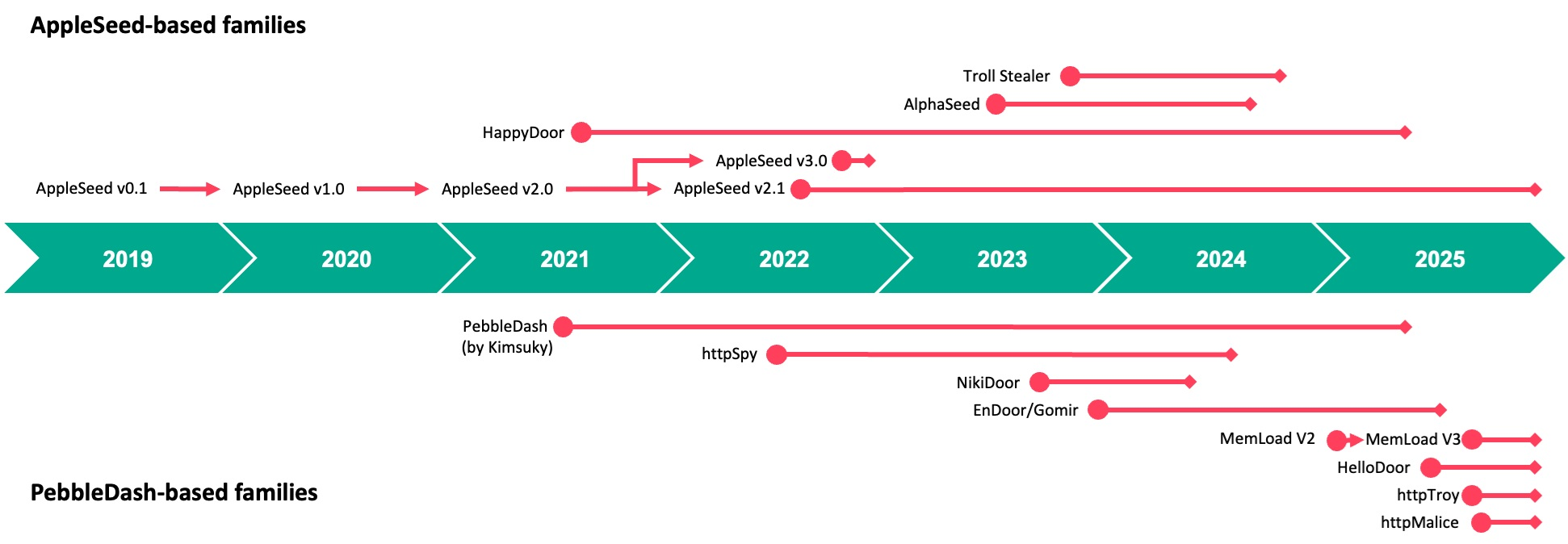
Timeline of the AppleSeed and PebbleDash malware families
AppleSeed and PebbleDash have primarily targeted the public and private sectors in South Korea. The PebbleDash cluster has shown a particular interest in the medical, military and defense industries worldwide. The PebbleDash cluster compromised Brazilian and South Korean defense organizations throughout the past several years, as well as a German defense firm. In 2024, the South Korean government released a security advisory regarding the AppleSeed cluster, detailing how the malware was distributed by replacing a security software installer required to access a construction entity’s website.
Initial accessKimsuky meticulously crafts and delivers spear-phishing emails to its targets in an attempt to entice them into opening attachments. According to recent research, the group also occasionally approaches targets by contacting them via messengers. In all cases, the initial contact leads to the delivery of a malicious attachment disguised as a document. These attachments often consist of compressed files containing droppers in formats such as .JSE, .EXE, .PIF, or .SCR. The filenames are consistent with the message content and are meant to convince the recipient to open the attachment. The malicious files are often disguised as product quotations, job offers, information guides, surveys, government documents, and personal photos.
Here are some recently discovered examples:
Number Filename Filename (translated to English) Detection date MD5 Malware deployed 1 [별지 제8호서식] 개인정보(열람 정정삭제 처리정지) 요구서(개인정보 보호법 시행규칙).hwp.jse Appendix Form No. 8 – Request for Access, Correction, Deletion, and Suspension of Processing of Personal Information (PIPA Enforcement Rules).hwp.jse August 28, 2025 995a0a49ae4b244928b3f67e2bfd7a6e HelloDoor 2 2026년 상반기 국내대학원 석사야간과정 위탁교육생 선발관련 서류.hwpx.jse Documents for the Selection of Commissioned Students for Domestic Graduate School Master’s Evening Programs (H1 2026).hwpx.jse December 14, 2025 52f1ff082e981cbdfd1f045c6021c63f httpMalice 3 security_20260126.scr – January 26, 2026 65fc9f06de5603e2c1af9b4f288bb22c Reger Dropper, MemLoad, httpTroy 4 노현정님.pdf.jse Ms. Noh Hyun-jung.pdf.jse January 28, 2026 8e15c4d4f71bdd9dbc48cd2cabc87806 AppleSeed chain 5 대국민서비스관리운영체계현장점검증적(초안).pif On-site Inspection Evidence for the Public Service Management System (Draft).pif February 5, 2026 8983ffa6da23e0b99ccc58c17b9788c7 Pidoc Dropper, HappyDoorJSE droppers contain a minimum of two Base64-encoded blobs: one serving as a benign lure file and one or more containing malicious code. Additional blobs may exist within the dropper, but they are unused. The two blobs are decoded using JScript and stored in an arbitrary location on disk, such as C:\ProgramData, with the malicious filenames randomly generated according to the scheme [random]{7}.[random]{4}. The lure file is opened immediately. The malicious payload leverages powershell.exe -windowstyle hidden certutil -decode [src path] [dst path] for the second Base64 decoding before execution. Ultimately, the malicious payload is executed via command-line instructions such as regsvr32.exe /s [file path] or rundll32.exe [file path] [export function].
Reger Dropper (.SCR) and Pidoc Dropper (.PIF) also contain benign lure files and malicious payloads that, in both cases, are encrypted using XOR operations. Specifically, Reger Dropper employs a hard-coded key #RsfsetraW#@EsfesgsgAJOPj4eml;, while Pidoc Dropper utilizes single-byte XOR with 0xFF to decrypt the internal data for execution. Pidoc Dropper is fully obfuscated using dummy data and encrypted strings. Both droppers deploy files in specific directories such as %temp% or C:\ProgramData before executing the malware using regsvr32.exe.
In addition to these droppers, Kimsuky employed a variety of executable droppers, including those crafted in Go or packaged with Inno Setup.
Deployed malwareIn this section, we describe several malware families recently dropped by the droppers discussed above.
HelloDoor: first Rust-based PebbleDash variantWritten in Rust, a programming language rarely used by Kimsuky, HelloDoor is a DLL-based backdoor first identified in August 2025. It is deployed via a malicious JSE dropper. Since it has limited capabilities and a simplistic communication mechanism, the backdoor is most probably in the early stages of development. Nevertheless, it is noteworthy that HelloDoor employs a C2 server hosted through TryCloudflare, a temporary tunneling service provided by Cloudflare. This service allows users to expose a local web service to the internet with no setup or account, making the infrastructure behind it difficult to trace.
HelloDoor establishes persistence upon execution by registering itself to the HKCU\Software\Microsoft\Windows\CurrentVersion\Run key with the value name tdll and the command regsvr32.exe /s [current file path].
The implant communicates with the C2 server (hxxp://female-disorder-beta-metropolitan.trycloudflare[.]com/index.php) over the HTTP protocol. Depending on whether the process is executing with an elevated token, it binds to a specific local port: 5555 if the token is elevated, or 5554 if not. Before initiating communication, it generates a unique identifier by collecting device information, such as the MAC address, computer name, and the string “windows”, then computes a hash value from this information.
The malware then constructs a query string in the format aaaaaaaaaa=2&bbbbbbbbbb=[the unique identifier]&cccccccccc=1, which is a traditional format used across the PebbleDash cluster. Subsequent server responses are Base64-decoded and then decrypted using RC4 with the key fwr3errsettwererfs. The decrypted content contains command strings. Possible commands are:
Command Description “mcd” Set the current directory “msleep” Sleep for the provided time “install” Register the regsvr32.exe /s [the provided file path] command to the HKCU\Software\Microsoft\Windows\CurrentVersion\Run autorun registry using the install value name [command] Execute the provided command using chcp 65001 > nul & cmd /U /C [command]Though interesting, it is no longer surprising that we found comments in the code that appear to have been generated by an LLM service rather than a human developer. This is based on traces that include emojis used for logging debugging messages.
✅ Port is now listening (no accepting) ❌ Port is already in use 🔍 regsvr32.exe detected as parent. Attempting to terminate...This is a common trait of LLM services that provides users with better visibility. We previously observed similar comments in the PowerShell-based stealer suite used by BlueNoroff. HelloDoor’s simple structure and the fact that no other Rust-based malware from the group has been discovered yet support our claim.
Even though the code is believed to have been developed using an LLM service, we still found some typos and grammatical errors, such as:
- result send fail (grammatically incorrect text)
- server request fail (grammatically incorrect text)
- command execute failed (grammatically incorrect text)
- decrytion failed (typos)
- autorum failed (typos)
It is likely that the flawed comments were added manually before or after AI was used.
httpMalice: latest backdoor variant of PebbleDashThe latest PebbleDash-based backdoor, httpMalice, emerged no later than December 2025 and is deployed by the JSE Dropper. Although we found limited direct connections to both the AppleSeed and PebbleDash clusters, the malware is closer to PebbleDash. The following shared characteristics have been identified:
- (PebbleDash cluster) Ability to run commands received from the C2 server with the S-1-12-12288 SID, indicating a high integrity level – a feature also observed in PebbleDash and httpTroy.
- (PebbleDash cluster) Unique identifier generated by combining the volume serial number of the root directory with the elevation status of the current token, mirroring a technique used since the appearance of NikiDoor.
- (PebbleDash cluster) Communication with its C2 server utilizing three HTTP parameters, consistent with other PebbleDash-based families.
- (PebbleDash cluster) Core command set more closely aligned with PebbleDash than with AppleSeed-based malware.
- (AppleSeed cluster) Use of the m= parameter in C2 communication.
- (AppleSeed cluster) Gathering system details using PowerShell and Windows commands similar to those found in AppleSeed and Troll Stealer.
Our analysis revealed two distinct versions of httpMalice based on their C2 communications: version 1.9 communicates over HTTP and version 1.8 uses Dropbox. The latter, the older variant, leverages the Dropbox API by utilizing pre-defined application credentials. Unlike its predecessor, the HTTP variant employs HTTP/HTTPS protocols to interact with its C2 server and maintains persistent access to the victim device through a Windows service named CacheDB. This mirrors tactics observed in similar threats, such as httpSpy.
The more recent variant gathers critical information from the compromised system, such as the current directory path, volume serial numbers, user privileges, username, local IP address, and the name and size of the currently executed httpMalice DLL file. It then combines the root drive’s volume serial number with the user’s access token privilege level to create a unique identifier for each infected system, formatted as [volume serial]{8}_[elevation status].
Value of elevation status Description 0 Running under the SYSTEM account with an elevated token 1 Running under an elevated administrator account 2 Running without elevationDepending on the token privilege, the backdoor then establishes persistence by either creating a service or registering itself to autostart at user logon. If the token is elevated, a service named CacheDB is created that executes the command cmd.exe /c “rundll32.exe [current DLL path], load”. The service’s display name is set to Administrator, and its description is defined as CacheDB Service. If the token is not elevated, the backdoor registers the same command under the registry key HKCU\Software\Microsoft\Windows\CurrentVersion\Run with the value name Everything 1.9a-[filesize]. The older version used Everything 1.8a-[filesize] as a value name.
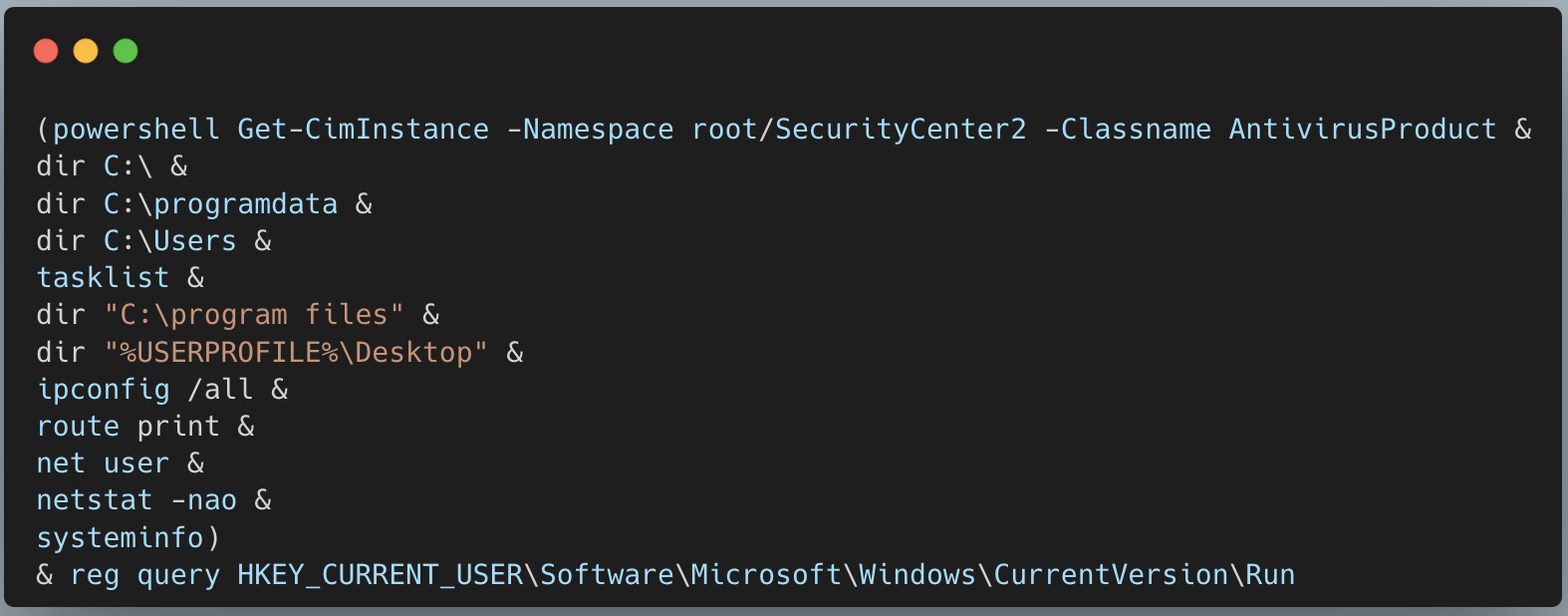
The latest version can execute a combination of Windows commands by default to perform host profiling, while the older version fetches the command set from Dropbox. In httpMalice, commands are mostly executed using the format cmd.exe /c chcp 949 [command] > [temporary filename], which redirects the output to separate files, with the consistent prefix 2Ato6478s added to their names. The chcp 949 command changes the code page to 949, indicating that the malware targets users of the Korean language (EUC-KR charset).
Windows commands used to gather system details
httpMalice transmits the result of host profiling to its C2 server as a URL parameter, using the POST method over the HTTP/HTTPS protocol, with the header x-www-form-urlencoded. The URL includes two or three parameters: operation mode, unique identifier (referred to as UID), and data. The operation mode, or parameter m, supports the following values:
Value Description 1 Send the session identifier (parameter s) along with the current state (parameter a) 2 Request command 3 Send result after executing the command (parameter d) 8 Request directory to be archived and sent 9 Send the archived directory 10 Send a message like “.cmd” or “.tmp” (parameter d) 11 Send ping 12 Send the captured screenshot (parameter d) 13 Send the infected device information (parameter d)As shown in the table above, the mode is set to 13 at the host profiling stage. The UID is formatted as [volume serial]{8}_[elevation status], and the data contains the ChaCha20-encrypted and Base64-encoded output of the command set stored in the temporary file. The resulting URL format is: m=13&u=[volume serial]{8}_[elevation status]&d=[Chacha20 encrypted + Base64-encoded data to be sent].
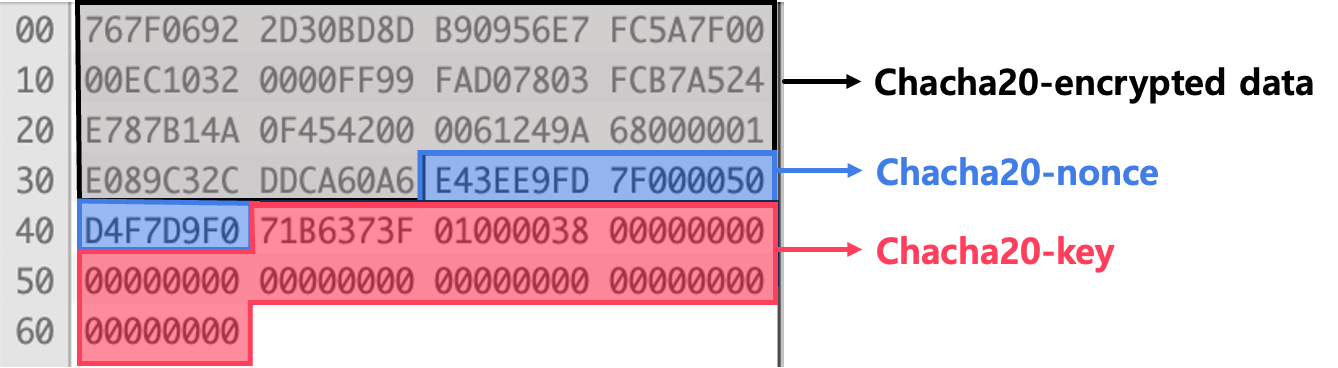
The key and nonce used for ChaCha20 encryption are derived from the pointer address of the buffer, resulting in nearly randomized keys. To ensure proper decryption on the attacker side, the nonce and key values are appended after the encrypted data, and the combined blob is then Base64-encoded. The counter is initialized to 0. The following figure illustrates how the encrypted data is structured after performing Base64 decoding.
Structure of the ChaCha20-encrypted data blob
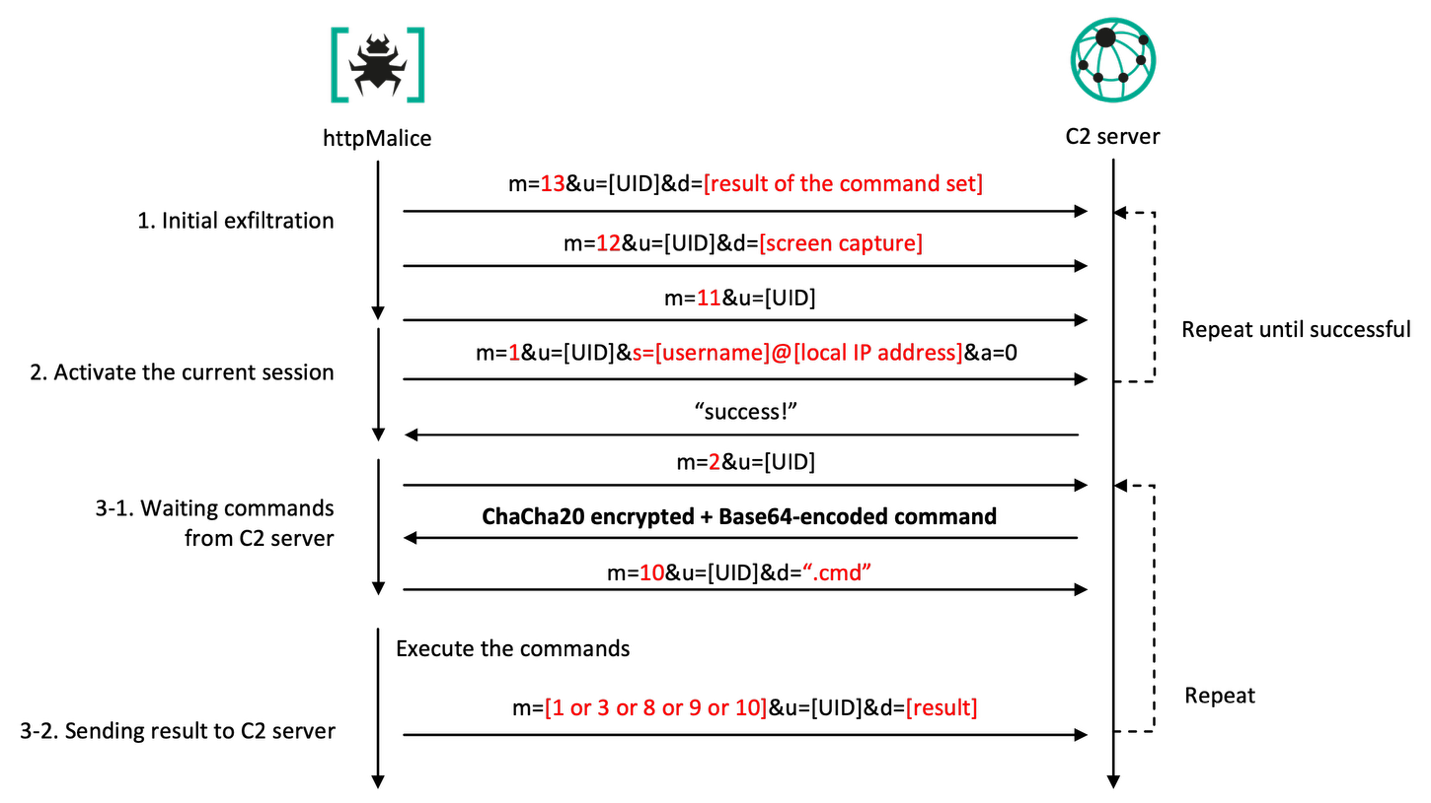
After sending the host profiling data, the backdoor continuously transmits a screen capture with mode 12 and a ping message with mode 11. Finally, it sends a session identifier, which is a combination of the current username and local IP address separated by an ‘@’ symbol. In this case, the mode is set to 1 and the a parameter (current state) is set to 0, indicating that the C2 operation has been activated. The following table provides other possible values of the a parameter:
Value Description 0 httpMalice has been activated 1 httpMalice has been inactivated (upon command 9) 2 httpMalice has been removed (upon command 8)The whole process from sending the host profile to the backdoor activation repeats every two minutes until the C2 server returns a “success!” message.
C2 communication sequence of httpMalice
When the backdoor receives the message from the C2 server, it creates two threads dedicated to processing commands and sending the current state, including the session identifier. The first thread receives a command from the C2 server. It requests a command by sending mode 2 and, if successful, immediately sends mode 10 along with the string “.cmd” in the d parameter.
The commands supported by httpMalice are as follows:
Command Description 0 Do nothing 1 Execute the command with EUC-KR encoding 2 Download and extract the file to the infected device 3 Upload a directory to the C2 server after it has been archived 5 Get the current directory 6 Set the current directory 7 Execute the command without setting a EUC-KR character set 8 Remove its persistence traces and exit the process 9 Hibernate 10 Execute the command using the provided session ID 12 Capture the screen 13 Load the downloaded payload into memory MemLoad downloads httpTroySince early 2025, we have observed several versions of MemLoad; specifically, MemLoad V2 emerged in March, and V3 appeared by September. The payload that began being deployed through the Reger Dropper this year has been identified as an updated variant of MemLoad, slightly modified from the V3 version (referred to internally as MemLoader.dll).
Kimsuky leverages MemLoad to evade detection of its final backdoor and to carefully assess the value of targeted systems through anti-VM checks and reconnaissance. Upon installation, it requests an additional payload from the C2 server, executing it reflectively in memory if deemed suitable. Notably, all versions of MemLoad V2 and later use the same RC4 key.
Below are the key operations of MemLoad:
- Creates a flag file. Creates a file containing a random eight-character string from the set 0123456789abcdefABCDEF with another random eight-character string as the name and “.dat.cfg” extension at the current file path.
- Generates an ID. Generates an ID value by adding either ‘A-‘ or ‘U-‘ to the beginning of the random bytes. The choice of symbol is determined by attempting to create a random file in the C:\Windows\system32 directory. If successful, the ID starts with ‘A-‘ (indicating administrative privileges); otherwise, it starts with ‘U-‘.
- Persistence via a scheduled task. Checks for the existence of the .dat.cfg file, and if confirmed, a scheduled task is set up for persistence. The task name is determined by whether the process is running with elevated privileges. If elevated, the task is named ChromeCheck, and the command schtasks /create /tn <task name> /tr "regsvr32 /s <current file path>" /sc minute /mo 1 /rl highest /f is executed. Otherwise, the task is named EdgeCheck, and the command schtasks /create /tn <task name> /tr "regsvr32 /s <current file path>" /sc minute /mo 1 /f is executed.
- C2 communication and payload download. Requests an additional payload from its C2 server, with the header Authorization: Bearer {ID} or X-Browser-Validation: {ID} for authentication. The ID is set to the previously generated ID value.
- Payload decryption and execution. Once the download is successful, the payload is decrypted using the RC4 algorithm with the key #RsfsetraW#@EsfesgsgAJOPj4eml;. The decrypted payload is then reflectively loaded into memory, and its hello export function is invoked.
The payload downloaded and executed by MemLoad is identified as the httpTroy backdoor. This backdoor serves as the primary role for long-term access and data exfiltration. Similar to MemLoad, it employs stealth techniques by creating a flag file and writing eight random bytes to it. However, in this case the file is created at [current file path]:HUI in the ADS (Alternative Data Stream) area. The backdoor then checks its privileges to determine if it is elevated and assigns an ID value in the format A-[random-8-chars] or U-[random-8-chars].
Since Gen Digital covers httpTroy’s features and functionality in detail elsewhere, we will not provide a thorough explanation here to avoid redundancy. Instead, we will simply note that it communicates with the C2 server at hxxps://file.bigcloud.n-e[.]kr/index.php.
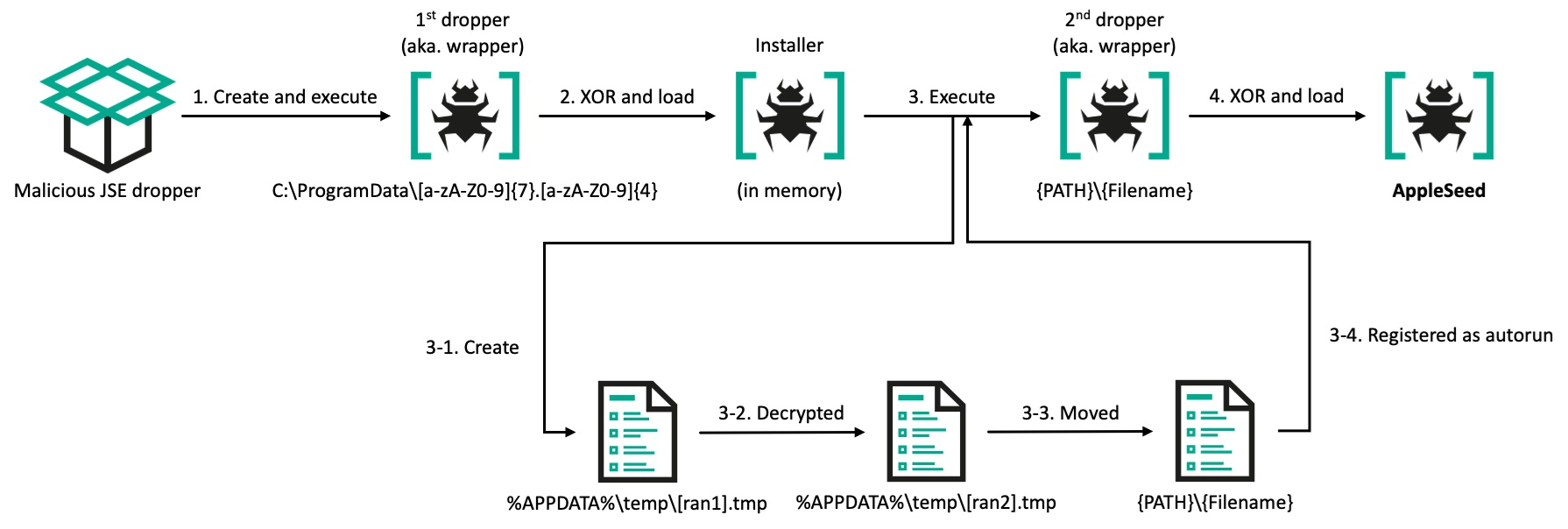
AppleSeedAppleSeed first appeared in 2019 and reached version 3.0. However, we now only see version 2.1. It originally consisted of two components: a dropper and the main AppleSeed. Since 2022, the updated AppleSeed chain has involved two droppers, an additional component referred to as the installer, and the main payload. It is mostly delivered through JSE Dropper.
Updated AppleSeed infection chain
There are two versions of the main AppleSeed: Dropper and Spy. The Dropper variant is responsible for downloading additional malware and executing commands received from its C2 server, while the Spy version gathers sensitive information such as documents, screenshots, keystrokes, and lists of USB drives. A notable change in version 2.1 is the inclusion, since 2022, of collecting the C:\GPKI directory – functionality that is also implemented in Troll Stealer. This directory contains a digital certificate used by the South Korean government to securely authenticate public officials and government systems.
HappyDoorHappyDoor, an AppleSeed-based backdoor malware disclosed by AhnLab in 2024, is less visible than AppleSeed. HappyDoor shares several features with AppleSeed, including the same string obfuscation algorithm, the data types it collects, and the use of RSA encryption. Given these similarities, we assess with medium confidence that HappyDoor is an advanced variant evolved from AppleSeed.
Post-exploitationWe observed interesting post-exploitation activities involving VSCode and DWAgent. All of the observed VSCode droppers used the same lure files as the PebbleDash malware cluster. While we are unsure of the exact reason for this strategy, we suspect that the actor prepared both PebbleDash and VSCode droppers in anticipation of the PebbleDash infection chain being detected by security products because of its backdoor capabilities. In contrast, the use of VSCode is designed to have fewer detection points.
VSCode (launched by the JSE dropper)Since last year, Kimsuky has been leveraging the legitimate Visual Studio Code Remote Tunneling feature to establish covert remote access to the victim’s device, bypassing detection designed for traditional malware-based C2 channels (first described by Darktrace researchers). In these attacks, instead of dropping malware, the JSE dropper downloads a legitimate Visual Studio Code (VSCode) CLI onto the infected device. The script establishes persistence by creating a tunnel via the application, with the tunnel name “bizeugene”, using the command below.
The Remote Tunneling feature in VSCode supports establishing a tunnel using either a Microsoft or GitHub account. When the code tunnel command is executed, the CLI initiates an authentication flow and returns a login URL along with a device code. The user must then navigate to the URL, enter the device code, and authenticate with their account. Once authentication is successful, the tunnel is created and the CLI outputs a URL for tunneling that enables browser-based access to the remote host.
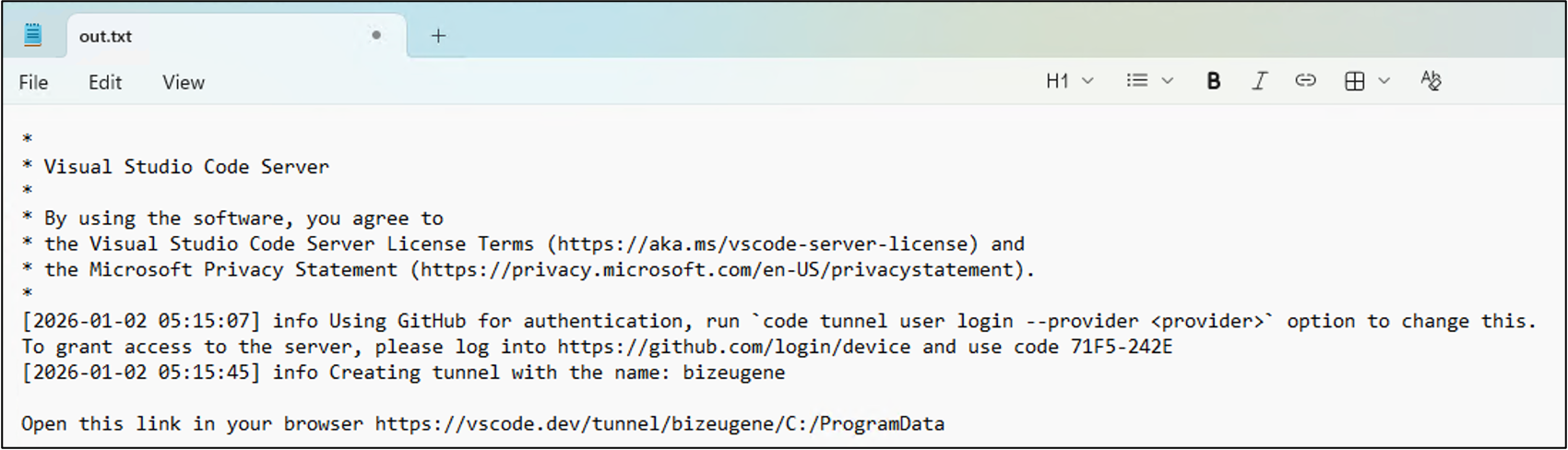
The GitHub authentication method is selected in this instance because GitHub is configured as the default provider in non-interactive execution contexts. By using echo |, the script injects a \r\n (Carriage Return and Line Feed) into the standard input stream, effectively confirming the default prompt selection without manual interaction. As a result, the CLI automatically initiates the GitHub authentication flow. Next, all CLI output that includes a login URL and a device code is saved to out.txt.
Out.txt content
The JScript code in the JSE dropper monitors the out.txt file for a URL that begins with hxxps://vscode[.]dev/tunnel. This URL contains the full address of the established tunnel. Once detected, the file content containing the URL and the device code is sent to a compromised legitimate South Korean website (hxxps://www.yespp.co[.]kr/common/include/code/out[.]php) using the HTTP POST method. The request contains the file contents in the application/x-www-form-urlencoded header data formatted as out=URLencoded{result of the command}&token=URLencoded{"bizeugene"}. After authentication is complete, the attacker can access the compromised host externally through a web browser by authenticating with their own GitHub account.
VSCode (launched by VSCode installer)While searching our telemetry for artifacts related to a different infection, we identified a new VSCode tunnel installer written in Go. A previous version of this installer was implemented using JScript and was limited to secure channels because of its reliance on a specific tunnel name. The new variant, named vscode_payload by the developer based on the embedded Go path, is fully operational and supports every tunnel on each targeted device. It includes features that are nearly identical to those of the previous version, such as downloading, unarchiving, and executing the VSCode CLI.
Number Installer type VSCode version Download source 1 Written in JScript VSCode CLI 1.106.3 hxxps://vscode.download.prss.microsoft[.]com/dbazure/download/stable/bf9252a2fb45be6893dd8870c0bf37e2e1766d61/vscode_cli_win32_x64_cli[.]zip 2 Written in Go VSCode CLI 1.106.2 hxxps://vscode.download.prss.microsoft[.]com/dbazure/download/stable/1e3c50d64110be466c0b4a45222e81d2c9352888/vscode_cli_win32_x64_cli[.]zipAfter the VSCode CLI file has been successfully downloaded, it is unzipped into the C:\Users\Public directory, and the extracted code.exe is executed with the tunnel command.
This is how the installer works:
- Executes code.exe tunnel.
- Searches for the “Microsoft Account” string in the stdout.
- Sends the 0x1B 0x5B 0x42 (Down Arrow) and 0x0A (Enter) escape sequence to the pseudo-terminal, which enables tunnel creation via a GitHub account.
- Searches for the “use code” string in the stdout.
- Sends the printed code for authentication, prepended with the “hxxps://github[.]com/login/device” => prefix. The attacker authorizes Visual Studio Code with the logged-in GitHub account using the printed code.
- Searches for the “What would you like to call this machine?” string in the stdout.
- Sends the 0x0A escape sequence to the pseudo-terminal to use the current machine name as the identifier.
- Searches for the “https://vscode.dev/tunnel/” string in the stdout.
- Sends the printed URL for tunneling to the Slack WebHook.
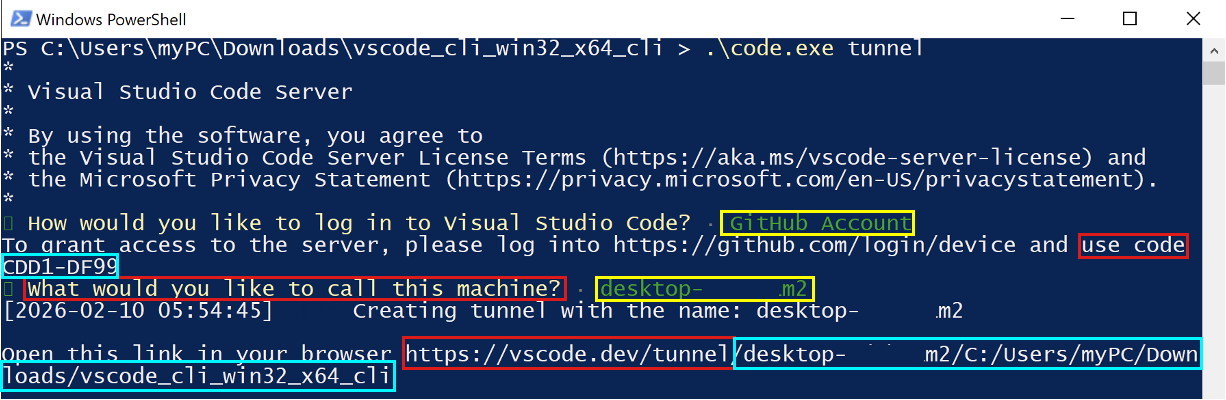
The following figure illustrates the sequence for creating a tunnel using the VSCode CLI. Red boxes highlight the strings that the installer searches for. Yellow boxes indicate standard input operations sent from the installer using escape sequences. Sky blue boxes represent the values that are necessary to create the tunnel on the attacker’s side. (The “Microsoft Account” string in the second step is not shown in this figure because the second “GitHub Account” was already selected during the process.)
Creating a tunnel using VSCode CLI
Once the process is complete, the attacker can access the targeted host through the tunnel on their remote machine using their GitHub account via a browser or VSCode. The targeted device then begins communicating with Microsoft-owned servers without the user realizing that the communication is from an attacker.
An interesting feature of this variant is that it sends debugging messages and necessary values to a Slack channel via a WebHook. Upon execution, it sends "+++ I am started +++", as well as a heartbeat message "~~~ I am alive ~~~" approximately every second during tunneling authentication.
DWAgentDWAgent is a remote administration tool that is frequently exploited by threat actors, including ransomware and APT groups, to easily access compromised endpoints with minimal risk of detection. Kimsuky is one of the threat actors that uses this tool in its operations.
We observed that the group delivered DWAgent in at least two ways. The first involved delivering a compressed file containing DWAgent, along with separate commands, to a host infected with httpMalice for installation. The second method involved creating a separate installer.
This installer is very similar to the Reger Dropper. It uses the same RC4 key and has a similar code structure. It includes an archived binary and a legitimate unrar.exe binary, both encrypted with RC4. When executed, the installer decrypts the archived binary and saves it as 1.zip in the C:\ProgramData directory. It also creates an unrar.exe file in the same location using the decrypted unrar.exe binary. The dropper then uses the command C:\programdata\unrar.exe x C:\programdata\1.zip C:\programdata\ to extract the contents of the ZIP file. Finally, it executes the commands necessary to install DWService as a service on the target host:
- c:\programdata\dwagent\native\dwagsvc.exe installService
- c:\programdata\dwagent\native\dwagsvc.exe startService
The compressed file contains a pre-packaged, ready-to-use DWAgent, as well as a predefined config file. The actor deployed the agent with a config.json file linked to their own account to covertly control the device. As a result, the remote session is immediately activated by the above command, granting the attacker control.
The predefined config file is as follows. Note that the servers are legitimate DWAgent relay servers.
{ "enabled": true, "key": "kDRNGmWGTMpjQmREgQzU", "listen_port": 7950, "nodes": [ { "id": "ND896147", "port": "443", "server": "node896147.dwservice[.]net" }, { "id": "ND828765", "port": "443", "server": "node828765.dwservice[.]net" }, { "id": "ND484265", "port": "443", "server": "node484265.dwservice[.]net" } ], "password": "eJwrynEqD0r294twTXLKCHWqDPLPCql0Kg/JDqpIdk4HAKYMCso=", "url_primary": "hxxps://www.dwservice[.]net/" } InfrastructureFor years, Kimsuky has relied heavily on the South Korea-based free domain hosting service 내도메인[.]한국 (pronounced as “naedomain[.]hankook) to mimic legitimate sites with domains like .p-e.kr, .o-r.kr, .n-e.kr, .r-e.kr, and .kro.kr. This service has been utilized to create C2 servers for PebbleDash and AppleSeed clusters, and the background infrastructures have been mostly resolved to the virtual private servers belonging to InterServer. It has also been noted that many other malicious actors have exploited this free domain hosting service, so it alone cannot be considered proof of a connection to Kimsuky.
The actor also occasionally exploits South Korean websites as C2 servers to evade network-IoC-based detection and increase the success rate of attacks. Furthermore, they actively leverage tunneling services such as Cloudflare Quick Tunnels, VSCode Tunneling, and Ngrok to hide their infrastructure. These traits are mostly observed across the PebbleDash cluster.
VictimsWe identified multiple infection logs uploaded to the Dropbox storage used for httpMalice’s C2 server. They were analyzed as having been stolen from infected systems across various organizations or individuals in South Korea. Notably, each victim’s folder contained a user.txt file with detailed information such as target details, the presence of something named “http” (possibly a backdoor, such as httpTroy or httpMalice), DWAgent existence, and relationships between infected devices and targets. While we could not verify the exact creation process of these files, they were likely created manually by attackers to manage victims using Korean words.
Below you can see an example of this type of file content. In this context, “장악” means “take over” and “있음” means “exists”.
[Target's name] [Description] [Infection date] 장악, http 있음, DWService 있음.While both clusters have mainly focused on targeting the private and public sectors in South Korea, the AppleSeed malware cluster shows more interest in government entities. The PebbleDash cluster has also shown particular interest in the defense sector worldwide.
AttributionOver the past few years, we have observed two clusters using overlapping distribution methods – JSE, EXE, SCR, and PIF droppers. The targets are also increasingly aligning. Furthermore, we noted that several samples from both malware clusters were signed with the same stolen certificate and used identical mutex patterns. These findings suggest that a single actor is likely controlling both clusters and has the capability to modify code as needed. This concept was also described in another research paper at the Virus Bulletin conference.
Since its emergence, AppleSeed has been linked to Kimsuky operations, with each variant showing ties to the group. Since 2021, PebbleDash has been found exclusively in Kimsuky attacks. Based on our analysis of targets, infrastructure, and malware characteristics, we assess with medium-high confidence that attacks associated with these malware families are conducted by Kimsuky-affiliated clusters.
These two clusters share technical links to the threat actor known as Ruby Sleet, one of the names Microsoft uses for Kimsuky activity. In previous reports, Mandiant also referred to these clusters as Cerium, but now they appear to consider them part of the broader APT43 designation – another name for Kimsuky.
ConclusionOur analysis shows that the actor retains access to the original source code of the malware clusters and the ability to modify it. Over time, malware undergoes updates and modifications, sometimes being repurposed or reused by other actors. Although analyzing malware may seem repetitive and time-consuming, understanding how these tools evolve helps us grasp the threat actor’s changing tactics.
Two clusters have overlapping target sectors that span the defense, military, government, medical, machinery, and energy industries. The AppleSeed cluster is shifting its focus to data exfiltration, and GPKI certificate extraction has become a signature capability. Meanwhile, the PebbleDash cluster demonstrates advanced remote control capabilities and an expanding set of targets.
Although AI may offer full automation for some attacks, many groups stick with the tools and strategies they have used for years. Structuring a fully automated attack is not trivial. Despite ongoing changes, we will continue to track advanced threat actors by comprehensively considering malware, initial vectors, targets, post-exploitation activities, and ultimate goals.
Indicators of compromise File hashesJSE Dropper
995a0a49ae4b244928b3f67e2bfd7a6e [별지 제8호서식] 개인정보(열람 정정삭제 처리정지) 요구서(개인정보 보호법 시행규칙).hwp.jse
52f1ff082e981cbdfd1f045c6021c63f 2026년 상반기 국내대학원 석사야간과정 위탁교육생 선발관련 서류.hwpx.jse
9fe43e08c8f446554340f972dac8a68c 2026년 상반기 국내대학원 석사야간과정 위탁교육생 선발관련 서류 (1).hwpx.jse
8e15c4d4f71bdd9dbc48cd2cabc87806 노현정님.pdf.jse
Reger Dropper
65fc9f06de5603e2c1af9b4f288bb22c security_20260126.scr
c19aeaedbbfc4e029f7e9bdface495b9 secu.scr
Pidoc Dropper
8983ffa6da23e0b99ccc58c17b9788c7 대국민서비스관리운영체계_현장점검_증적(초안).pif
AppleSeed (Dropper)
a7f0a18ac87e982d6f32f7a715e12532
f4465403f9693939fe9c439f0ab33610
5c373c2116ab4a615e622f577e22e9be
HappyDoor
d1ec20144c83bba921243e72c517da5e
MemLoad
58ac2f65e335922be3f60e57099dc8a3
f73ba062116ea9f37d072aa41c7f5108 jhsakqvv.dat
httpTroy
7e0825019d0de0c1c4a1673f94043ddb c:\programdata\config.db
httpMalice
08160acf08fccecde7b34090db18b321
94faed9af49c98a89c8acc55e97276c9
HelloDoor
c42ae004badddd3017adadbdd1421e00
VSCode Tunnel installer
9ca5f93a732f404bbb2cee848f5bbda0 xipbkmaw.exe
DWAgent installer
678fb1a87af525c33ba2492552d5c0e2
opedromos1.r-e[.]kr C2 of AppleSeed
morames.r-e[.]kr C2 of AppleSeed
load.ssangyongcne.o-r[.]kr C2 of MemLoad
load.yju.o-r[.]kr C2 of MemLoad
attach.docucloud.o-r[.]kr C2 of MemLoad
load.supershop.o-r[.]kr C2 of MemLoad
load.erasecloud.n-e[.]kr C2 of MemLoad
cms.spaceyou.o-r[.]kr C2 of HappyDoor
erp.spaceme.p-e[.]kr C2 of HappyDoor
file.bigcloud.n-e[.]kr C2 of httpTroy
load.auraria[.]org C2 of httpTroy
female-disorder-beta-metropolitan.trycloudflare[.]com C2 of HelloDoor
hxxps://www.pyrotech.co[.]kr/common/include/tech/default.php C2 of httpMalice
hxxp://newjo-imd[.]com/common/include/library/default.php C2 of httpMalice
hxxps://www.yespp.co[.]kr/common/include/code/out.php VSCode Tunneling using JScript
Kategorie: Hacking & Security, Viry a Červi
Dirty Frag gets a sequel as Fragnesia hands Linux attackers root-level access
Linux admins hoping Dirty Frag was a one-off horror from the kernel networking stack are about to have a considerably worse week. Researchers at Wiz have published an analysis of "Fragnesia," a Linux kernel local privilege escalation flaw discovered by William Bowling of the V12 security team that allows unprivileged users to gain root by corrupting page cache memory. The bug, tracked as CVE-2026-46300, has public proof-of-concept exploit code documented by V12 on GitHub that demonstrates the vulnerability being used against /usr/bin/su to spawn a root shell. According to Google-owned Wiz, the flaw sits in the Linux kernel's XFRM subsystem, specifically ESP-in-TCP processing tied to IPsec support. By carefully triggering the bug, attackers can modify protected file data in memory without changing the original files stored on disk. Wiz describes Fragnesia as part of the broader "Dirty Frag" bug family rather than a completely separate class of issue. Dirty Frag itself only surfaced days ago and was already attracting attention thanks to public exploit code, incomplete patch coverage, and unusually reliable privilege escalation. According to researcher Hyunwoo Kim, who uncovered Dirty Frag, "Fragnesia" emerged as an unintended side effect of patches shipped to fix the original Dirty Frag vulnerabilities, adding yet another entry to the long tradition of security fixes accidentally creating new security problems. As The Register previously reported, Dirty Frag followed hot on the heels of Copy Fail, another Linux kernel privilege escalation flaw that abused page cache handling to overwrite supposedly read-only files. Historically, local Linux privilege escalation bugs had a reputation for being unreliable, crash-prone, or fiddly enough that attackers needed good timing and a fair bit of luck to pull them off cleanly. Fragnesia looks different, as Wiz and V12 both say the exploit avoids race conditions entirely, making it far more predictable than older Linux root exploits like Dirty COW. That makes the bug much more useful after an initial compromise. An attacker who gains access to a system through phishing, stolen credentials, or a vulnerable cloud workload suddenly has a cleaner path to full root access. The V12 proof-of-concept repository is already public, while Linux vendors have started pushing out advisories and mitigation guidance. AlmaLinux warned that all supported releases are affected and urged administrators to patch quickly or disable unused ESP-related functionality where possible. Similar advisories have also been issued by Amazon Linux, CloudLinux, Debian, Gentoo, Red Hat Enterprise Linux, SUSE, and Ubuntu as distributors scramble to assess exposure across supported kernel versions. Microsoft also urged organizations to patch quickly, noting that though it had not observed in-the-wild exploitation so far, Fragnesia "can modify any file readable by the user, including [/]etc[/]passwd." The Linux networking stack is starting to look less like infrastructure and more like a root exploit vending machine. ®
Kategorie: Viry a Červi
To gain root access at this company, all an intruder had to do was ask nicely
PWNED Welcome once again to PWNED, the column where we help you prepare for security success by studying others’ embarrassing failures. Today’s terrible tale involves individuals trying to do right by a company executive by letting their guard down, never a smart move. Have a story about someone leaving a gaping hole in their network? Share it with us at [email protected]. Anonymity is available upon request. Our sad story comes from Brandon Dixon, who currently serves as CTO and co-founder of AI security firm Ent. In a prior life, however, Dixon was a penetration tester for hire and he saw some things that made all my remaining hairs stand on end just hearing about them. During one pentesting assignment, Dixon tried to find out how easy it would be to steal someone’s account using social engineering. The answer: barely an inconvenience. Dixon telephoned IT security and pretended that he was the head of security who had lost his password. When they asked him challenge questions, he said he had forgotten the answers to those also. Then he gave them the password he wanted to use over the phone and they did a reset for him. After that, he was able to get into the network and do whatever he wanted there. There’s so much that’s obviously wrong here that it’s hard to know where to begin with our lesson-taking. The IT support agents should not have taken Dixon’s word that he was the security manager, especially after he failed challenge questions, and should have denied his request to reset the password. They were probably thinking “this guy is an executive and we don’t want to piss him off” rather than “we have procedures that everyone must follow.” The other problem here is that the IT department entered Dixon’s suggested password for him over the phone. First of all, the IT department should have sent a password reset to the real employee’s email or phone number. Second of all, it’s piss-poor security for anyone to know a user’s password other than the user themselves. And I say this as someone who used to work for a company where, if you had a problem, the IT support people would ask for your password via chat. Dixon also shared another story about social engineering from a time when he consulted for a pharmaceutical company. Members of the competition would call sales and marketing reps, pretend they were coworkers, and then extract information about upcoming drugs. This would allow competitors to know what was coming and how to respond to it. To help solve the problem, Dixon instituted a system where real employees had to give a secret password at the beginning of a conversation. “I built a system called 'Chal-Resp,' short for 'challenge-response,' that generated work pairings so a user could validate they were speaking with an actual employee,” he told The Register. “The caller would need to say the word and the end-user would need to respond with the proper challenge; only employees had access.” What both of Dixon’s stories have in common is the proof that humans are eager to please and be helpful. But suspicion is the whole root of infosec, so it behooves us all to be a little less helpful to strangers in the workplace. ®
Kategorie: Viry a Červi
AI models are getting better at replacing cybersecurity pros on certain tasks
The UK AI Security Institute (AISI) has found that frontier models are quickly becoming more efficient when asked to do some cybersecurity work. AISI measures this with its "time window benchmark for cybersecurity," which estimates how much work an AI can do compared to a human. Using the benchmark could lead to findings such as Claude Sonnet 4.5 can do what a human cybersecurity expert can do in 16 minutes about 80 percent of the time, given a budget of 2.5m tokens. AISI has found the human-comparable task time – 16 minutes in this instance – is growing, fast. If tokens flowed freely instead of being arbitrarily capped, AI models might do better still. In February 2026, AISI internally reduced the expected task time doubling period from 8 to 4.7 months, based on progress made since late 2024. With the release of Anthropic Mythos Preview and OpenAI GPT-5.5, AISI has once again had to compress its projected doubling period. "In February 2026, we estimated that frontier models' 80 percent-reliability cyber time horizon had doubled every 4.7 months since reasoning models emerged in late 2024, given a 2.5M token limit," the AISI said in a post on Wednesday. "This was around half our November 2025 doubling time estimate, which was 8 months for both 50 percent and 80 percent reliability. Claude Mythos Preview and GPT-5.5 have since significantly outperformed this trend." The recalculated doubling time estimate, given what Mythos Preview and GPT-5.5 can do, is even shorter than 4.7 months. AISA does not cite a specific value but the organization points to similar time horizon estimates based on measurements of a broader skillset, software engineering, made by non-profit AI research house METR. "Their results imply a consistent doubling time of 4.2 months on software tasks since late 2024," AISI said, noting that with the latest Mythos Preview checkpoint (model update), it's closer to 4 months. Note that the time window benchmark is not a broad assessment of capabilities – AISI is not saying frontier models are becoming twice as capable by all measures. It's a narrow assessment based on the time it takes people to accomplish security tasks. Citing a different metric, AISI says the latest Mythos Preview checkpoint solved a 32-step simulated corporate network attack called "The Last Ones" in six of 10 attempts and managed to complete a previously unsolved challenge, a seven-step industrial control system attack called "Cooling Tower," in three of 10 attempts. As a point of comparison, when Opus 4.6 was evaluated in February 2026, it completed a maximum of 22 of 32 steps for The Last Ones. That model managed to reach milestone 6, which involves reverse-engineering a Windows service binary to access encrypted credentials, escalating privileges via token impersonation, and recovering a cryptographic key to access a command-and-control management service. "Frontier AI's autonomous cyber and software capability is advancing quickly: the length of cyber tasks that frontier models can complete autonomously has doubled on the order of months, not years," AISI concludes. "What this evidence does not tell us is how the pace of progress will evolve, when AI will reach any particular capability threshold, or how these capabilities will translate against defended, real-world systems." The curl project offers one data point with regard to the real world implications of the latest frontier models: Mythos managed to find just one confirmed vulnerability in its codebase. But watch this space. ®
Kategorie: Viry a Červi
Cisco to fire 4,000 staff and generously give them free training – on Cisco
Cisco will make around five percent of staff redundant and has generously offered them free Cisco training for a year once they’re gone. CEO Chuck Robbins broke the news in a Wednesday blog post titled “Our Path Forward” that opens “Today we announced our Q3 FY26 earnings with record revenue of $15.8 billion, up 12 percent year over year, and double-digit top and bottom-line growth. The ELT [executive leadership team] and I could not be prouder of the growth you have all delivered for Cisco.” That growth included net income growing 35 percent to $3.4 billion. Yet Robbins’ pride was not sufficient for all Cisco staff to keep their jobs. The CEO said the layoffs are necessary because “The companies that will win in the AI era will be those with focus, urgency, and the discipline to continuously shift investment toward the areas where demand and long-term value creation are strongest.” For Cisco that means “reducing roles in some areas” and also “making clear, strategic investments – particularly in silicon, optics, security, and in our employees’ use of AI across the company.” On Thursday, US time, close to 4,000 unlucky Cisco staff will be shown the door. Robbins said Cisco will help its soon-to-be-former workers find their next gig, and that the company’s efforts to do so have a 75 percent success rate. “We are also committed to continued personalized learning and will provide one year of access to all Cisco U courses and certifications, covering AI, Security, Networking, and more,” he added. Cisco made two big rounds of layoffs in 2024, one of which ejected seven percent of staff and the other resulted in Cisco firing five percent of employees. The restructures appear not to have slowed the company down: Robbins said product orders in Q3 rose 35 percent year over year – a figure that encapsulates a 105 percent year-over-year surge in revenue from hyperscalers and more modest 18 percent growth from other buyers. Robbins said Cisco has already scored $5.3 billion of AI infrastructure sales this year, and forecast full-year sales of $9 billion – 4.5 times its haul from last year. More prosaic products, like Wi-Fi kit, also grew fast as sales rose 40 percent. The company hopes to keep that cash flowing by building wireless kit that uses less memory. “You’ll see products that’ll become orderable in Q4 that’ll actually require 50 percent less memory,” Robbins said, with the design work to make that possible an example of the “20-plus programs that we’ve put into place that are active to reduce the memory utilization across the portfolio.” Cisco’s doing that despite the rising price of memory and storage not putting a dent in its margins, an outcome that execs attributed to supply chain management efforts. Glasswing to lift security sales Later in the earnings call, Robbins revealed that Cisco is participating in Anthropic’s Project Glasswing and using the Mythos model to test its code. The CEO said another impact of Anthropic’s bug-finding AI will be to accelerate plans to replace security appliances once other vendor’s use of Mythos finds flaw that are hard to fix. “I actually think while there will be a security opportunity, there’s going to most likely be a lot of focus from our customers on modernizing their infrastructure so that they don’t have this risk from technology that just can’t be patched,” Robbins said. Robbins said Cisco may have won an order or two from customers who were already close to replacing old security kit “and Mythos pushed them over the edge.” But he said Cisco didn’t receive “any meaningful orders in Q3 as a result of Mythos, but that could change in the future as we continue to work with customers.” ®
Kategorie: Viry a Červi
Welcome to the vulnpocalypse, as vendors use AI to find bugs and patches multiply like rabbits
The vulnpocalypse has begun. Palo Alto Networks usually finds five vulnerabilities a month, but on Wednesday said it scanned its entire codecase using the latest frontier models, including Anthropic’s Mythos, and found 75 security holes, covered in 26 CVEs. This comes a day after Microsoft said it used its new agentic bug hunting system called MDASH to find 17 vulnerabilities across its products - on a record-setting Patch Tuesday that saw Redmond disclose a whopping 30 critical CVEs. Plus, last week Mozilla said it fixed 423 Firefox bugs in April, which is more than five times higher than the 76 fixes issued in March and almost 20 times higher than its 21.5 monthly average last year. The browser maker previously said Mythos found 271 flaws in Firefox 150. It shouldn’t be all that shocking. Security vendors have long warned about attackers using AI, and how this means defenders need to operate at AI speed to protect their own networks and systems (aka buying their AI-infused products). Now that models have become really good at finding bugs in code, security shops are using AI to scan their own software, hopefully to uncover and fix flaws before the baddies do. And this trickles down to two things: more patches, and more work for admins. Zero Day Initiative’s chief vuln finder Dustin Childs agrees with this assessment. “At first, yes, this means more patches and thus more work for admins,” he told The Register. “The goal over time would be to eliminate as many as possible, and, over time, that monthly number goes down.” What will make this whole AI bug hunting season “really painful,” he continued, is if the patches don’t work or - worse yet - break things. “Many customers don’t trust patches as it is, so if AI-related patches break things, they are less likely to apply as time goes on,” Childs added. “This will be true even if AI only finds the bugs and doesn’t make the patches.” Bug hunting on steroids This isn’t to say security companies should avoid AI to find and fix flaws. “All vendors should use what tools they have to find and remediate bugs before they are exploited in the wild,” Childs said. “Ideally, they would find the bugs before they even ship, but I’m not holding my breath for that to happen.” Both Microsoft and Palo Alto Networks (PAN) are part of Anthropic’s Project Glasswing, which means they are among the select group of entities allowed to test Mythos, the much-hyped LLM, to find security holes in their own products. Palo Alto Networks began testing Mythos on April 7, and has since continued using the LLM and other frontier models, including Claude Opus 4.7 and OpenAI’s GPT-5.5-Cyber, according to Chief Product and Technology Officer Lee Klarich. “Today, we released our May ‘Patch Wednesday’ security advisories,” Klarich said in a Wednesday blog, adding that “this is the first time where the majority of findings were the result of frontier AI models scanning our code.” The LLMs scanned over 130 Palo Alto Networks products and platforms platforms, and as noted above found 75 issues, covered in 26 CVEs. None of these bugs are under exploitation, and as of Wednesday the company has fixed all bugs in its SaaS-delivered products and coded patches for all customer-operated products. Maybe 5 months before 'AI-driven exploits the new norm' “We intend to fix every vulnerability we find before advanced AI capabilities become widely available to adversaries,” Klarich said in his blog, adding that his company expects “a narrow three-to-five-month window for organizations to outpace the adversary before AI-driven exploits start to become the new norm.” A day earlier, Microsoft said its new multi-model agentic scanning harness (codename MDASH) helped researchers find 16 new vulnerabilities across the Windows networking and authentication stack, as disclosed in May’s Patch Tuesday event. This included four critical remote code execution flaws in components such as the Windows kernel TCP/IP stack and the IKEv2 service. “Unlike single-model approaches, the harness orchestrates more than 100 specialized AI agents across an ensemble of frontier and distilled models to discover, debate, and prove exploitable bugs end-to-end,” Microsoft VP of agentic security Taesoo Kim said in a Tuesday blog. Tom Gallagher, VP of engineering at Microsoft Security Response Center, admitted that “this month's release sits on the larger side of a hotpatch month.” Gallagher said he expects AI-assisted bug hunting to increase Patch Tuesday releases as both Microsoft and third-party researchers use these tools to boost vulnerability discovery. And yes, all of this ultimately means more patches and more work. More patches = more work “Finding bugs has always been the cheap end of the pipeline,” Luta CEO Katie Moussouris told The Register. “Triage, disclosure, building patches that do not break production, and getting customers to deploy them is the expensive end, and nobody has funded it for this volume.” Moussouris helped convince Redmond's top brass that Microsoft needed a bug bounty program in 2013, and three years later started her own bug bounty consultancy. She noted Palo Alto Networks’ staggering jump in CVEs this month. “Multiply that across every vendor and the bottleneck becomes admins and vulnerability management teams,” Moussouris said. And she also stressed that people should be using these new models to find vulnerabilities. “It is exactly what defenders should be doing,” Moussouris said. “Both PAN and Microsoft landed on the same answer: no single model catches everything. PAN ran Claude Mythos, Claude Opus 4.7, and GPT-5.5-Cyber because each finds bugs the others miss,” she added. “Microsoft orchestrates over 100 specialized agents across multiple models. Add threat intel and codebase context, and Microsoft rediscovered 96 percent of five years of confirmed bugs in a critical Windows component. The asymmetry is temporary, PAN puts adversary parity at three to five months, so any vendor not scanning their own code now is letting someone else find their bugs first.”®
Kategorie: Viry a Červi
AWS to Quick admins: The access control didn't work, but you weren't using it anyway, so what's the problem?
Most users put up with AWS the way you put up with the DMV. I say this with love, but it's hard to disagree that the UI is awful. The console is a UX time capsule if time capsules weren't allowed to ever look like other time capsules. The pricing pages were designed by someone who hates you personally, and you accept all of it because the one thing AWS has historically gotten right is the boring, important stuff. The security model. The IAM language no one likes, but everyone trusts. The boundary between your account and someone else's. Get that wrong, and the whole bargain collapses. So when Fog Security disclosed an authorization bypass in Amazon Quick on May 12 (that's the BI service formerly known as QuickSight, briefly known as Quick Suite, and now apparently just Quick, but check back next week) and AWS responded with a statement claiming "no customer data was at risk," it's fair to ask which definition of customer data they're using. Because it isn't an obvious one, and it certainly isn't mine. What Fog found Fog reports that when an Amazon Quick administrator (which is an absolutely devastating personal insult) uses "custom permissions" to explicitly deny access to AI Chat Agents, the UI correctly hides the feature. Great! Awesome! I sure wish to hell I could do that with S3 buckets to which I do not have access! Notably, there's no other way for an admin to do this - it's custom permissions or naught. The API, however, was perfectly willing to keep answering chat requests for any user in the account who knew how to send them. Fog's proof-of-concept was a non-admin asking the agent "Tell me about mangoes" from a session that was, on paper, locked out of the agent entirely. The agent told them about mangoes. AWS deployed the fix between March 11 and March 12, eight days after Fog reported it via HackerOne. So far, so coordinated. Seriously, for a company of this scale, that's underpants-outside-the-pants superhero speed. Good for you; gold star. What came next Where this gets uncomfortable is the response. AWS classified the severity as "none." It issued no customer notification. It published no advisory. After Fog disclosed the HackerOne report and published a blog post, AWS provided a statement to Fog Security reading, in full: "We appreciate Fog Security's coordinated disclosure. This issue was addressed in March 2026. No customer data was at risk and there is no customer action required. As always, customers can contact AWS Support with any questions or concerns about the security of their account." Take that sentence apart and see how much work "no customer data was at risk" is doing. Amazon Quick is described on its own product page as an AI assistant that "connects Slack, Microsoft Teams and Outlook, CRMs, databases, and documents in one place" and "grounds every answer in your real business data." The default chat agent, which is automatically and annoyingly provisioned the instant Quick is enabled whether the customer wants those AI features or not, is the front end for that data. It is the whole point of the front end for that data. Now consider the actual scenario AWS just patched. An administrator at, say, a regulated bank (an unregulated bank is called "a criminal enterprise that hasn't been caught yet") configures custom permissions denying chat agent access to a large group of users. Maybe those users are contractors. Maybe they're in a business unit that isn't cleared for AI tools. Maybe the bank's compliance posture flat-out prohibits shadow AI usage on top of internal data. Until two months ago, every one of those users could send an HTTP request directly to the agent endpoint and get a response. Fog asked about mangoes because they're a security firm doing a clean disclosure, not a malicious insider. A malicious insider would not have asked about mangoes. The question to AWS, with no rhetoric attached: In what sense was customer data not at risk? Either the chat agent doesn't actually have access to the data the product page says it does (in which case the marketing department has some serious splainin' to do) or unauthorized users could query an agent wired into customer data, in which case "customer data was at risk" is the correct English-language description of the situation. AWS clarifies, and says the quiet part out loud After this story started circulating, AWS offered a follow-up comment that I sincerely appreciate, because it's so much more honest than the first one. Per a hounded-looking AWS spokesperson: "The researcher was using the Admin Control capability that no customers were actively using when the server side validation was not present." Reading that twice doesn't help. Let me translate. AWS is saying: Yes, the server-side authorization check was missing. Yes, an authenticated user in your Quick account could bypass the only access control mechanism the service offers. The reason this is fine, apparently, is that no real customer had bothered to configure that access control during the window when it didn't work. Um ... what? The defense isn't "the bug wasn't real," which you could be forgiven for hearing in AWS's first statement. The defense also isn't "the bug couldn't have done what Fog says it could have done," which is the even stronger implication of their first statement. The defense is "the access control didn't enforce what we said it did, but luckily nobody was relying on it." This is the corporate-comms equivalent of "the lock on the front door didn't work, but nobody had locked it anyway, so why are you upset?" It's also a surprisingly specific telemetry claim. AWS is asserting that they know zero customers had configured custom permissions to deny chat agent access during the exposure window. That's a confident thing to say, and an even more interesting thing to volunteer as a defense, because it doubles as a withering review of Quick's access management model: the only knob the service provides for this purpose, the one AWS's own documentation explicitly tells administrators to use, has zero recorded uptake. The same follow-up also pointed back to the HackerOne thread to demonstrate that AWS told Fog throughout the disclosure window that "user-based authorization remained enforced." Translation: you needed authenticated credentials in the same Quick account to exploit this. Yes. That's intra-account scope, which Fog documented in their writeup, and which is precisely the scope in which custom permissions are supposed to function as a security boundary. AWS saying "user-based authorization was fine" is saying "you couldn't exploit this anonymously from the internet," which was never the threat model in question. The threat model is the contractor with valid SSO credentials whose admin tried to lock them out of some datasets. Why this matters more than it sounds Amazon Quick's access model is already an outlier: IAM policies don't govern Quick's AI Chat Agent, SCPs don't apply, and RCPs don't apply. Custom permissions are the only knob the service provides. If those don't enforce, nothing else does. And per AWS's own follow-up, literally nobody was using them anyway. Both halves of that sentence should be alarming, and AWS is offering them as reassurance. AWS's competitive moat for the last decade hasn't been pricing. It sure as poop hasn't been developer experience, documentation, console design, or the inscrutable poetry of service names. It's been the well-earned belief that AWS gets the foundational things right: boundaries, identity, durability, reliability, and the parts customers can't easily verify themselves. Customers have paid the AWS premium because they trusted the boring stuff. This year that trust is being tested in a way it hasn't been before. The 2025–2026 cadence of AWS security advisories has noticeably increased, for reasons that are as yet unclear. Coordinated disclosures from independent researchers keep surfacing missing authorization checks in newer, AI-adjacent services. The fixes are landing fast, which is good. The customer communication isn't landing at all, which is, charitably, a choice. A "severity: none" rating on a bypass of the only access control a service offers is not an objective security finding so much as it is a communication decision. And the communication decision now reads, with the benefit of AWS's follow-up: "We'll fix the bug, we won't tell you it existed, and if you ask we'll explain that you weren't using the feature anyway." AWS gets a lot of forgiveness on the small stuff because they own the big stuff. They might want to reconsider how much of the big stuff they keep classifying as "none." ®
Kategorie: Viry a Červi
Bug hunter tracks down three massive MCP flaws and one vendor won't fix theirs
Security vulnerabilities in MCP servers for three popular database projects could let attackers execute unintended SQL statements on Apache Doris, exfiltrate sensitive metadata from Alibaba RDS, and potentially take over Apache Pinot instances exposed to the internet. Alibaba, meanwhile, declined to patch its flaw. Apache issued a patch and a CVE tracker for Doris MCP, and there’s an open ticket in the MCP Pinot Github repository for the flaw, we're told. However, Alibaba decided not to patch the vulnerability in RDS MCP, according to Akamai security analyst Tomer Peled, who wrote about the flaws on Tuesday and will present his full research next month at x33fcon. MCP, or Model Context Protocol, is an open source protocol originally developed by Anthropic that allows LLMs, AI applications, and agents to connect to external data, systems, and one another. While security issues are never a good thing - and they are especially concerning when they exist in a server sitting between an AI agent and a production database, these in particular point to a larger problem in the way MCPs are developed. “There is missing or faulty security validation between the MCP server and its back end,” Peled wrote, adding that these security “gaps will become high-value targets for attackers and we expect more of these issues to surface.” Here’s a closer look at all three, starting with the flaw that has since been fixed and assigned a CVE. Apache Doris is a high-speed analytics and search database with more than 10,000 mid- and large-enterprise users. Its MCP server allows AI agents to interact with and perform operations on Doris instances. This includes SQL queries or retrieving table and schema metadata - and foreshadows the found flaw: CVE-2025-66335, a SQL injection vulnerability, that affects Apache Doris MCP Server versions earlier than 0.6.1. When an MCP tool is called, the server’s “exec_query” function fails to validate one of the five parameters (the db_name parameter) before constructing the SQL query. This means an attacker can invoke the function and inject malicious SQL through the db_name parameter, which gets prepended to the beginning of the final SQL statement. Plus, the SQL validator only checks the first portion of the query, so all it sees is the attacker’s directive. “As a result, any attacker that gains access to a client connected to the Doris MCP server can execute arbitrary commands on the victim’s Apache Doris instance,” Peled said. Apache issued a patch in December to fix this flaw. The second issue, an authentication validation bypass in Apache Pinot MCP, can also lead to SQL injection attacks and full database takeover. Apache Pinot is another super-fast analytics database, and StarTree’s MCP integration for Pinot before v2.0.0 allowed users to run queries directly from their AI agent against their Pinot instance. The open-source project uses HTTP as the transport layer without requiring any type of authentication. This exposes the endpoint to remote attackers who can reach it, allowing them to invoke MCP tools, including those used for SQL execution. “In environments where the MCP endpoint is reachable externally, this behavior allows unauthenticated attackers to execute queries against the Pinot instance, which can allow a full remote takeover of the database,” Peled wrote. StarTree has since added OAuth as an authentication option when using HTTP, which he says lowers the threat of SQL injection (but it still exists in the code), and Apache has also opened a security issue in the MCP Pinot github repository. Pinot MCP v1.1.0 and earlier versions are affected. Neither Apache nor StarTree responded to The Register’s requests for comment. The third security flaw, an information disclosure issue in the Alibaba RDS MCP server, also stems from the server not authenticating users before invoking the retrieval-augmented generation (RAG) MCP tool, which allows AI models to connect with and query databases. This means “any client able to reach the MCP endpoint can issue requests to the server without any query validation,” according to Peled. “The vector index may contain table names, schema definitions, or other potentially sensitive metadata, and unauthenticated attackers can exfiltrate this data with little or no effort." All versions of Alibaba RDS MCP are affected by this vuln. The bug hunter says that he reported the issue to Alibaba in November, and the cloud giant told him the issue is “not applicable” for a fix - so it’s still in the codebase. Akamai also reported this inaction to the CERT Coordination Center (CERT/CC). Alibaba did not respond to The Register’s inquiries. Peled said that the threat-hunting team, upon starting this investigation, assumed that there would be some baseline security specification for all MCP servers. Turns out they were wrong, and as the research found, flaws like SQL injection, missing authentication, and insufficient query validation exist in the code. “This means that more attention should be given not just to the specification but also to the best security practices guides when developing secure MCP servers,” he wrote.®
Kategorie: Viry a Červi
Mystery Microsoft bug leaker keeps the zero-days coming
The anonymous security researcher who has already maliciously exposed three Windows zero-days this year has revealed two more, dropping them just after Microsoft's monthly Patch Tuesday update. Nightmare-Eclipse, or Chaotic Eclipse, depending on which of their aliases you prefer, released details about YellowKey and GreenPlasma - respectively a BitLocker bypass and a privilege escalation flaw, handing SYSTEM access to attackers. Experts speaking to The Register warned that both vulnerabilities present serious security concerns, especially since Nightmare-Eclipse released substantial technical information about exploiting them. Nightmare-Eclipse described YellowKey as "one of the most insane discoveries I ever found." They provided the files, which have to be loaded onto a USB drive, and if the attacker completes the key sequence correctly, they are granted unrestricted shell access to a BitLocker-protected machine. When it comes to claims like these, we usually exercise some caution, as this bug requires physical access to a Windows PC. However, seeing that BitLocker acts as Windows' last line of defense for stolen devices, bypassing the technology grants thieves the ability to access encrypted files. Rik Ferguson, VP of security intelligence at Forescout, said: "If [the researcher's claim] holds up, a stolen laptop stops being a hardware problem and becomes a breach notification." Despite the physical access requirement, Gavin Knapp, cyber threat intelligence principal lead at Bridewell, told The Register that YellowKey remains "a huge security problem for organizations using BitLocker." Citing information shared in cyber threat intelligence circles, he added that YellowKey can be mitigated by implementing a BitLocker PIN and a BIOS password lock. Nightmare-Eclipse hinted at YellowKey also acting as a backdoor, allegedly injected by Microsoft, although the people we spoke to said this was impossible to verify based on the information available. The researcher also published partial exploit code for GreenPlasma, rather than a fully formed proof of concept exploit (PoC). Ferguson noted attackers need to take the code provided by the researcher and figure out how to weaponize it themselves, which is no small task: in its current state it triggers a UAC consent prompt in default Windows configurations, meaning a silent exploit remains a work in progress. Knapp warned that these kinds of privilege escalation flaws are often used by attackers after they gain an initial foothold in a victim's system. "These elevation of privilege vulnerabilities are often weaponized during post-exploitation to enable threat actors to discover and harvest credentials and data, before moving laterally to other systems, prior to end goals such as data theft and/or ransomware deployment," he said. "Currently, there is no known mitigation for GreenPlasma. It will be important to patch when Microsoft addresses the issue." Four, five… and more? YellowKey and GreenPlasma are the latest in a series of five Microsoft zero-day bugs the researcher has exposed this year. When Nightmare-Eclipse released BlueHammer (CVE-2026-32201, 6.5) - patched by Microsoft in April - they were described as a disgruntled researcher who has since been rumored to be a former Microsoft employee. According to their maiden blog post under the Chaotic Eclipse alias, the bug leak began after an alleged violation of trust. "I never wanted to reopen a blog and a new GitHub account to drop code," they wrote. "But someone violated our agreement and left me homeless with nothing. They knew this will happen and they still stabbed me in the back anyways, this is their decision not mine." In early April, the researcher leaked proof-of-concept code for Windows Defender exploits they called RedSun and UnDefend - another admin privilege escalation bug and denial-of-service flaw, respectively - as well as BlueHammer. Both RedSun and UnDefend remain unfixed, and according to Huntress, the proof-of-concept code released was quickly picked up and abused in real-world attacks. Ferguson described the exposure of YellowKey and GreenPlasma as the latest in an escalating, retaliatory campaign against Microsoft, and warned of more coming. "Prior releases include BlueHammer and RedSun, both of which attracted serious community attention and real forks," he said. "The same post linking yesterday's releases warns of another Patch Tuesday surprise and hints at future RCE disclosures. They claim to have a dead man's switch with more ready to go. This researcher has followed through on every prior threat." ®
Kategorie: Viry a Červi
Student Loan Breach Exposes 2.5M Records
2.5 million people were affected, in a breach that could spell more trouble down the line.
Kategorie: Viry a Červi
Watering Hole Attacks Push ScanBox Keylogger
Researchers uncover a watering hole attack likely carried out by APT TA423, which attempts to plant the ScanBox JavaScript-based reconnaissance tool.
Kategorie: Viry a Červi
Tentacles of ‘0ktapus’ Threat Group Victimize 130 Firms
Over 130 companies tangled in sprawling phishing campaign that spoofed a multi-factor authentication system.
Kategorie: Viry a Červi
Ransomware Attacks are on the Rise
Lockbit is by far this summer’s most prolific ransomware group, trailed by two offshoots of the Conti group.
Kategorie: Viry a Červi
Cybercriminals Are Selling Access to Chinese Surveillance Cameras
Tens of thousands of cameras have failed to patch a critical, 11-month-old CVE, leaving thousands of organizations exposed.
Kategorie: Viry a Červi