Agregátor RSS
Konec píchání do prstu se blíží. V MIT pracují na hodinkách, které změří hladinu cukru v krvi světlem
Neinvazivní metoda zjišťuje hladinu krevního cukru světlem • Optická technologie analyzuje tři konkrétní pásma pomocí Ramanovy spektroskopie • Sledování glukózy bez bolestivých vpichů brzy nabídnou běžné chytré hodinky
Kategorie: IT News
Tropic Trooper Uses Trojanized SumatraPDF and GitHub to Deploy AdaptixC2
Chinese-speaking individuals are the target of a new campaign that uses a trojanized version of SumatraPDF reader to deploy the AdaptixC2 Beacon post-exploitation agent and ultimately facilitate the abuse of Microsoft Visual Studio Code (VS Code) tunnels for remote access.
Zscaler ThreatLabz, which discovered the campaign last month, has attributed it with high confidence to Tropic Trooper (aka Ravie Lakshmananhttp://www.blogger.com/profile/[email protected]
Kategorie: Hacking & Security
Greece relaxes Euro biometric border entry rules amid airport chaos
Greece is taking a flexible approach to introducing the European Union's biometric Entry/Exit System (EES), after some British passport holders missed flights home following the system's implementation on 10 April. On 20 April, the Hellenic Police said it had started to fully deploy EES and Greece will use all necessary measures to manage traffic at border crossings in accordance with the regulations. The UK government updated its travel advice on the same day: "Greek authorities have indicated that they will not collect biometric data (fingerprints and photos) for UK travellers as part of EES" although passengers should "follow the advice of authorities on the ground". The Independent's travel correspondent Simon Calder said EES regulations allow flexibility to suspend biometric data collection at specific places for limited periods of time, yet the European Commission does not expect blanket exemptions for citizens of specific countries for extended periods. EES went live in October last year, causing launch-day queues at Prague's international airport. Many countries phased it in, but its use became compulsory on 10 April. Since then some Brits have missed flights due to border control delays caused by the system, including around 100 passengers due to take an Easyjet flight from Milan Linate to Manchester on 12 April and a smaller number trying to travel with Ryanair from Milan Bergamo to Manchester on 16 April. "The issues some passengers have experienced are unacceptable and so we continue to urge border authorities to ensure they make full and effective use of the permitted flexibilities for as long as needed, so our customers' travel plans are not impacted," Easyjet said in a statement. The airline will transfer passengers delayed by EES to other flights it provides for free, something it offered to a Register staffer and his family when they were delayed trying to fly from Paris to London Gatwick on 10 April. As replacement flights were not available until 15 days later, our vulture decided to catch a Eurostar instead. Airport operator group ACI Europe and Airlines for Europe, which includes Easyjet, Ryanair and British Airways parent company International Airlines Group, said some passengers have waited two to three hours due to the system. "Border control authorities must be allowed to fully suspend the EES when waiting times become excessive," said the heads of the two organizations. "This is essential not only in the coming weeks, but throughout the peak summer travel season." As of 10 April, the European Commission said that EES had registered more than 52 million entries and exits, refused entry to more than 27,000 individuals (about 0.1 percent of those trying to enter) and identified more than 700 as security risks. The EU has built a Travel to Europe app allowing those required to use EES to undertake some of the process in advance. However, so far only Sweden and Portugal are accepting its use. ®
Kategorie: Viry a Červi
Greece relaxes Euro biometric border entry rules amid airport chaos
Missed flights and more means something has got to give at the border
Greece is taking a flexible approach to introducing the European Union's biometric Entry/Exit System (EES), after some British passport holders missed flights home following the system's implementation on 10 April.…
Kategorie: Viry a Červi
Výborný batoh za 719 Kč. Voděodolný Kingsons s objemem 30 litrů pojme notebook i oblečení na dlouhý výlet
Kingsons Laptop Backpack 30L zlevnil o 20 % na 719 Kč. • Na dovolenou do něj dáte notebook, příslušenství i oblečení. • Je kvalitně vyrobený, může na palubu letadla, jen pozor na netradiční boční plnění.
Kategorie: IT News
UK gov pays public £550 to discuss Digital ID – then bans journalists from the room
Nothing says 'We want honest opinions' like a 36,000-letter mailshot with no awkward questions allowed
Members of the UK government’s People’s Panel on Digital ID will spend two weekends in Birmingham and three evenings on Zoom discussing how Britain should build a national digital identity system, earning £550 plus expenses for their trouble.…
Kategorie: Viry a Červi
PhantomRPC: A new privilege escalation technique in Windows RPC
Intro
Windows Interprocess Communication (IPC) is one of the most complex technologies within the Windows operating system. At the core of this ecosystem is the Remote Procedure Call (RPC) mechanism, which can function as a standalone communication channel or as the underlying transport layer for more advanced interprocess communication technologies. Because of its complexity and widespread use, RPC has historically been a rich source of security issues. Over the years, researchers have identified numerous vulnerabilities in services that rely on RPC, ranging from local privilege escalation to full remote code execution.
In this research, I present a new vulnerability in the RPC architecture that enables a novel local privilege escalation technique likely in all Windows versions. This technique enables processes with impersonation privileges to elevate their permissions to SYSTEM level. Although this vulnerability differs fundamentally from the “Potato” exploit family, Microsoft has not issued a patch despite proper disclosure.
I will demonstrate five different exploitation paths that show how privileges can be escalated from various local or network service contexts to SYSTEM or high-privileged users. Some techniques rely on coercion, some require user interaction and some take advantage of background services. As this issue stems from an architectural weakness, the number of potential attack vectors is effectively unlimited; any new process or service that depends on RPC could introduce another possible escalation path. For this reason, I also outline a methodology for identifying such opportunities.
Finally, I examine possible detection strategies, as well as defensive approaches that can help mitigate such attacks.
Microsoft RPC (Remote Procedure Call) is a Windows technology that enables communication between two processes. It enables one process to invoke functions that are implemented in another process, even though they are running in different execution contexts.
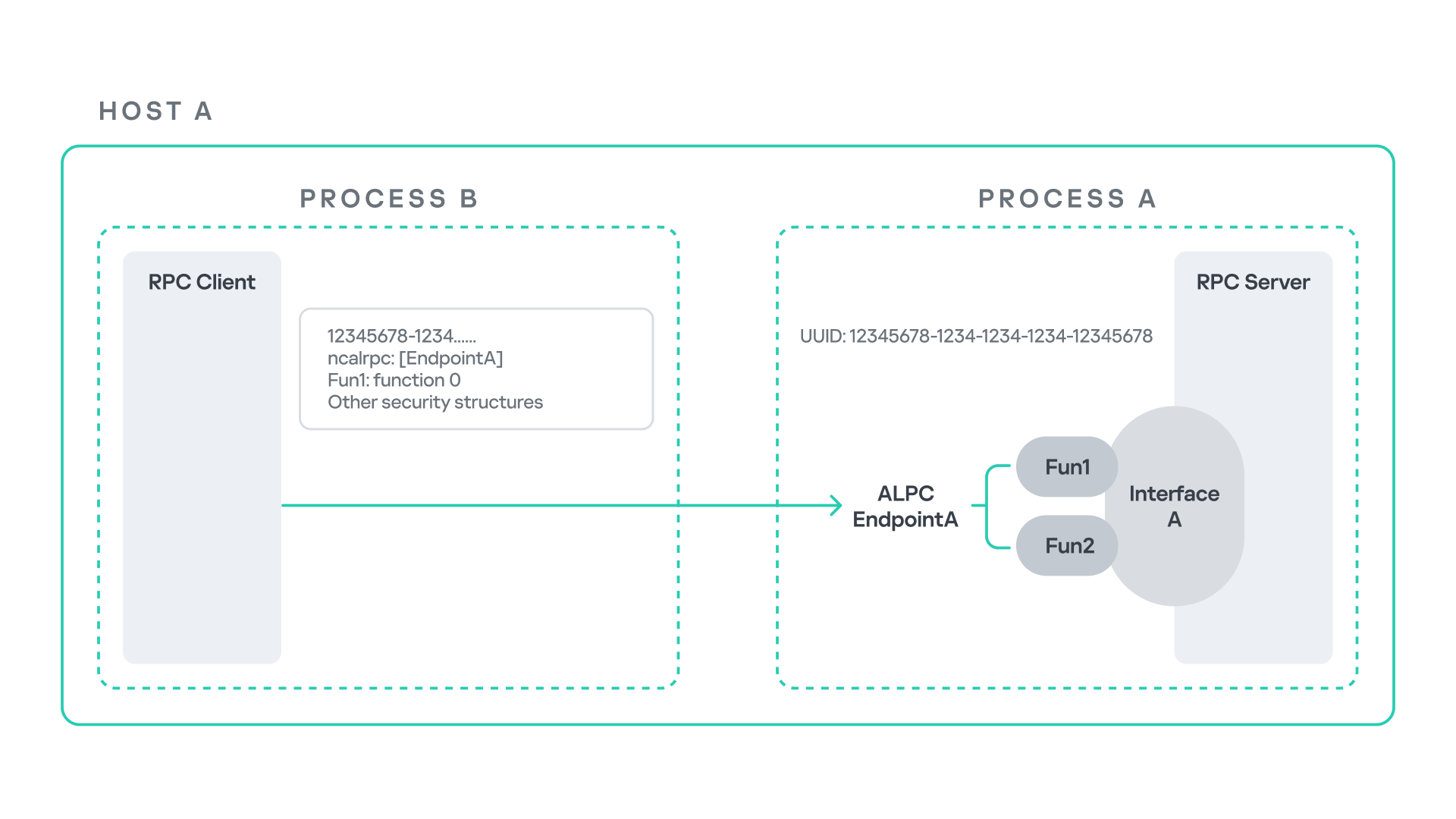
The figure below illustrates this mechanism.
Let us assume that Host A is running two processes: Process A and Process B. Process B needs to execute a function that resides inside Process A. To enable this type of interaction, Windows provides the Remote Procedure Call (RPC) architecture, which follows a client–server model. In this model, Process A acts as the RPC server, exposing its functionality through an interface, in our example, Interface A. Each RPC interface is uniquely identified by a Universally Unique Identifier (UUID), which is represented as a 128-bit value. This identifier enables the operating system to distinguish one interface from another.
The interface defines a set of functions that can be invoked remotely by the RPC client implemented in Process B. In our example, the interface exposes two functions: Fun1 and Fun2.
To communicate with the server, the RPC client must establish a connection through a communication endpoint. An endpoint represents the access point that enables transport between the client and the server. Because RPC supports multiple transport mechanisms, different endpoint types may exist, depending on the underlying transport.
For example:
- When TCP is used as the transport layer, the endpoint is a TCP port.
- When SMB is used, communication occurs through a named pipe.
- When ALPC is used, the endpoint is an ALPC port.
Each transport mechanism is associated with a specific RPC protocol sequence. For instance:
- ncacn_ip_tcp is used for RPC over TCP.
- ncacn_np is used for RPC over named pipes.
- ncalrpc is used for RPC over ALPC.
In this research, I focus specifically on Advanced Local Procedure Call (ALPC) as the RPC transport mechanism. ALPC is a Windows interprocess communication mechanism that predates MSRPC. Today, RPC can leverage ALPC as an efficient transport layer for communication between processes located on the same machine.
For simplicity, an ALPC port can be thought of as a communication channel similar to a file, where processes can send messages by writing to it, and receive messages by reading from it.
When the client wants to invoke a remote function, for example, Fun1, it must construct an RPC request. This request includes several important pieces of information, such as the interface UUID, the protocol sequence, the endpoint, and the function identifier. In RPC, functions are not referenced by name, but by a numerical identifier called the operation number (OPNUM). Depending on the requirements of the call, the request may also contain additional structures, such as security-related information.
Impersonation in WindowsIn Windows, impersonation enables a service to temporarily operate using another user’s security context. For example, a service may need to open a file that belongs to a user while performing a specific operation. By impersonating the calling user, the system allows the service to access that file, even if the service itself would not normally have permission to do so. You can read more about impersonation in James Forshaw’s book Windows Security Internals.
This research focuses specifically on RPC impersonation. Instead of describing the interaction as a service and a user, I refer to the participants as a client and a server. In this model, the RPC server may temporarily adopt the identity of the client that initiated the request.
To perform this operation, the RPC server can call the RpcImpersonateClient API, which causes the server thread to execute under the client’s security context.
However, in some situations, a client may not want the server to be able to impersonate its identity. To control this behavior, Windows introduces the concept of an impersonation level. This defines how much authority the client grants the server to act on its behalf.
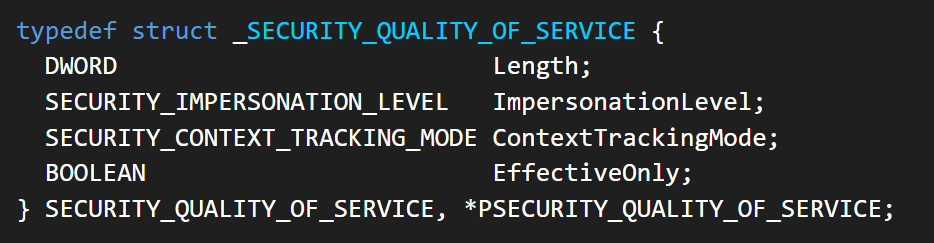
These settings are defined as part of the Security Quality of Service (SQOS) parameters, specified using the SECURITY_QUALITY_OF_SERVICE structure.
As you can see, this structure contains the impersonation level field, which determines the extent to which the server can assume the client’s identity.
Impersonation levels range from Anonymous, where the server cannot impersonate the client at all, to Impersonate and Delegate, which allow the server to act fully on behalf of the client.
At the same time, not every server process is allowed to impersonate a client. If any process could perform impersonation freely, it would pose a serious security risk. To prevent this, Windows requires the server process to possess a specific privilege called SeImpersonatePrivilege. Only processes with this privilege can successfully impersonate a client.
This privilege is granted by default to certain service accounts, such as Local Service and Network Service.
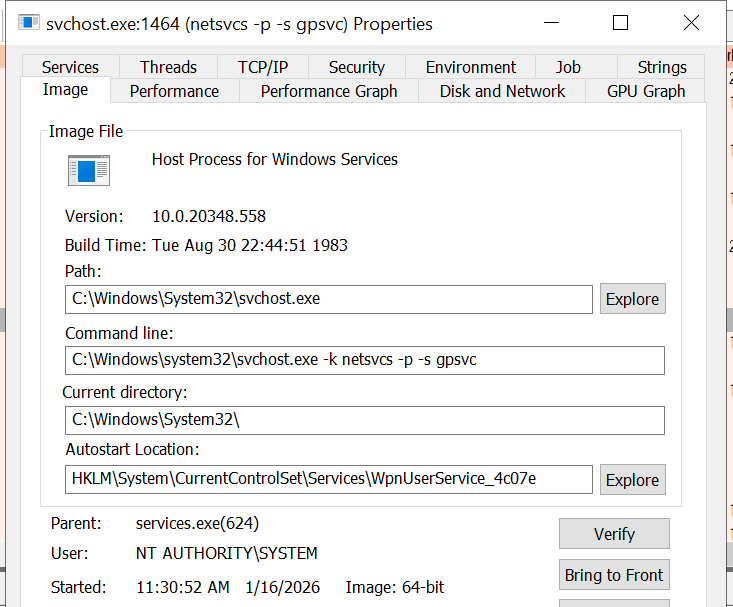
Interaction between Group Policy service and TermServiceThe Group Policy Client service (gpsvc) is a core Windows service responsible for applying and enforcing group policy settings on a system. It runs under the SYSTEM account inside svchost.exe.
When a group policy update is triggered, Windows uses an executable called gpupdate.exe. This tool can be executed with the /force flag to force an immediate refresh of all group policy settings. Internally, this executable communicates with the Group Policy service, which coordinates the update process.
At a certain stage during this operation, the Group Policy service attempts to communicate with TermService (Terminal Service, the Remote Desktop Services service) using RPC.
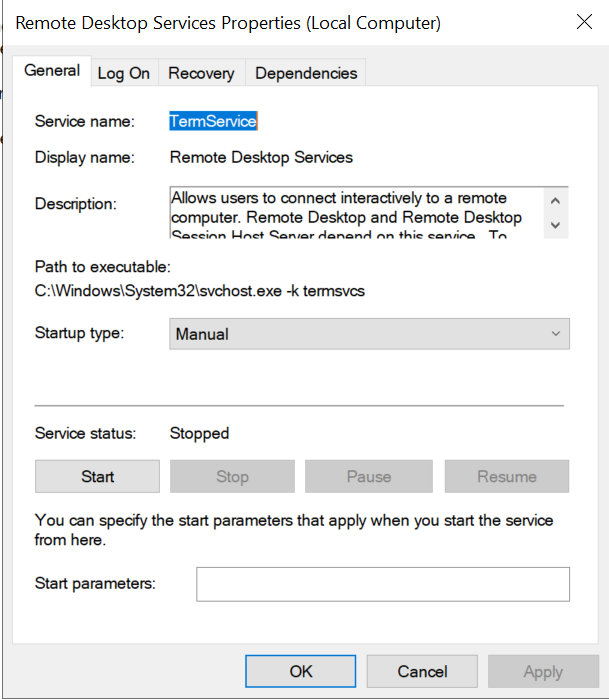
TermService is responsible for providing remote desktop functionality. This service is not running by default and can be enabled manually by the administrator via activation of Remote Desktop access. When this happens, the service exposes an RPC server with multiple interfaces and endpoints. TermService runs under the NT AUTHORITY\Network Service account.
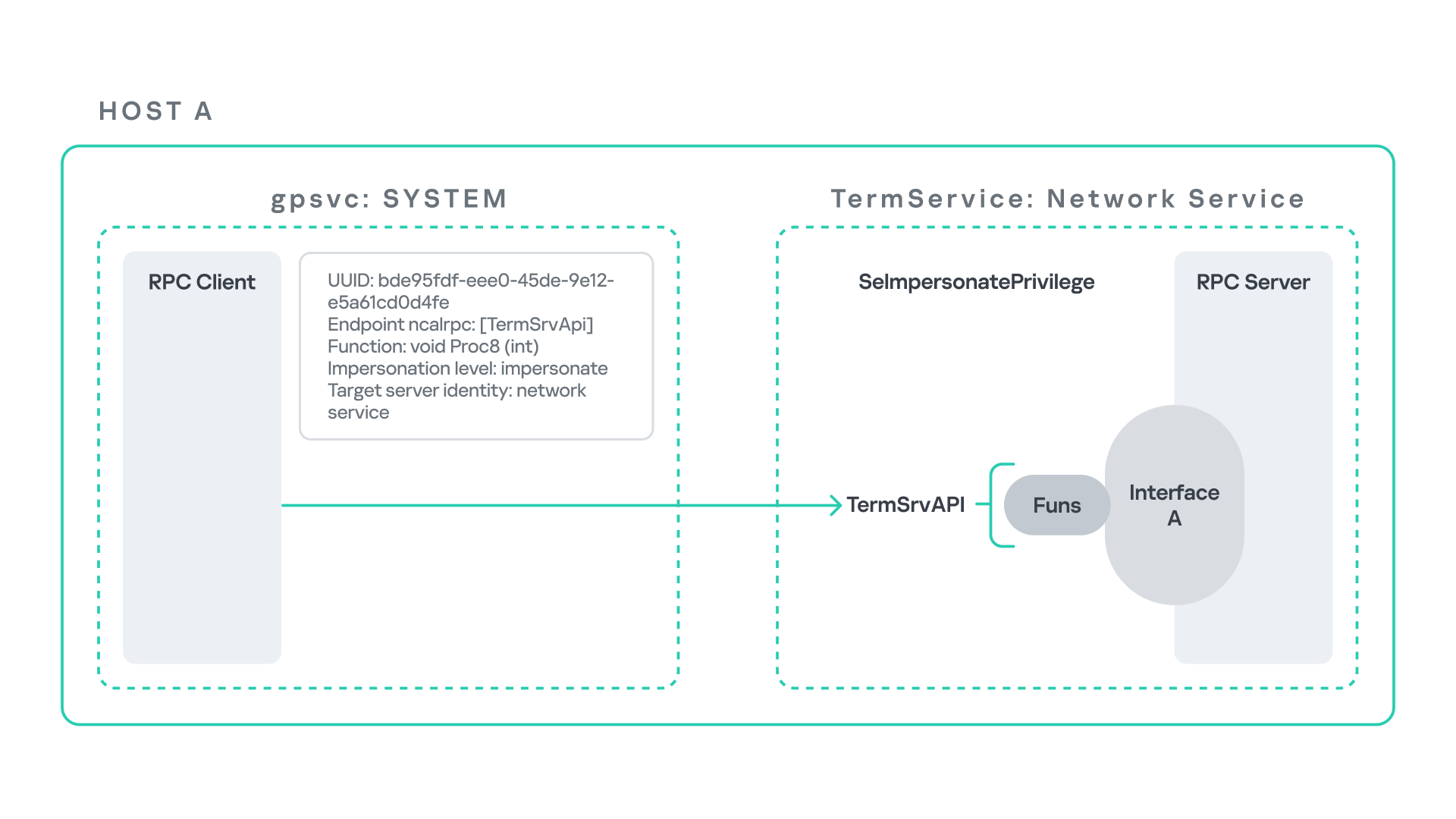
When the command gpupdate /force is executed, the Group Policy service performs an RPC call to the TermService using the following parameters:
- UUID: bde95fdf-eee0-45de-9e12-e5a61cd0d4fe.
- Endpoint: ncalrpc:[TermSrvApi].
- Function: void Proc8(int).
However, because TermService is disabled by default, the RPC call fails and an exception occurs in rpcrt4.dll (the RPC runtime). The returned error is:
- 0x800706BA (RPC_S_SERVER_UNAVAILABLE, 1722).
This error indicates that the RPC client could not reach the target server.
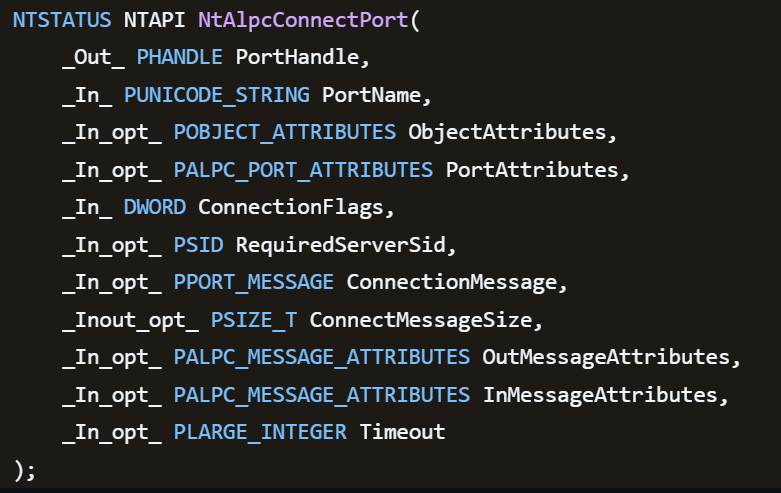
Tracing the failure path further reveals that the root cause originates from a call to NtAlpcConnectPort, which is used by RPC to establish an ALPC connection between processes.
The NtAlpcConnectPort function is responsible for connecting to a specific ALPC port and returning a handle that the client can use for further communication. This function accepts multiple parameters.
The first two parameters include:
- A pointer to the returned port handle.
- The ALPC port name, represented as an ASCII string.
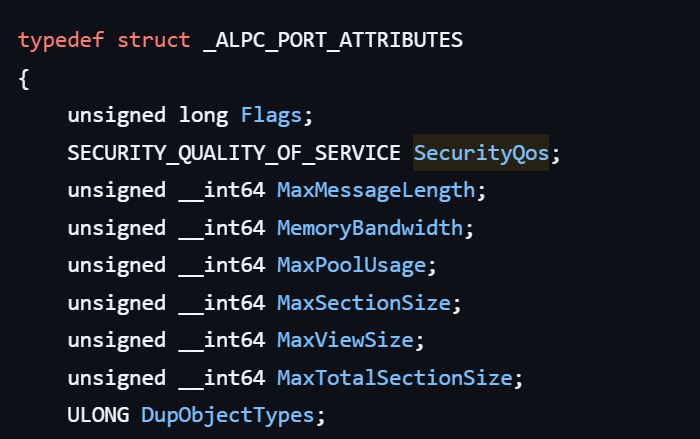
Another important argument is PortAttributes, which is an ALPC_PORT_ATTRIBUTES structure. Inside this structure is the SECURITY_QUALITY_OF_SERVICE structure, which, as mentioned above, defines the impersonation level used for the connection.
The final parameter of interest is RequiredServerSid, which specifies the expected identity of the target server process. This identity is represented using a Security Identifier (SID) structure.
Inspecting this call reveals that the Group Policy service attempts to connect to the RPC server using an impersonation level of Impersonate, expecting the remote server to run under the Network Service account. This behavior makes sense because TermService normally runs under Network Service.
Based on all the information above, the following scheme can be created to illustrate the interaction between TermService and gpsvc.
Up to this point, nothing unusual has occurred. An RPC client attempts to connect to an RPC server that is unavailable, resulting in an exception handled by the RPC runtime.
However, an interesting question arises: What if an attacker compromises a service that runs under the Network Service identity and mimics the exact RPC server exposed by TermService?
Could the attacker deploy a fake RPC server with the same endpoint?
If so, would the RPC runtime allow the client to connect to this illegitimate server?
And if the connection is successful, how could an attacker leverage this behavior?
Coercing the Group Policy serviceTo better understand the implications of the previously described behavior, let us consider the following attack scenario.
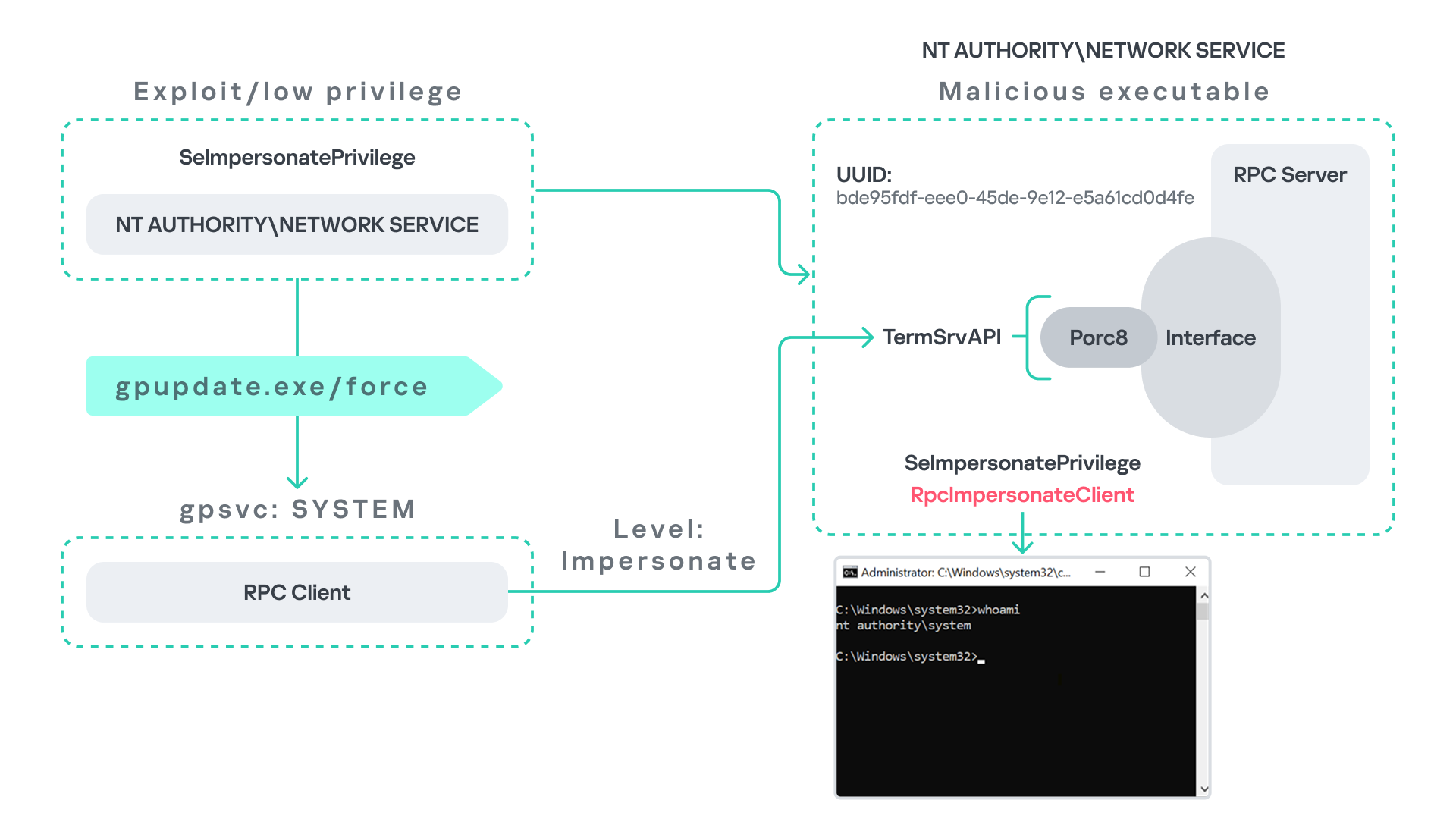
Imagine an attacker has compromised a service running on the system under the Network Service account, for example, an IIS server operating under the Network Service account. With this level of access, the attacker can deploy a malicious RPC server.
The attacker’s RPC server is designed to mimic the RPC interface exposed by the Remote Desktop service (TermService). Specifically, it implements the same RPC interface UUID and exposes the same endpoint name: TermSrvApi. Once deployed, the malicious server listens for RPC requests that would normally be directed to the legitimate RDP service.
Next, the attacker coerces the Group Policy service by triggering a policy update using gpupdate.exe /force. This causes the Group Policy Client service, which runs under the SYSTEM account, to perform the previously described RPC call. As observed earlier, this RPC call uses a high impersonation level (Impersonate).
When the attacker’s fake RPC server receives the request, it calls RpcImpersonateClient. This enables the server thread to impersonate the security context of the calling client, which, in this case, is SYSTEM.
As a result, the attacker can elevate privileges from Network Service to SYSTEM. In our proof-of-concept implementation, the exploit demonstrates privilege escalation by spawning a SYSTEM-level command prompt.
When this attack scenario was first discussed, it was purely theoretical. However, after implementing the malicious RPC server, the experiment confirmed that Windows allowed the server to be deployed and started successfully, and that the RPC runtime permitted the client to connect to the malicious endpoint. This made it possible to reliably escalate privileges from Network Service to SYSTEM using this technique. For this attack to succeed, though, at least one group policy must be applied on the system.
RPC architecture flowFurther investigation revealed that many Windows services attempt to communicate with TermService using RPC. These RPC calls often originate from winsta.dll, which acts as the RPC client component.
Windows processes invoke APIs exposed by winsta.dll; these APIs rely internally on RPC communication with TermService. This pattern is common in Windows; many system DLLs use RPC behind the scenes when their exported APIs are called.
However, it appears that the RPC runtime (rpcrt4.dll) does not provide a mechanism to verify the legitimacy of RPC servers. Moreover, Windows allows another process to deploy an RPC server that exposes the same endpoint as a legitimate service.
As a result, this architectural design introduces a large attack surface because RPC is heavily used across numerous system DLLs. Applications that invoke seemingly benign APIs may unintentionally trigger privileged RPC interactions. Under certain conditions, these interactions could be abused to achieve local privilege escalation without the user’s knowledge.
Identifying RPC calls to unavailable serversAs the issue appears to stem from an architectural weakness, a systematic approach is needed to identify RPC clients attempting to communicate with servers that are unavailable. First, I need a platform capable of monitoring RPC activity and extracting relevant information from each RPC request.
Specifically, I need to capture key RPC metadata, including:
- Interface UUID, endpoint, and OPNUM.
- Impersonation level and RPC status code.
- Client process privilege level, process name, and module path.
This information is critical because it enables me to reconstruct the RPC interaction, mimic the expected RPC server, and determine how the call is triggered.
The platform that provides this capability is Event Tracing for Windows (ETW). ETW is a built-in Windows logging framework that captures both kernel-mode and user-mode events in real time.
Windows provides a tool called logman to collect ETW data. It enables us to create trace sessions, select event providers, and configure the verbosity level of the tracing process. The collected tracing data is stored in an .etl file, which can later be analyzed using tools such as Event Viewer or other ETW analysis utilities.
ETW provides deep visibility into RPC activity without requiring modifications to applications. Through ETW, it is possible to capture detailed RPC information, such as:
- RPC bindings
- Endpoints
- Interface UUIDs
- Authentication details
- Call flow and timing
- RPC status codes
However, I’m not interested in every RPC event. My focus is on RPC call failures, specifically those that return the status RPC_S_SERVER_UNAVAILABLE.
For an event to be relevant to this research, the exception must meet two conditions:
- It must originate from a high-privileged process because impersonating such a process may allow an attacker to escalate privileges to a more powerful security context.
- The RPC call must use a high impersonation level, enabling the server to fully impersonate the client once the connection is established.
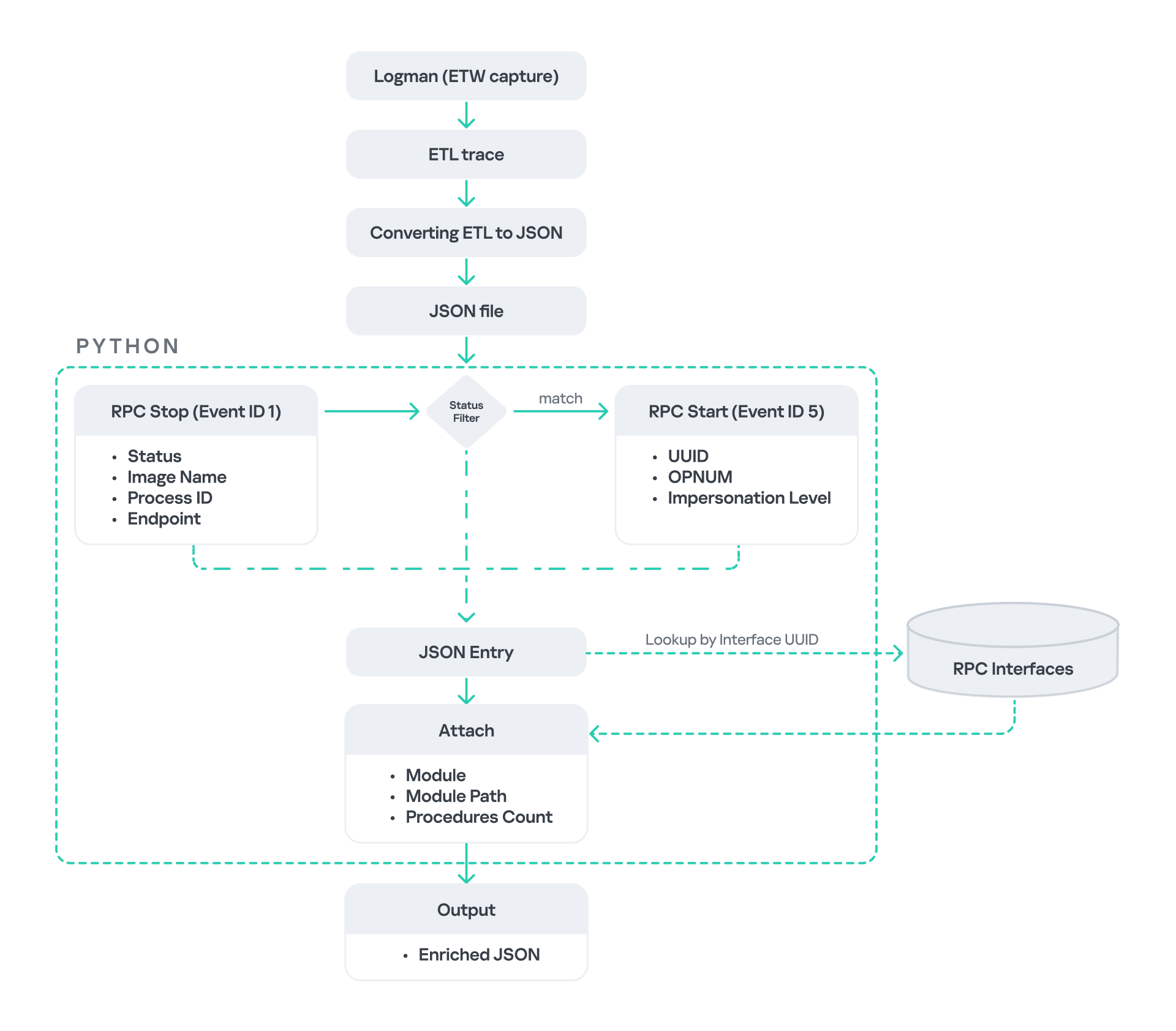
I cannot rely solely on the raw ETW output to implement this framework because it contains thousands of events, making manual filtering with standard tools inefficient. Therefore, I need to automate this process. The workflow shown below enables me to efficiently filter and extract only those events that are relevant to this analysis.
After generating the logs as an .etl file, I convert them to JSON format using tools such as etw2json. JSON is a much easier format to process programmatically. In this case, I use a Python script to filter and extract the relevant information.
The filtering process begins with a search for Event ID 1, which corresponds to an RPC stop event. This event indicates that the RPC client has completed the call and the result is available. From this event, I can extract useful information, such as:
- Status code
- Client process name
- Client process ID
- Endpoint
After extracting the status code, I filter for the specific value RPC_S_SERVER_UNAVAILABLE, which indicates that the target server was unreachable during an RPC call. These events represent the scenarios that are of interest.
However, Event ID 1 does not contain all of the required RPC metadata. To obtain the missing information, it is correlated with Event ID 5, which represents the RPC start event. This event is generated when the client initiates the RPC call.
By matching the metadata between Event ID 1 and Event ID 5, I can recover the missing details, including:
- Interface UUID
- OPNUM
- Impersonation level
After correlating and filtering these events, a JSON entry is obtained that is almost ready for analysis. At this stage, the data can be enriched further by adding context that will be helpful when reversing or analyzing the RPC server implementation. For example, the following can be identified:
- The DLL where the RPC interface is implemented
- The location of that DLL
- The number of procedures exposed by the interface
To retrieve this information, I match the UUID with an external RPC interface database. In this case, I used the RPC database, which contains a comprehensive list of RPC interfaces and their corresponding DLL implementations.
At the end of this process, a complete JSON dataset is obtained that can be used for further analysis.
One important observation is that the RPC calls I am looking for may only occur when specific system actions are triggered. Additionally, the resulting exceptions may vary from one system to another depending on which services are enabled or disabled. Therefore, I need a reliable way to generate these RPC exceptions.
In this research, I used several approaches to trigger such events:
- Monitoring RPC activity during system startup
I observed RPC activity while the system booted. During startup, many services initialize and perform various RPC calls, which increases the chances of capturing calls to unavailable servers. - Triggering administrative operations
I developed PowerShell scripts that perform common administrative tasks, such as updating Group Policy, changing network settings, or creating new users. These operations often trigger RPC communication and may generate exceptions. - Disabling services intentionally
After observing that Remote Desktop was disabled by default, I extended this idea by disabling additional services one by one and repeating the previous steps. This approach can reveal RPC clients that attempt to connect to services that are no longer available.
After running the logging and monitoring framework described earlier, I identified four additional scenarios that can lead to privilege escalation. The following sections introduce each case and explain how escalation can be achieved.
User interaction: From Edge to RDPMicrosoft Edge (msedge.exe) comes preinstalled on Windows systems. During startup, Edge triggers an RPC call to TermService. This RPC call is performed with a high impersonation level.
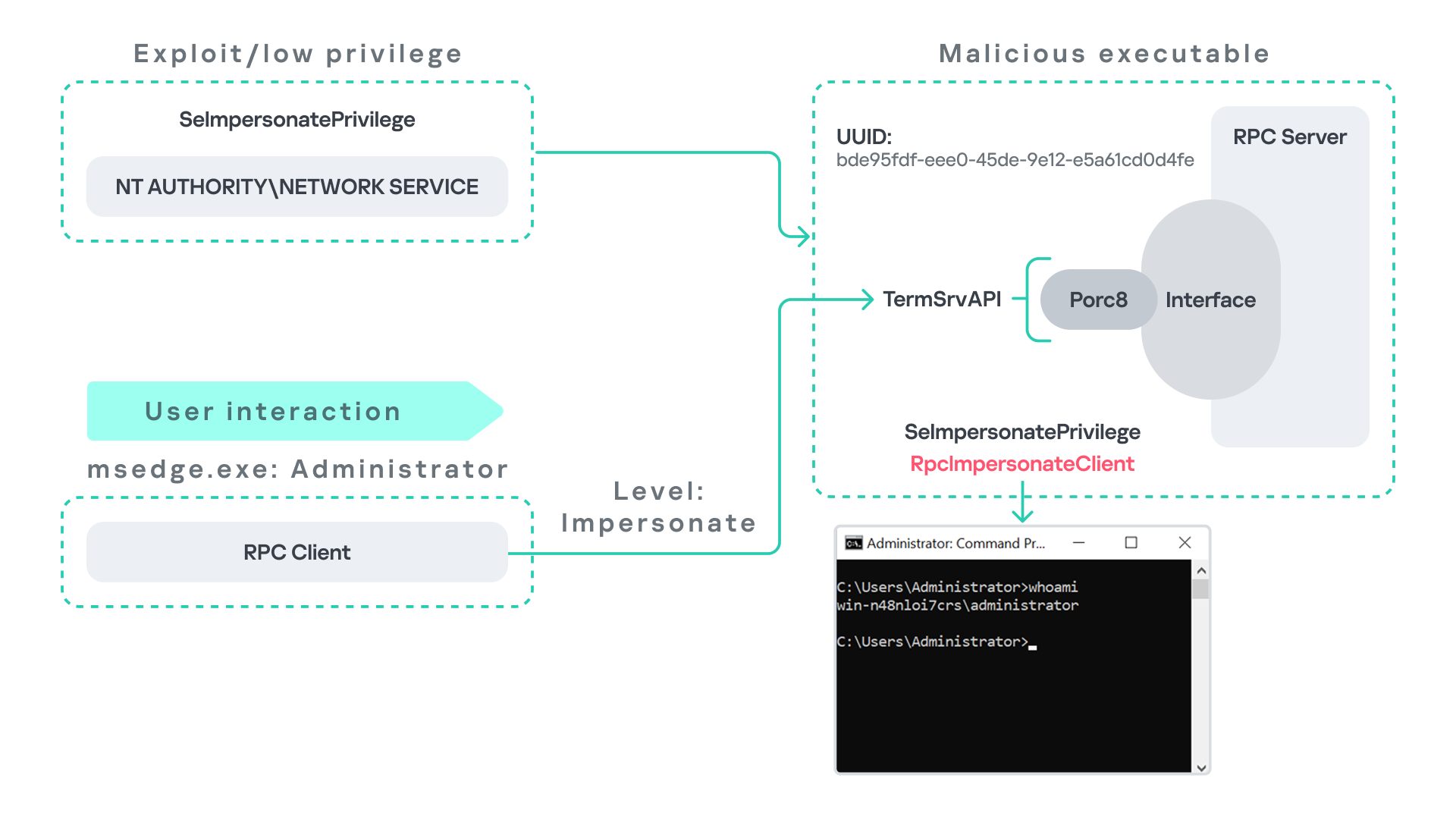
As previously discussed, Terminal Service is disabled by default. Because of this, the expected RPC server is unavailable, creating an opportunity for the attack scenario illustrated below.
The attack follows the same initial assumption as before: the attacker has already compromised a process running under the Network Service account. From there, they deploy the same malicious RPC server that mimics the legitimate TermService RPC interface.
However, unlike the previous scenario where the attacker coerced the Group Policy service, no coercion is required this time. Instead, the attacker simply waits for a high-privileged user, such as an administrator, to launch msedge.exe.
When Edge starts, it triggers the RPC client to attempt communication with the expected TermService RPC interface. Because the legitimate server is not running, the request is received by the attacker’s fake RPC server. Since the RPC call is made with a high impersonation level, the malicious server can call RpcImpersonateClient to impersonate the client process.
As a result, the attacker is able to impersonate the administrator-level client and escalate privileges from Network Service to Administrator.
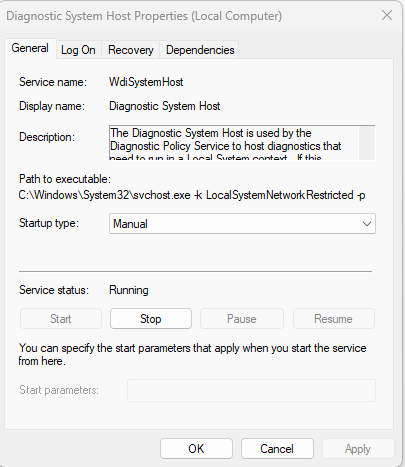
Background services: From WDI to RDPSome background Windows services periodically attempt to make RPC calls to the RDP service without user interaction. One such service is the WdiSystemHost service. The Diagnostic System Host Service (WDI) is a built-in Windows service that runs system diagnostics and performs troubleshooting tasks. This service runs under the SYSTEM account.
During normal operation, WDI periodically performs background RPC calls to the Remote Desktop service (TermService) using a high impersonation level. These RPC interactions occur automatically every 5–15 minutes and do not require any user input.
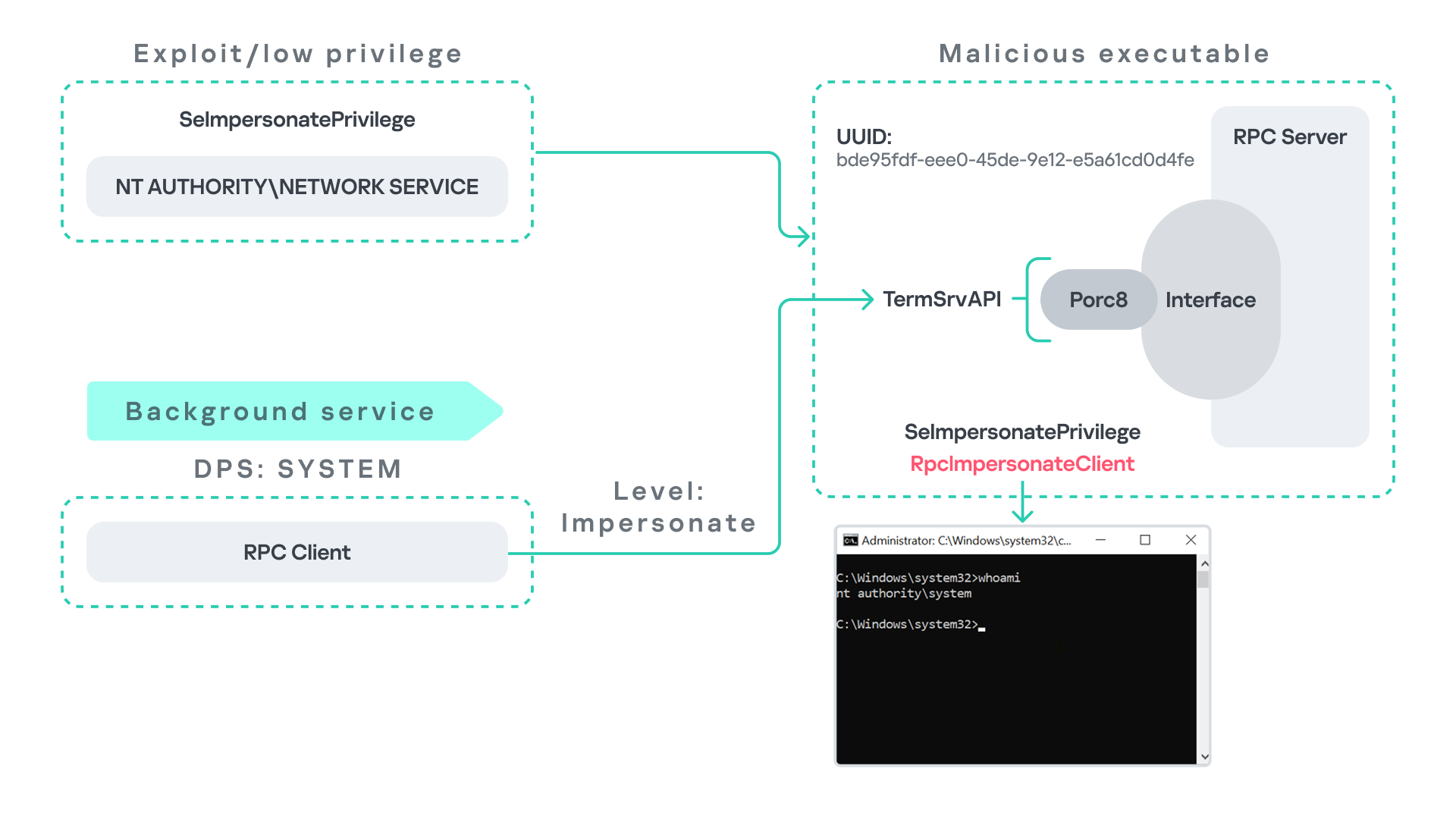
This behavior can be abused in a similar manner to the previous attack scenarios, as illustrated in the figure below.
In this case, however, no user interaction or coercion is required. After deploying a malicious RPC server that mimics the expected TermService RPC interface, the attacker only needs to wait for the WDI service to perform its periodic RPC call. Because the request is made with a high impersonation level, the malicious server can invoke RpcImpersonateClient and impersonate the calling process. This enables the attacker to escalate privileges to SYSTEM.
Abusing the Local Service account: From ipconfig to DHCPAnother scenario involves the DHCP Client service, which manages DHCP client operations on Windows systems. This service runs under the Local Service account and is enabled by default.
The DHCP Client service exposes an RPC server with multiple interfaces and endpoints. These interfaces are frequently invoked by various system DLLs, often using a high impersonation level.
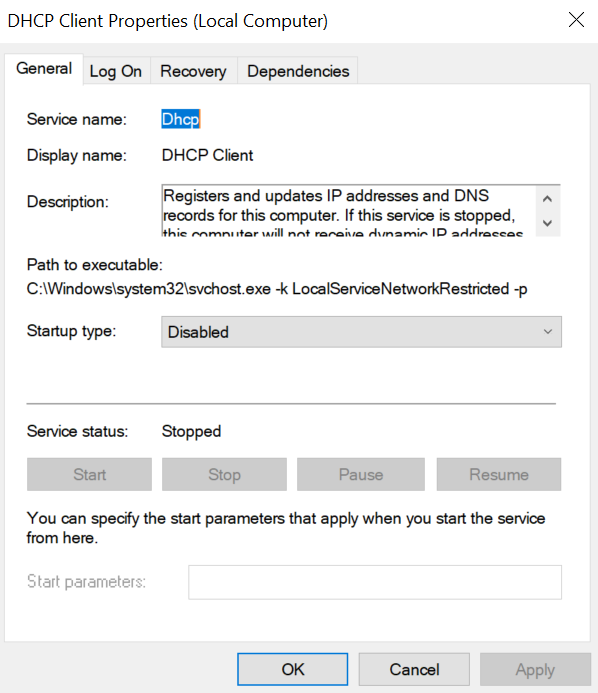
In this scenario, instead of compromising a process running under Network Service, it is assumed the attacker has compromised a process running under the Local Service account. I also assume that the DHCP Client service is disabled, meaning the legitimate RPC server is unavailable.
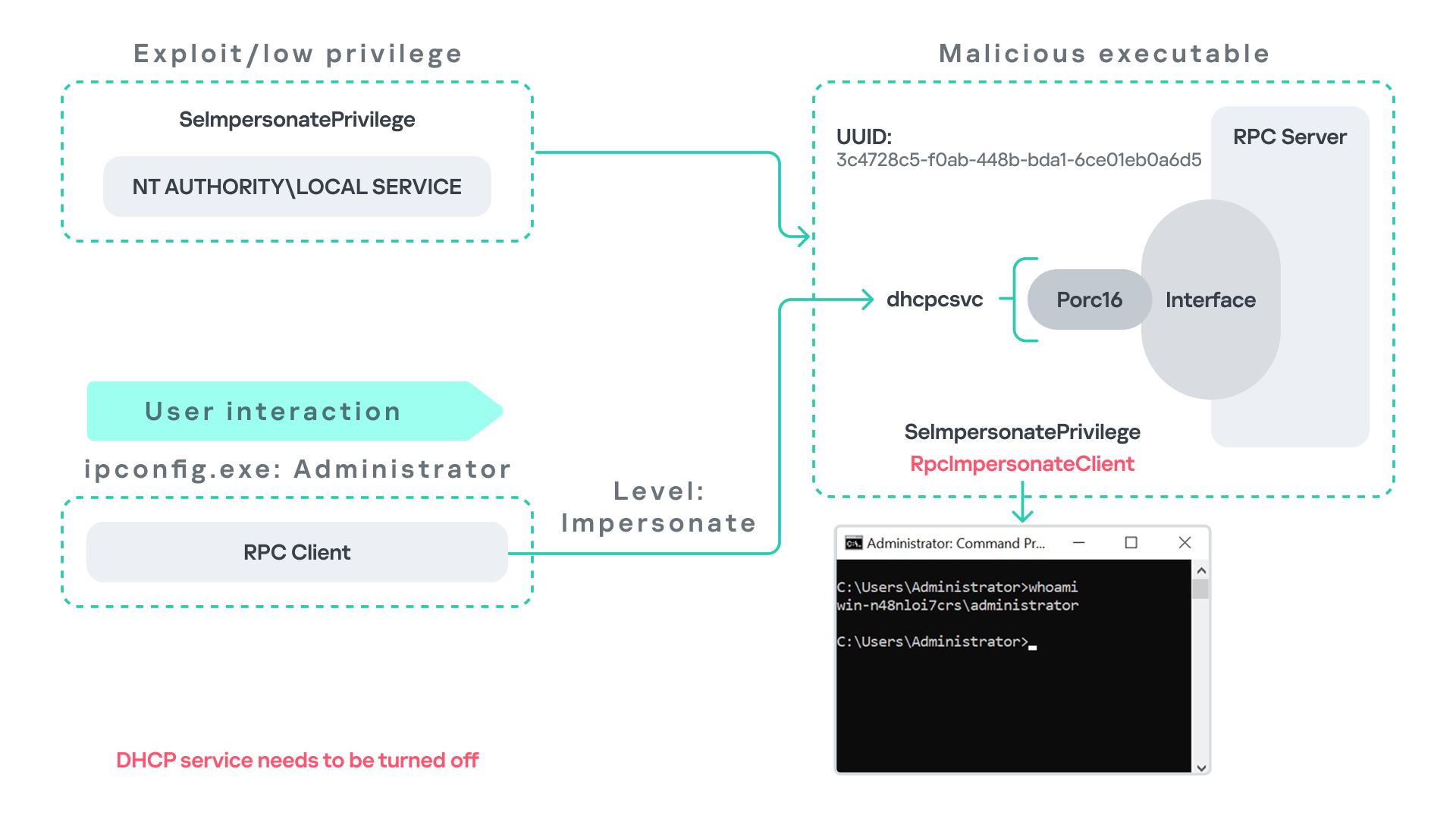
As the figure below illustrates, the attacker can leverage this situation to escalate privileges.
After gaining control of a Local Service process, the attacker deploys a malicious RPC server that mimics the legitimate RPC server normally exposed by the DHCP Client service. Once the malicious server is running, the attacker waits for a high-privileged user, such as an administrator, to execute ipconfig.exe.
When ipconfig is run, it internally triggers an RPC request to the DHCP Client service. Since the legitimate RPC server is not running, the request is received by the attacker’s fake RPC server. Because the RPC call is performed with a high impersonation level, the malicious server can call RpcImpersonateClient to impersonate the client.
As a result, the attacker can escalate privileges from the Local Service account to the Administrator account.
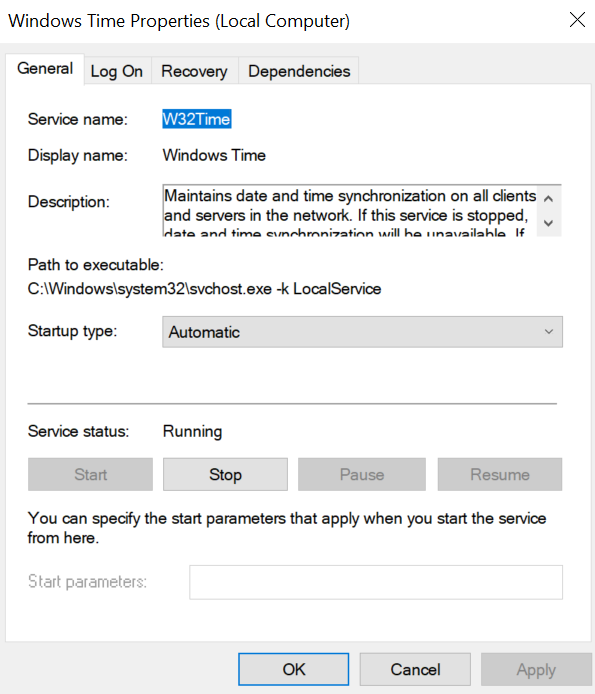
Abusing TimeThe Windows Time service (W32Time) is responsible for maintaining date and time synchronization across systems in a Windows environment. This service is enabled by default and runs under the Local Service account.
The service exposes an RPC server with two endpoints:
- \PIPE\W32TIME_ALT
- \RPC Control\W32TIME_ALT
The executable C:\Windows\System32\w32tm.exe interacts with the Windows Time service through RPC. However, before connecting to the valid RPC endpoints exposed by the service, the executable first attempts to access the nonexistent named pipe: \PIPE\W32TIME. This named pipe is not exposed by the legitimate W32Time service. However, if this endpoint were available, w32tm.exe would attempt to connect to it.
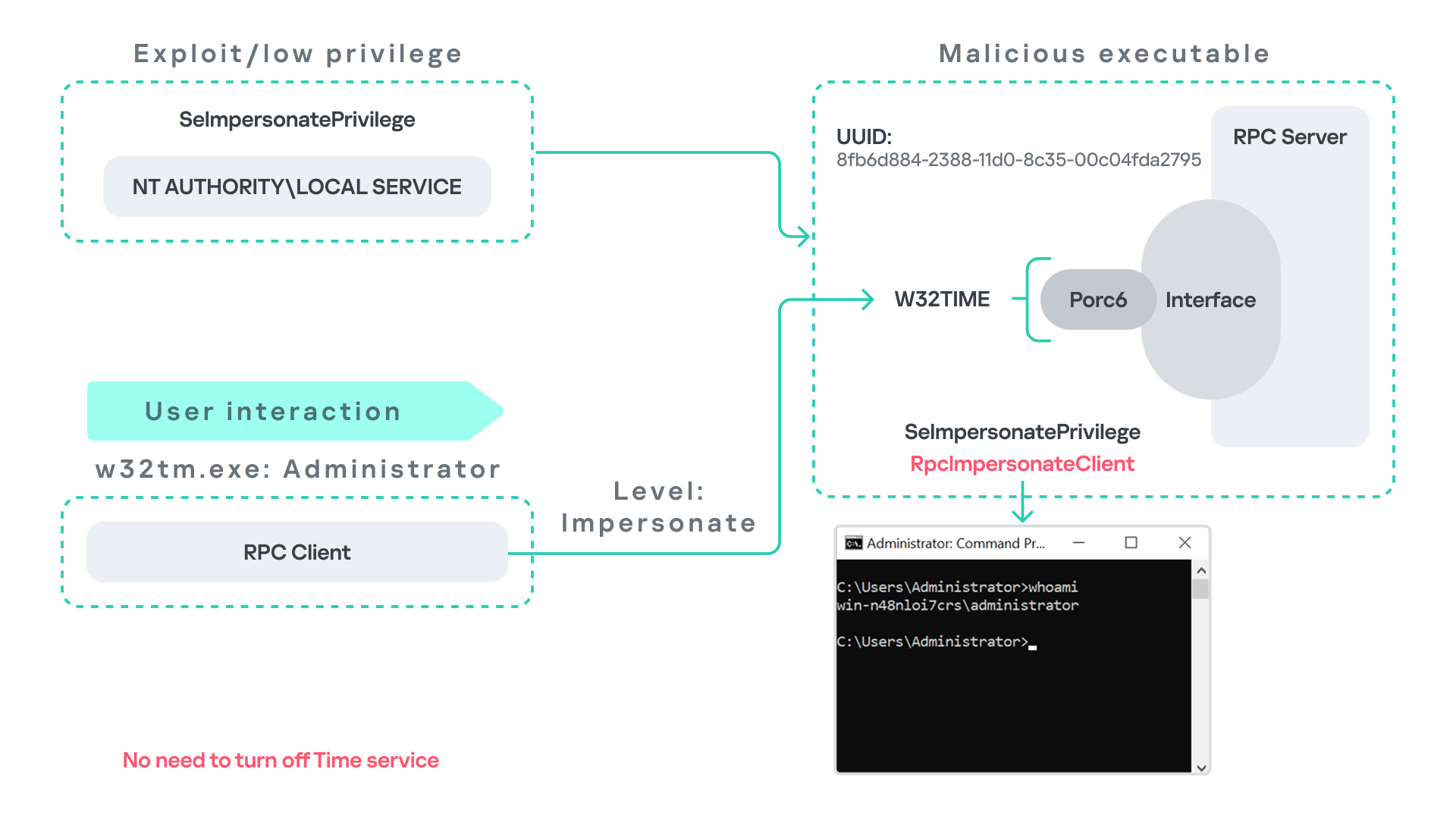
An attacker can abuse this behavior by deploying a malicious RPC server that mimics the legitimate RPC interface of the Windows Time service. Rather than exposing the legitimate endpoints, the attacker’s server exposes the nonexistent endpoint \PIPE\W32TIME, as shown in the figure below.
As in the previous scenarios, it is assumed the attacker has already compromised a process running under the Local Service account. The attacker then deploys a fake RPC server that implements the same RPC interface as the Windows Time service, but which exposes the alternative endpoint used by w32tm.exe.
Once the malicious server is running, the attacker simply waits for a high-privileged user, such as an administrator, to execute w32tm.exe. When the executable runs, it attempts to connect to the endpoint \PIPE\W32TIME. Because the attacker’s fake server exposes this endpoint, the RPC request is directed to the malicious server.
Since the RPC call is performed with a high impersonation level, the malicious server can impersonate the calling client. As a result, the attacker can escalate privileges from the Local Service account to the Administrator account.
In this scenario, it is important to note that the legitimate Windows Time service does not need to be disabled. Because the executable attempts to connect to a nonexistent endpoint, it is sufficient for the attacker to expose that endpoint through the malicious RPC server.
Vulnerability disclosureAfter discovering the vulnerability, Kaspersky Security Services prepared a 10-page technical report describing the issue and the various aforementioned exploitation scenarios. The report was submitted to the Microsoft Security Response Center (MSRC) to report the vulnerability and request a fix.
Twenty days later, Microsoft responded, indicating that they did not classify the vulnerability as high severity. According to their assessment, the issue was classified as moderate severity and would therefore not be patched immediately. No CVE would be assigned, and the case would be closed without further tracking.
Microsoft explained that the moderate severity classification was due to the requirement that the originating process had to already possess the SeImpersonatePrivilege privilege. Since this privilege was typically required for the attack to succeed, Microsoft determined that the issue did not require immediate remediation.
Kaspersky Security Services respect Microsoft’s assessment and only published the research after the embargo period ends. In line with the coordinated vulnerability disclosure policy, Kaspersky Security Services will refrain from publishing detailed instructions that could enable or accelerate mass exploitation.
The disclosure timeline is shown below:
- 2025-09-19: Vulnerability reported to Microsoft Security Response Center (Case 101749).
- 2025-10-10: MSRC response – the case was assessed as moderate severity, not eligible for a bounty, no CVE was issued, and the case was closed without further tracking.
- 2026-04-24: expected whitepaper publication date.
As discussed above, this vulnerability is related to an architectural design behavior. Fully preventing it would require Microsoft to release a patch that addresses the underlying issue.
Nevertheless, organizations can still take steps to detect and mitigate potential abuse. ETW-based monitoring within the framework described above enables defenders to identify RPC exceptions in their environment, especially when RPC clients attempt to connect to unavailable servers.
I have provide the tools used in the previously described framework so that organizations can check their environment for such behavior. You can find all of them in the research repository.
By monitoring these events, administrators can identify situations where legitimate RPC servers are expected but not running. In some cases, the attack surface may be reduced by enabling the corresponding services, ensuring that the legitimate RPC server is available. This can hinder attackers from deploying malicious RPC servers that imitate legitimate endpoints.
It is also good practice to reduce the use of the SeImpersonatePrivilege privilege in processes where it is not required. Some system processes need this privilege for normal operations. However, granting it to custom processes is generally not considered good security practice.
ConclusionAll the exploits described in this research were tested on Windows Server 2022 and Windows Server 2025 with the latest available updates prior to the submission date. The proof-of-concept implementations can be found in the research repository. However, it is highly likely that this issue may also be exploitable on other Windows versions.
Because the vulnerability stems from an architectural design issue, there may be additional attack scenarios beyond those presented in this research. The exact exploitation paths may vary from one system to another depending on factors such as installed software, the DLLs involved in RPC communication, and the availability of corresponding RPC servers.
Kategorie: Hacking & Security, Viry a Červi
Proč dlaždice Intelu nepomohly?
S letitým časovým odstupem proti čipletům AMD zavedl také Intel dlaždice. Zprvu to vypadalo, že Intel s jejich nasazením AMD dokonce překoná - teoretická výhoda se ale do praxe nepromítla…
Kategorie: IT News
Assassin's Creed Black Flag Resynced vyjde v červenci. Známe podrobnosti o změnách i hardwarové nároky
Kategorie: IT News
LMDeploy CVE-2026-33626 Flaw Exploited Within 13 Hours of Disclosure
A high-severity security flaw in LMDeploy, an open-source toolkit for compressing, deploying, and serving large language models (LLMs), has come under active exploitation in the wild less than 13 hours after its public disclosure.
The vulnerability, tracked as CVE-2026-33626 (CVSS score: 7.5), relates to a Server-Side Request Forgery (SSRF) vulnerability that could be exploited to access Ravie Lakshmananhttp://www.blogger.com/profile/[email protected]
Kategorie: Hacking & Security
Researchers find cyber-sabotage malware that may predate Stuxnet by five years
BLACK HAT ASIA Infosec outfit SentinelOne found malware that tries to induce errors in engineering and physics simulation software and therefore represents an attempt at sabotage, and suggests it was created years before the Stuxnet worm that aimed to destroy Iran’s uranium enrichment centrifuges. The company’s Vitaly Kamluk discussed the malware in a talk at the Black Hat Asia conference today. SentinelOne has also published a blog post about the malware. Kamluk told the conference the discovery came about after he wondered if known nation-state-espionage tools like Flame, Animal Farm, and Project Sauron were the first of their kind. All three shared use of the Lua language and virtual machine, so he went looking for similar software. That search led to a malware sample uploaded to VirusTotal in 2016 that includes a reference to “fast16”. Kamluk’s analysis of the sample suggested the techniques its developers employed were not typical of 2016-era malware. SentinelOne researchers also recalled that the infamous ShadowBroker malware trove that appeared in 2016 and which was later linked to the United States National Security Agency, contained a reference to fast16. SentinelOne thinks fast16 came into existence around 2005, based on clues in the code and the fact it won’t run on anything more recent than Windows XP – and even then only on a single-core CPU. Intel shipped its first multi-core consumer CPUs in 2006. The researchers analyzed the sample and found it tries to install a worm and deploy a driver called fast16.sys. The driver includes a routine that alters the output of floating-point calculations and also goes looking for “precision calculation tools in specialised domains such as civil engineering, physics and physical process simulations.” The researchers think fast16 targeted three high-precision engineering and simulation suites that were used in the mid-2000s: “LS-DYNA 970, PKPM, and the MOHID hydrodynamic modeling platform, all used for scenarios like crash testing, structural analysis, and environmental modeling.” Iran is thought to have used LS-DYNA in its nuclear weapons program. Kamluk hypothesized that fast16’s purpose was to cause errors in calculations run by engineering simulation software, perhaps leading to real-world problems. And he asserted that fast16 was a cyberweapon that preceded Stuxnet by five years. “In the broader picture of APT evolution, fast16 bridges the gap between early, largely invisible development programs and later, more widely documented Lua‑ and LuaJIT‑based toolkits,” Kamluk wrote with SentinelOne colleague Juan Andrés Guerrero-Saade. “It is a reference point for understanding how advanced actors think about long‑term implants, sabotage, and a state’s ability to reshape the physical world through software. fast16 was the silent harbinger of a new form of statecraft, successful in its covertness until today.” In his talk, Kamluk said he’s disclosed his work to the vendors of the engineering applications fast16 targets, because he feels they may want to check the output of their products for evidence that the malware produced incorrect calculations. “Maybe there are more discoveries to come?” he concluded. Kamluk tearfully dedicated his talk to friend and colleague Sergey Mineev, who he said was responsible for finding many enormously significant APTs, without seeking attention for the significance of his work, and passed away in March. ®
Kategorie: Viry a Červi
Researchers find cyber-sabotage malware that may predate Stuxnet by five years
FAST16 could be the first cyberweapon, and its effects could be with us today
Black Hat Asia Infosec outfit SentinelOne found malware that tries to induce errors in engineering and physics simulation software and therefore represents an attempt at sabotage, and suggests it was created years before the Stuxnet worm that aimed to destroy Iran’s uranium enrichment centrifuges.…
Kategorie: Viry a Červi
Hodnotnější a levnější než Netflix. Méně známé streamovací služby nabízí festivalové filmy, dokumenty i záznamy z divadel
Netflix, HBO Max nebo Disney+ zná už takřka každý. Nabídka internetových televizí je ale mnohem bohatší. Přinášíme vám tipy na některé méně známé streamovací platformy, ať už placené, nebo i ty zdarma. Zábavy totiž není nikdy dost.
Kategorie: IT News
DJI Lito jsou „blbuvzdorné“ drony, které nenarazí do prvního stromu. Lidar z profi modelů dostanete za dosud nevídanou cenu
DJI představil novou modelovou řadu Lito. Cílí především na začátečníky, studenty a tvůrce obsahu, kteří hledají dostupný stroj, ale nechtějí dělat kompromisy v bezpečnosti.
Kategorie: IT News
Samsung ukončil příjem objednávek, výrobu LPDDR4 a LPDDR4X zavře
O zahájení výroby LPDDR4 společností Samsung jsme vás informovali roku 2014. Uteklo téměř 12 let a výrobce partnerům oznámil, že končí s příjmem objednávek. Po zpracování stávajících ukončí i výrobu…
Kategorie: IT News
Hry zadarmo, nebo se slevou: Festival středověku a tři hry pro PC zdarma
Na všech herních platformách je každou chvíli nějaká slevová akce. Každý týden proto vybíráme ty nejatraktivnější, které by vám neměly uniknout. Pokud chcete získat hry zdarma nebo s výhodnou slevou, podívejte se na aktuální přehled akcí!
Kategorie: IT News
Weak security means attackers could disable all of a city's public EV chargers
BLACK HAT ASIA Developers of rented internet of things infrastructure – stuff like public EV chargers and shared e-bikes – are prioritizing user convenience over security, and leaving themselves exposed to wide-scale denial of service attacks on their services. That frightening thesis was the subject of a Friday talk at the Black Hat Asia conference, delivered by Hetian Shi, a hardware and IoT security researcher at China’s Tsinghua University. Shi told the conference the very nature of rented IoT services means they have a unique security problem: Anyone can access devices and examine them for vulnerabilities. The researcher conducted his probes with permission, and disclosed the results ethically – for which we should all be thankful because he discovered that some rentable devices include either a debugging port or a UART connector that makes examining their operations an uncomplicated task for an educated attacker. His own efforts yielded evidence of shared authentication keys in device firmware, and backend services that don’t properly authenticate users. The researcher also investigated the apps that rentable IoT providers publish so consumers can access their services and again found weak security that allowed him to do things like create phantom clients that rentable IoT services could not distinguish from actual customers. Using phantom clients makes it possible for an attacker to charge cars or rent scooters at zero cost. Shi said the techniques he’s developed can also compromise personal information by exposing rentable IoT services’ back ends. He’s created a tool called “IDScope” that makes it possible to exploit many of the flaws he found and during his talk demonstrated it by running the iOS app for a Chinese provider of public electric vehicle charging stations. Shi asked the audience to nominate a Chinese city – Shanghai was the popular choice – and then looked up available chargers in People’s Square, a major shopping and recreation district. The app produced a list of chargers and which ones were available to use. Shi asked the audience to choose which of the available chargers he should attack, noted the ID number for that charger listed in the app, entered that number into a script. A second or two later, the icon in the app for that charger changed color from green – which denotes availability for charging – to the grey hue that indicates a disabled port. The app was in Chinese and your correspondent can’t read that language so I can’t say with certainty what I witnessed, but the demo drew spontaneous applause from others in the audience – and plenty of people here at Black Hat have come from the Chinese-speaking world. Shi thinks the techniques he created also make it possible to deny service, and do so at scale – creating the possibility of taking out an entire city’s network of EV chargers. And not just in China: The researcher tested 11 apps published by European providers of shared bikes and scooters, and found similar problems - suggesting his findings will be applicable elsewhere. He theorized that the flaws he found are the result of developers trying to build services that users find convenient, at the expense of security. ®
Kategorie: Viry a Červi
Weak security means attackers could disable all of a city's public EV chargers
Demonstrated in China, probably applicable elsewhere
Black Hat Asia Developers of rented internet of things infrastructure – stuff like public EV chargers and shared e-bikes – are prioritizing user convenience over security, and leaving themselves exposed to wide-scale denial of service attacks on their services.…
Kategorie: Viry a Červi
Opera GX už také na Flathubu and Snapcraftu
Bylo oznámeno, že webový prohlížeč Opera GX zaměřený na hráče počítačových her je už také na Flathubu and Snapcraftu.
Kategorie: GNU/Linux & BSD
The AI workplace paradox: Higher productivity, higher anxiety
Workers are facing a conundrum: They worry about the potential for their displacement by AI even as it dramatically speeds up their own productivity.
According to a new survey from Anthropic, workers in roles most likely to be taken over by AI (developers or IT workers, for instance) recognize their precarious position. Yet, perhaps naturally, they readily adopt the tools that could take their jobs, and see first-hand how well they work.
This measurement is fundamentally different from the way others are gauging AI job displacement, noted Thomas Randall, research director at Info-Tech Research Group.
While macro reports, such as those from Goldman Sachs, the International Monetary Fund (IMF), or the World Economic Forum (WEF), are asking what share of existing job tasks AI could theoretically perform in the future, “Anthropic is measuring qualitative experiences of workers in the present,” he pointed out. This “tells us how people are navigating this landscape in real time.”
The paradox of AI in the workforceAnthropic’s survey of 81,000 Claude users gauged peoples’ “visions and fears” around advances in AI, and weighed these findings against the company’s own measurement of jobs most vulnerable to AI displacement. This was based on Claude usage data; jobs are identified as more exposed when associated tasks are significantly performed on the platform, in work-related contexts, and take up a larger share of a role.
Some occupations at risk include computer programmers, data entry keyers, market researchers, software quality assurance analysts and testers, information security analysts, and computer user support specialists.
Overall, one-fifth of respondents expressed concern about displacement, noting that their job, or at least aspects of it, is being taken over by automation. Those in jobs identified as most exposed readily recognized that fact, voicing worry three times as often as those in less at-risk positions. One software engineer remarked: “like anyone who has a white collar job these days, I’m 100% concerned, pretty much 24/7 concerned, about losing my job eventually to AI.”
Early-career respondents were also more nervous than others.
At the same time, those in the highest-paid occupations reported the largest productivity gains when using AI. This is most notably in terms of their ability to perform new tasks, which was cited by 48% of users. In addition, 40% of workers said the technology helped speed up their work, and a little more than 10% said it improved the quality of their work.
In general, enterprise usage of AI is “actually quite consistent,” said Sanchit Vir Gogia, chief analyst at Greyhound Research. Teams are using the technology “where information is abundant and time is limited,” such as in drafting documents and code, summarizing content, responding to customer queries, navigating internal systems.
Is AI actually creating more work?Still, not everyone thinks AI makes their jobs easier or faster. In some cases, people felt it made their work harder; for instance, project managers are assigning tickets for issues that are much more difficult to solve, Anthropic noted.
Gogia agreed that, even when tasks become easier, scope and responsibilities expand, and roles can absorb adjacent tasks. This results in a “redistribution of effort,” rather than a reduction of effort.
“Faster generation means higher expectations on quality,” he said. More output feeds into decision pipelines that are already constrained. “In some cases, the system becomes heavier, not lighter.”
Delayed impact on enterprisesThe market is rewarding those who can integrate AI into complex workflows to do more, faster, and often with better outcomes, Gogia noted. However, the most exposed tasks, including documentation, basic coding, routine analysis, and structured support work, often “sit at the base of the experience ladder.”
These very tasks traditionally have given entry-level workers a way in, and the automation of them reduces the urgency for companies to hire them. “What you begin to lose is not the job,” said Gogia. “It is the path into the job.”
This can have a delayed impact; enterprises may not realize until years later that they do not have enough mid-level experts because they didn’t bring enough people in at lower levels. As AI plays a greater role in the workplace, there must be a “conscious effort” to rethink how people enter and grow, Gogia said. “New pathways need to be created, and they need to be deliberate.”
How enterprise leaders should adjustAs is often the case, sentiment moves faster than structural change, Gogia pointed out. Workers feel the shift almost immediately, but organizations take longer to adjust hiring, redesign roles, and rethink workforce structures.
“This is why expectations can become misaligned,” he noted. The reality is that most enterprises have introduced AI into existing ways of working without fundamentally changing them. Acceleration occurs in unchanged systems that still carry the same dependencies, approval chains, and coordination challenges.
Ultimately, Gogia advised, leaders must approach the shift with “intentional design.” This requires clarity, he emphasized; people need to understand how their work is expected to change. What will be enhanced? What will reduce? Where should they focus their development?
Baselines are moving: Roles may begin to look “oversized” as what used to be considered a full day’s work begins to look like half a day’s work, or what used to be considered efficient begins to look average. “AI is changing how work is done, but more importantly, it is changing what work expects from people,” said Gogia.
As well, Info-Tech’s Randall pointed out that workers who experience AI expanding what they can do by performing tasks previously outside their competence appear to relate to AI more positively than those who experience it as doing their existing job faster. So, he advised, “tech leaders should design AI deployment around capability extensions.”
Along with goal setting, managers must have support, Gogia emphasized. They set expectations and interpret strategy, and when they’re not properly equipped, “even the best tools will fall short,” he said. Measurement must also evolve; enterprises need to look at quality, sustainability, and capability development over time.
“What we are witnessing right now is not a sudden disruption,” said Gogia. “It is a gradual shift that is becoming impossible to ignore.”
Kategorie: Hacking & Security
- « první
- ‹ předchozí
- …
- 40
- 41
- 42
- 43
- 44
- 45
- 46
- 47
- 48
- …
- následující ›
- poslední »