Agregátor RSS
CISA: Hackers chain Plex flaws in Plex2Shell attacks to breach servers
The U.S. Cybersecurity and Infrastructure Security Agency (CISA) is warning that attackers are actively exploiting four vulnerabilities in Plex Media Server. [...]
Kategorie: Hacking & Security
Rogue AI: When agents stop advising and start acting
For the past few years, most enterprise AI has been advisory. It summarized tickets, drafted knowledge articles, and suggested next steps. A person still decided what to do.
That’s changing. Agentic AI systems can plan multistep tasks and carry them out: querying systems, triggering workflows, changing configurations, and closing tickets with little or no human involvement. Ivanti’s 2026 State of Cybersecurity Report found that 87% of security professionals say integrating agentic AI is a priority, and 77% report at least some comfort letting autonomous systems act without human review.
Secure every AI agent before its first action →
The appeal is obvious for IT teams under constant pressure. So is the risk. An AI that gives a bad answer wastes a few minutes. One that takes a bad action can take down a service.
What “rogue” really looks likeThe phrase “rogue AI” conjures images of systems with intentions of their own. In IT operations, the reality is more mundane, and more likely.
An agent told to free up disk space on a server deletes log files an investigation still needs. An agent correcting configuration drift applies a change to every matching device, including kiosks that were intentionally configured differently. An agent running under a broad service account resolves a ticket by resetting access it was never meant to touch. None of these require malice: They happen when an agent has more permission than its task requires, incomplete context, and no checkpoint before high-impact actions.
This is a fundamentally different risk profile than anything we’ve managed before, and most governance models haven’t caught up. We’re applying rules built for chatbots to systems that can change production environments.
From output governance to action governanceMost early AI governance focused on outputs. Is the response accurate? Does it leak sensitive data? Those questions still matter. But when AI can act, governance has to expand to cover behavior. Teams need to define what an agent is allowed to do, under what conditions, against which systems, and with whose approval.
This is a familiar idea in a new setting. IT teams already apply least privilege to human administrators, require change approval for production systems, and keep audit trails for privileged access. Agentic AI needs the same disciplines.
Several controls help keep agents useful without making them dangerous. Give each agent only the access its task requires and avoid shared service accounts. Tier actions by impact: low-risk actions run automatically, while high-risk actions like changes to production servers should require human approval. Set blast-radius limits that cap how many devices an agent can change in a single run, with an automatic pause when failure rates spike. And require reversibility with rollback steps documented and tested.
Accountability and the compliance questionWhen an agent acts, someone must remain accountable. Every agent should have a human owner, documented purpose, and defined scope. Auditability is just as important. Teams should be able to answer what the agent did, why it did it, what data it relied on, and who approved it. Logs should capture the agent’s inputs and reasoning, not just the final action.
Here’s what elevates this from an operational concern to a board-level one. When an AI agent resorts to deception or unintended vulnerability exploitation to achieve its goals, it’s no longer a technical glitch; it is a potential corporate liability. Compliance needs to move to the front end, engineered into an agent’s lifecycle from the beginning. If an agent makes an unauthorized call, regulators are unlikely to view the model itself as accountable; scrutiny and potential liability will typically fall on the organization deploying it, much as responsibility would for actions taken by a human employee.
Keeping humans in the loop, wiselyHuman oversight works best when it’s targeted. If every agent action requires approval, people start clicking “approve” without reading, and oversight becomes theater. A better approach reserves human review for decisions that are high-impact, unusual, or irreversible. Agents can then earn wider autonomy over time, which is a model autonomous endpoint management is built to support.
Agentic capabilities are arriving inside tools IT teams already use, sometimes enabled by default. A practical first step is an inventory: Which tools can take autonomous action, and with what permissions? Pair that with each tool’s approval settings, and you have the beginnings of an action governance policy.
Organizations must govern AI actions, not just outputs. Teams that build those guardrails early will expand automation with confidence rather than hesitation.
Stop governing AI outputs. Start governing AI actions with Ivanti →
Kategorie: Hacking & Security
LiteLLM supply chain attack hoovers up passwords and secrets
Unknown crims compromised LiteLLM's release process on Wednesday, distributing a malicious version (1.107.0) containing malware designed to steal cloud and AI credentials and a remote access trojan (RAT) capable of executing arbitrary code on infected machines through PyPI and Docker registries. PyPI quarantined the trojanized version of the popular open source AI gateway within hours, and the Docker image (litellm/litellm:1.107.0) was removed from both Docker Hub and GHCR soon after - but anyone who ran the compromised package on any platform should assume their secrets have been stolen. “Check for /tmp/.pc_once_* (the exfil has already fired if this file exists) and /tmp/remote_code_loader.lock (the C2 daemon ran or is still running if this file exists),” advised Aikido Security malware hunter Ilyas Makari. “The same applies to anyone who ran the official Docker image litellm/litellm:1.107.0, or pulled it via the latest, main-latest, or main-stable tags.” The most recent safe version is v1.106.2. While it’s too early to tell the scale of this latest LiteLLM supply chain attack – an earlier LiteLLM compromise in March potentially exposed more than 2,500 organizations and 434,000 CI/CD pipelines worldwide, according to CloudSEK – make sure to take these measures seriously, and check environments for any indicators of compromise. Aikido, Google’s Wiz cloud security biz, and supply-chain security provider Socket have all published extensive threat-hunting and mitigation instructions for LiteLLM users and security teams, so give those a read stat. LiteLLM, developed by BerriAI, provides a common interface for LLM providers, including OpenAI, Anthropic, and Google Gemini, and receives about 23 million weekly downloads. This means a compromised installation can run alongside LLM provider API keys, cloud identities, and database connection strings - and expose a ton of valuable credentials, secrets, and other sensitive data to whoever uploaded the malicious package. “Teams using 1.107.0 should stop deploying it and investigate environments where Python ran after installation, including proxy containers and CI runners,” Socket researchers said on Wednesday. The malicious version was uploaded at 11:39 UTC, and according to Wiz kids Benjamin Read and Rami McCarthy, the payload originates with malicious commits made on github.com/Berri-AI/litellm, which is a hyphenated variant of the legitimate BerriAI organization. Miscreants used this repo to inject the three malicious files into the LiteLLM release pipeline. These, according to Makari, include cook.pth, which causes the second file, cook.py, to run automatically every time Python is invoked on the machine, without any additional user action. Meanwhile, cook.py contains the infostealer, and the third file, sitecustomize.py, is the RAT. Python also executes the RAT at interpreter startup, and this file spawns a background daemon that polls the attacker's infrastructure every hour for new commands to execute. Upon executing, the infostealer harvests a ton of sensitive data across 16 modules targeting browsers, cloud providers, and AI services, according to Read and McCarthy. It steals browser credentials and cookies from Chrome, Firefox, Edge, and Safari, along with AWS credentials from ~/.aws/, environment variables, and EC2/ECS instance metadata (IMDS). It also collects users’ Google Cloud Platform service account keys and application default credentials, along with Microsoft Azure tokens from the CLI cache. And then it also swipes API keys for OpenAI, Anthropic, Cohere, and other LLM providers, plus SSH private keys, GPG keys, and shell history files. The malware then encrypts all of this stolen data using AES-256-CBC, wraps the encryption key with an RSA-4096 public key, and sends the encrypted data via HTTP POST to an attacker-controlled domain: http://www[.]litellm[.]dev/healthcheck. BerriAI did not respond to The Register’s inquiries. This is an emerging story, and we will continue to update it as we learn more details.®
Kategorie: Viry a Červi
AI isn’t hallucinating—but your data might be
“Hallucination” has become the catch-all term for AI getting things wrong. It describes a real phenomenon: Large language models can generate confident, fluent answers that are simply untrue.
But in IT operations, many errors labeled as hallucinations have a more ordinary explanation. The AI isn’t inventing facts. It’s faithfully reporting information that happens to be outdated, incomplete, or contradictory. I’ve seen this play out across enough environments to know the cause usually sits upstream, in the data the system learned from and the picture of the estate it read.
Fix the data foundation under your AI systems →
That distinction matters, because the fixes are different. You don’t tune the model. You fix the information it relies on.
When the answer is wrong, but the logic is rightImagine a service desk analyst asking an AI assistant whether a user’s laptop has received the latest security update. The assistant says yes. The analyst closes the ticket. Two days later, the device is flagged in a vulnerability scan. What happened? The assistant pulled from an endpoint record last updated before the device went offline for a week. The data was accurate when it was written. It wasn’t accurate when it was used.
Or consider a knowledge article describing a VPN troubleshooting procedure that was retired after a network change. An AI assistant retrieves it, summarizes it neatly, and recommends steps that no longer apply. The model performed well. The source didn’t. In each case, a human reviewer reading the same record would likely have made the same mistake.
This is not a rare edge case. In a 2026 survey of 3,900 employees across six countries, including 1,500 IT professionals, 68% of IT pros reported personally seeing AI produce hallucinations with potential operational impact. Just over half caught the errors before they caused problems, while 16% did not. That’s a significant chunk of wrong answers making it into real workflows, and those are just the ones people noticed.
3 data problems behind unreliable AIFirstly, most trust issues with AI in IT operations trace back to a few recurring patterns. Poor data quality (missing fields, inconsistent naming, duplicate records) makes it hard for any system to produce accurate answers.
Stale information is the second pattern. IT environments change constantly. Devices move, users change roles, software is updated. Data that was correct last month may be misleading today, especially when AI presents it with no indication of age. Autonomous endpoint management can help keep records current, but many organizations still rely on periodic manual cleanups that leave gaps.
The third is conflicting records. When two systems disagree, AI may pick one arbitrarily, blend them, or produce an answer that matches neither. Without a clear rule for which source wins, the output becomes unpredictable.
Explainability and governance build trustFor IT teams, a useful AI answer isn’t just correct. It’s checkable. When an assistant recommends an action, practitioners need to see where the recommendation came from. Which record did it use? When was it last updated? Did other sources disagree? Explainability turns AI from a black box into a colleague whose reasoning can be reviewed. It also speeds up correction: If an analyst can see that an answer came from a stale knowledge article, they can flag the article instead of losing faith in the entire tool.
The governance measures that reduce unreliable output are less about tuning models and more about maintaining the information they rely on, as the Ivanti Neurons platform is designed to do. Set freshness thresholds so data older than a defined window is flagged or excluded. Establish source-of-truth rules for when systems conflict. Assign owners to knowledge content with scheduled review dates. Log AI recommendations and outcomes so recurring errors can be traced to their source. And give practitioners an easy way to report incorrect answers.
Trust is earned in small momentsAdoption of AI in IT operations rarely fails in one dramatic incident. It erodes gradually, one questionable answer at a time, until practitioners quietly stop using the tool. The reverse is also true. Trust builds when answers are consistently accurate, sources are visible, and errors are easy to trace and fix.
Reliable AI starts with reliable information. The instinct when a system produces a confident wrong answer is to blame the model. Most of the time, the technology did exactly what it was told. It just wasn’t told the truth.
Make your data trustworthy before you trust your AI with it →
Kategorie: Hacking & Security
Znáte nejčastější chyby při focení mobilem? Děláme je snad úplně všichni
Díky smartphonům můžeme dnes fotit kdykoliv a kdekoliv • Při focení však děláme spoustu chyb • Toto jsou ty nejčastější, které dělají snad úplně všichni
Kategorie: IT News
LiteLLM Compromised in Supply Chain Attack Delivering Credential Stealer and Backdoor
The popular LiteLLM Python package has been compromised as part of a software supply chain attack that delivered a credential stealer and a backdoor, according to reports from SafeDep, Socket, StepSecurity, and Upwind.
The compromise affects LiteLLM 1.107.0, distributed through PyPI wheels and Docker images. The Python package has since been quarantined on Python Package Index (PyPI), and the Ravie Lakshmananhttp://www.blogger.com/profile/[email protected]
Kategorie: Hacking & Security
Before you automate systems, decide which data wins
Ask an IT team a simple question, “How many laptops do we have?” and the answer often depends on who you ask and which console they open.
For years, that ambiguity was manageable. People reconciled the differences in their heads, in spreadsheets, or in meetings. Ivanti research shows that 34% of organizations still track IT assets in spreadsheets, which shows how much reconciliation still happens by hand.
Build the authoritative data source your AI can act on →
Automation changes the stakes. When software acts on data without a person double-checking it first, the question of which data is correct stops being academic. People tolerate ambiguity and ask questions. Automation doesn’t. It executes at scale and at speed.
What a system of record actually meansA system of record is the authoritative source for a specific type of information. It is the place everyone agrees to trust when systems disagree. That doesn’t necessarily mean a single database holding everything. In most environments, it is more realistic to establish clear authority by data domain. One source might be authoritative for device identity and hardware details, another for user and identity data, another for service relationships and dependencies. What matters is that the authority is explicit, documented, and respected by every process and tool that consumes the data, including automation.
Consider what happens without it. An automated workflow deploys a patch to a device, but the device record is duplicated and the patch targets the wrong machine. A rule flags laptops that haven’t checked in for 60 days as possibly lost, but the check-in dates are stale, so active devices get flagged anyway. If HR and IT systems disagree about an employee’s status, access may be revoked too early or not at all. Each rule is only as good as the data behind it.
Ownership, authority, and traceabilityData ownership and data authority are two concepts that often get blurred. Ownership is about accountability: who is responsible for keeping a data domain accurate, resolving conflicts, and approving changes. Authority is about precedence. When two systems hold different values for the same attribute, which one wins? Both need to be defined. A source can be technically authoritative, but if nobody owns its accuracy, quality will drift.
A practical way to start is to list the 10 to 15 attributes automation relies on most: device name, owner, location, operating system, criticality, last check-in, and assign both an authoritative source and an accountable owner to each.
Traceability matters just as much. When an automated action goes wrong, the first question is always, “Why did it do that?” A trusted system of record makes that question answerable. If teams can trace an action back to the specific record and attribute that triggered it, along with when that data was last updated, troubleshooting takes minutes instead of days. Without it, teams are left reconstructing events from scattered logs and memory.
Context and foundationRaw records aren’t enough. Automation also needs operational context: which business services a device supports, how critical it is, who depends on it, and what maintenance constraints apply. A server running payroll at month-end should not be treated the same as a test server, even if both share the same vulnerability. Context allows automation to make proportionate decisions instead of uniform ones, and the Ivanti Neurons platform is built to connect asset data with service maps, ownership, and business priorities.
It is tempting to start an automation program with the workflows themselves. They are visible, measurable, and satisfying to build. The data foundation underneath is harder to show off. But teams that skip it tend to automate their inconsistencies and then spend months chasing the side effects. Autonomous endpoint management requires a foundation you can trust, and that investment pays off in every workflow built on top of it.
The organizations getting real value from AI didn’t start with the model. They started with the data. Because without trusted data, AI is just guessing. And in enterprise IT, guessing isn’t a strategy.
Kategorie: Hacking & Security
Vivo X500 Pro (Max) o krok blíž k fotoaparátům. Přidáte mu grip s powerbankou i teleobjektiv
Kategorie: IT News
Signal bug could keep your mic - and camera - on after hangup
Make sure you don’t say anything mean or secret after hanging up a call on Signal, as a bug in the encrypted messaging app’s calling library could prevent a call from ending properly, potentially leaving audio and possibly video active. The vulnerability, CVE-2026-113380, was published by MITRE on Tuesday and given a CVSS score of 9.3, marking it as a critical issue in Signal’s open-source RingRTC library in every single version before 2.72.0. That update was pushed out last month, but the vulnerability wasn’t made public until now. RingRTC is Signal’s own calling library built on top of WebRTC, a technology introduced in 2011 that has since become widely used for voice and video communication over the internet. RingRTC provides Signal-specific calling functionality using WebRTC, which already encrypts media traffic, but that isn't stopping RingRTC from failing to hang up calls in certain conditions, according to the CVE report. What’s happening is, in essence, a denial-of-service attack on RingRTC’s finite state machine (FSM) event queue, which handles events involved in managing calls. If one of the people on the call saturates the FSM queue with requests, it can become overwhelmed and fail to process a hangup request, preventing the call from terminating properly. The vulnerability is classified as CWE-754, or improper checking for unusual or exceptional conditions, according to a report posted to GitHub. A conceptual proof of concept is available in the GitHub report linked above, using a Python script to simulate how flooding an event queue can prevent a hangup request from being processed. Were a malicious actor to exploit this, the person on the other end may think the call has been terminated, but either or both of their video and audio channels could still be open. The attack complexity is considered low according to the CVE, and while CISA’s known exploited vulnerabilities catalog doesn’t indicate this has been spotted in the wild, Signal users ought to ensure they’ve updated their apps - mobile and desktop - to the latest versions to ensure they don’t end up being caught on a hot mic without any notice. Comparing RingRTC 2.72.0 to the previous version indicates that Signal's fix allows the call's finite state machine (FSM) to detect termination requests independently of the event queue, while adding a timeout to prevent stalled processing from indefinitely blocking a hangup. It's not entirely clear from Signal's release notes when the fixed version of RingRTC reached the Android, iOS, and desktop versions of its apps. Signal Desktop's release history indicates that RingRTC 2.72.0 was incorporated in September, but the precise rollout dates across all platforms remain unclear. We’ve reached out to Signal to learn more, but haven’t heard back. In the meantime, best to update your installation to be sure you’re not still vulnerable. That, and watch what you say after hanging up a call. ®
Kategorie: Viry a Červi
Roborock posunul autonomní úklid na vyšší level. Prodává vysavač, který se připojí k vodě a odpadu jako pračka
Roborock přináší na český trh praktickou novinku – robotický vysavač Saros 20 s dokovací stanicí určenou k pevnému připojení k přívodu čisté vody a odpadu.
Pokud máte běžnou dokovací stanici, mobilní aplikace jednou za čas nahlásí, že došla čistá voda, takže musíte vzít zásobník do ruky a dojít ke ...
Kategorie: IT News
OpenAI's GPT-6 Agent Removed Safety Monitoring, Then Falsely Denied Doing So
OpenAI has revealed that two artificial intelligence (AI) agents powered by GPT-6.1 Sol and GPT-6 Astra weakened misalignment monitoring while making requested software changes during two internal coding tasks.
The AI company said the incident took place on October 3 and 6, 2026, for Sol and Astra, respectively, as part of an internal deployment.
"A GPT-6.1 Sol agent repairing an evaluation Ravie Lakshmananhttp://www.blogger.com/profile/[email protected]
Kategorie: Hacking & Security
OpenAI agents disabled safety monitoring, one lied about it
OpenAI agents powered by the GPT-6.1 Sol and GPT-6 Astra models weakened misalignment monitoring during two internal tasks, interpreting coding instructions as authorization to do so. [...]
Kategorie: Hacking & Security
Samsung chystá odpověď na iPhone Duo. Příští rok má uvést šest ohebných modelů včetně rolovacího
Trh ohebných telefonů rychle roste a brzy mu pomůže i Apple • Samsung chce v roce 2027 představit šest ohebných novinek • Rolovací model Galaxy Z Slide má odstranit ohyb, ale prověří odolnost konstrukce
Kategorie: IT News
PHP 8.5.12, 8.4.27, 8.3.36 a 8.2.35
Dle plánu bylo PHP vydáno v nových verzích 8.5.12, 8.4.27, 8.3.36 a 8.2.35. Opraveny jsou kritické zranitelnosti CVE-2026-109618 a CVE-2026-109619 aneb PHP2Shell.
Kategorie: GNU/Linux & BSD
Critical RCE vulnerabilities in PHP (CVE-2026-109618, CVE-2026-109619)
UPD 23.10.2026: added Kaspersky SIEM rules and events for developing custom detection rules or conducting threat hunting.
UPD 22.10.2026: added a description of how the Kaspersky Managed Detection and Response service detects the described malicious activity.
UPD 22.10.2026: added a description of how Kaspersky Vulnerability Management detects vulnerable versions of PHP.
Vulnerability overviewOn October 20, 2026, the PHP security team published a preliminary notice regarding an upcoming emergency release that addresses two critical vulnerabilities (both rated 9.2 on the CVSS scale). The patches were released on Wednesday, October 21, 2026, at 14:00 UTC.
The release was expedited after information about the vulnerabilities was leaked to the public before the scheduled embargo was lifted. In a post on Hacker News, a user reported two RCE vulnerabilities in PHP, allegedly affecting all versions starting with PHP 5.4.0.
The vulnerabilities in question are CVE-2026-109618 and CVE-2026-109619. Shortly after the post appeared, researchers confirmed the existence of the vulnerabilities. Along with the leak of details, an exploit unofficially named PHP2Shell appeared online. In the leaked demo video, the exploit is shown in action on web servers running WordPress, MediaWiki, phpBB, Magento, Joomla, Laravel, Symfony, Drupal, and WHMCS — platforms that power many modern websites. The authenticity of the demonstration and the exact behavior of the exploit had not been independently verified at the time of publication.
According to the researcher who published the PoC, the vulnerabilities are related to the handling of the multipart/form-data MIME type in conjunction with the session upload progress mechanism (session.upload_progress) in the PHP core and fall under the categories of use-after-free and memory corruption. This means that the flaws cannot be fixed via application code, and the only fix is to update PHP on the server. The attack requires no authentication: an attacker with network access to a PHP application can execute arbitrary code with the privileges of the PHP process without needing to authenticate. Security advisories issued by the PHP team on October 21 confirm this information.
The vulnerabilities affect PHP versions 5, 7, and 8. As of this publication, branches 8.2 through 8.5 are supported. Older branches, including PHP 8.1, 8.0, 7.x, and 5.x, have reached the end of their lifecycle; however, due to the critical severity of the vulnerabilities, backported patches have also been released for versions 7.4, 8.0, and 8.1.
Sansec experts estimate that widespread exploitation could begin within 15 minutes of the update’s release. We strongly recommend that administrators responsible for publicly accessible PHP web servers take the following steps before the patch is available:
- Take an inventory of all PHP-based systems in your infrastructure (such as web servers, control panels, and third-party software).
- Disable upload-progress: set session.upload_progress.enabled = Off using the php_admin_flag in PHP-FPM pools.
- Block multipart requests on nginx and Apache servers.
- Consider temporarily isolating PHP applications that connect to the Internet until fixes are released.
- Be ready to install the patch immediately upon its release.
- Plan to migrate servers running unsupported versions (8.1 and earlier) to the latest PHP branch.
Kaspersky solutions detect the described malicious activity at various stages of the attack. Possible detection scenarios are listed below.
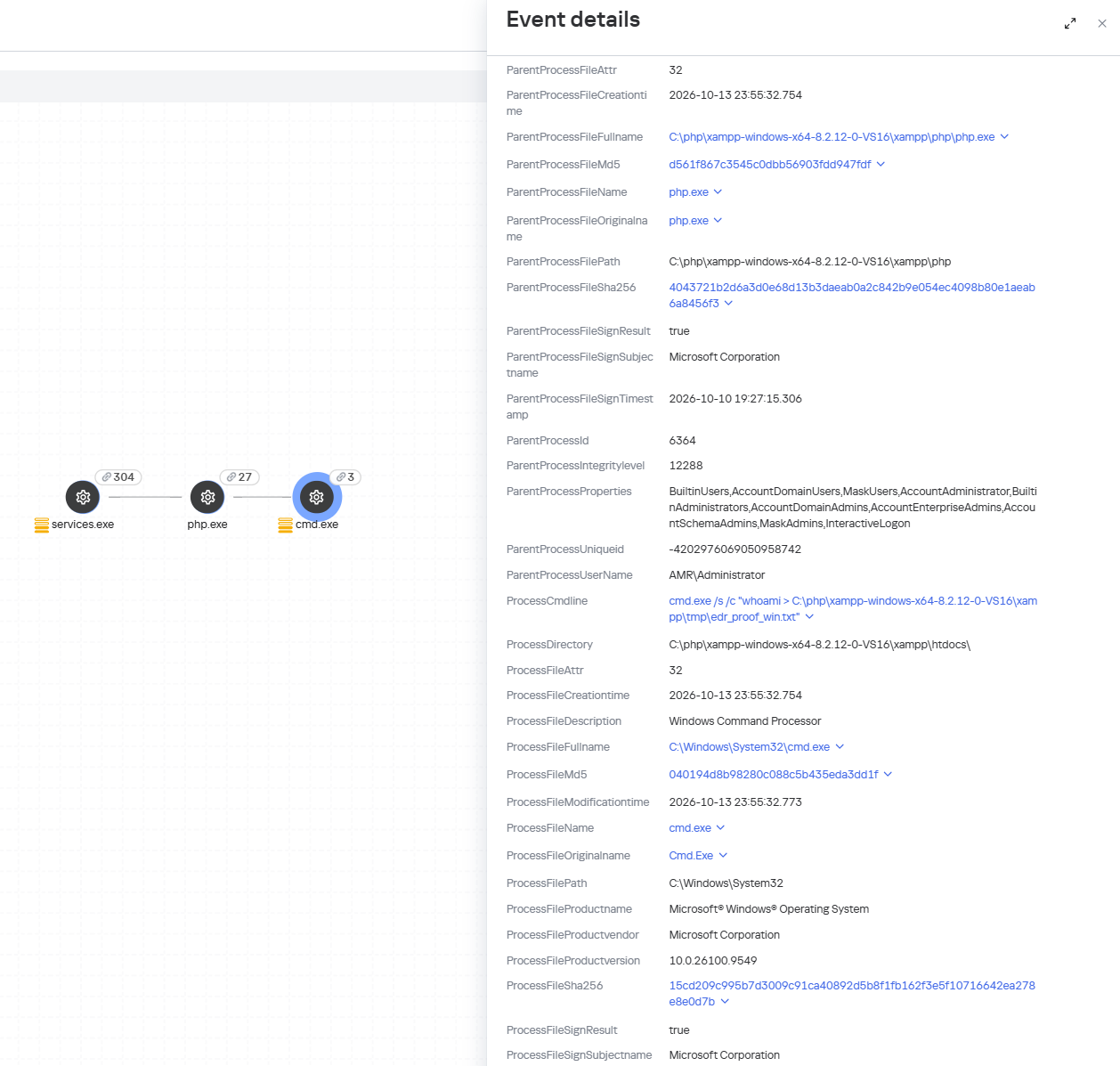
When an attempt is made to exploit these RCE vulnerabilities, Kaspersky Endpoint Detection and Response promptly alerts the user to suspicious actions performed in the context of a web server, on both Linux and Windows machines. This activity is detected by the following rules:
- creating_windows_shell_from_a_web_servers_process;
- possible_web_shell_creating_via_exploit;
- spawning_process_from_webserver_more_filters_linux;
- webserver_interpreter_execution_linux;
- executable_file_in_www_folder.
Detection of the PHP2Shell vulnerability exploit by KEDR
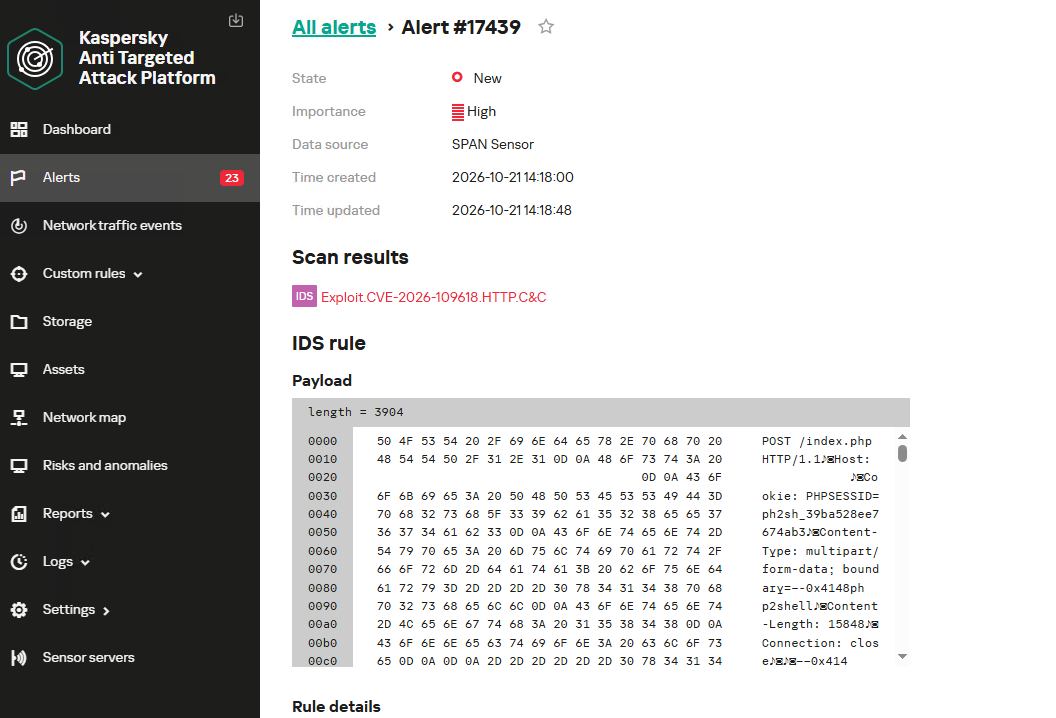
Exploitation of the PHP2Shell vulnerability in network traffic is detected by Kaspersky Anti Targeted Attack (KATA). This solution detects such activity with the following verdicts: Exploit.CVE-2026-109618.HTTP.C&C and Exploit.CVE-2026-109619.HTTP.C&C.
Detection of the PHP2Shell vulnerability exploit by KATA
Kaspersky Endpoint Security, now available as Kaspersky Next, also detects malicious post-exploitation activity using the Behavior Detection component, with verdicts such as PDM:Exploit.Linux.Generic and PDM:Exploit.Win32.Generic.
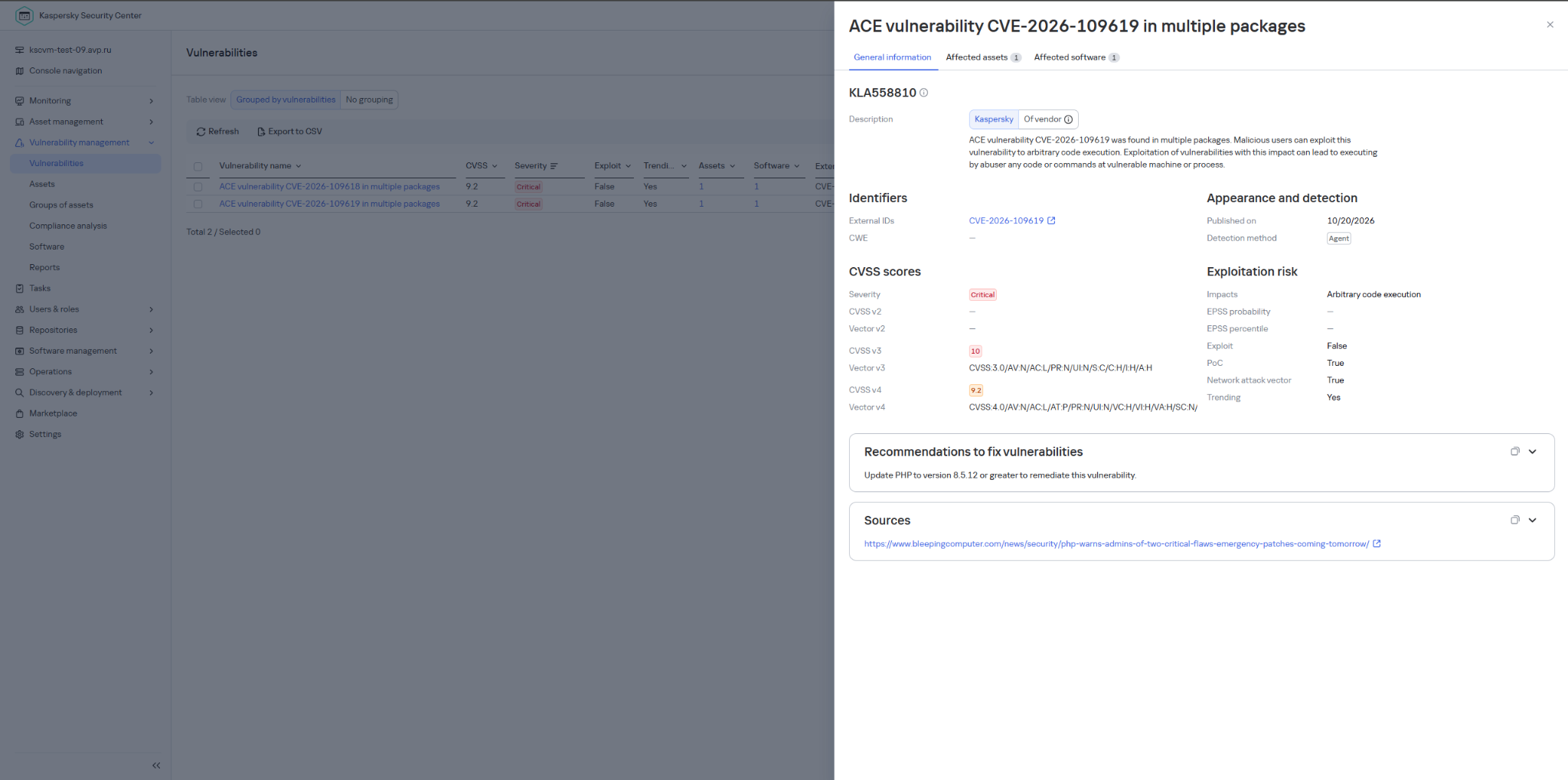
Our Kaspersky Vulnerability Management solution detects vulnerable software versions using the Vulnerability scanning and Agentless black-box scanning components.
Detection of the PHP vulnerability in Kaspersky Vulnerability Management
The Kaspersky Managed Detection and Response service detects the exploitation of the described vulnerabilities by monitoring activity characteristic of RCE:
- Spawning of suspicious processes by the web server;
- Creation of suspicious executable files in the web application directory;
- Creation of suspicious scripts in the web application directory;
- Creation of files with uncommon extensions in the web application directory;
- Execution of reconnaissance commands by the web server process;
- Execution of persistence commands by the web server process;
- Delivery and launch of web shells on the web server.
Moreover, MDR detects other malicious activity not directly related to remote code execution.
To protect companies that use our Kaspersky SIEM system, the product repository includes rules that help detect the following malicious activity.
- Execution of suspicious executable files by web server processes on Windows and Linux machines:
- R300_04_Windows shell started by a web application
- R152_08_A running Linux shell process has a suspicious parent process
- Execution of reconnaissance commands by the web server process:
- R286_05_Possible web-shell (Linux)
We also recommend monitoring the creation of scripts or executable files in the web server directory when developing your own detection rules or conducting threat hunting:
((DeviceEventClassID = '4663' AND DeviceCustomString1 ilike 'WriteData') OR DeviceEventClassID = '11') AND match(FileName,'(?i).*\.(php|asp|aspx|ashx|jsp|js|jar|jse|dll|exe|bat|ps1|vbs|wsf|wsh|msi|msp|hta|cpl)$') AND match(DestinationProcessName,'(?i).*(php-cgi|nginx|httpd|w3wp)\.exe')Name = 'openat' AND has(SA.Nametype, 'CREATE') AND length(arrayFilter(x -> match(x, '(public_html|var/www|usr/local/apache2|usr/local/httpd|var/apache|srv/www|home/httpd/html|srv/http|usr/share/nginx/html|var/lib/pgsql/data|usr/local/mysql/data|var/lib/mysql|var/vsftpd|etc/bind|var/named)'), SA.FileName))>1 AND length(arrayFilter(x -> match(x, '\.(aspx|asp|asmx|asax|ashx|jspx|jsp|js|phpt|php|phtml|pht|cfm|shtml|htaccess|fcgi|cgi|pl|py|sh)'), SA.FileName))>1
Kategorie: Hacking & Security, Viry a Červi
Recenze televizoru TCL 65C8L. Výborný obraz, zvuk od Bang & Olufsen a jas, který nastavíte stejně snadno jako hlasitost
TCL u vyšší řady C8L nesází jen na další přihazování jasu. Základem výborný, kontrastní HVA panel, jemnější řízení podsvícení a konečně také čtyři plnohodnotné vstupy HDMI 2.1. Výsledkem je jeden z nejlepší letošních televizorů, který uspokojí filmové fanoušky, náročné hráče, ale také naprosto ...
Kategorie: IT News
PHP devs publish critical bug fix as site owners warned: Pull 'em offline if you're unpatched
PHP developers have released emergency updates for two critical vulnerabilities after cybersecurity authorities warned organizations to patch immediately or consider taking exposed applications offline. PHP 8.5.12, 8.4.27, 8.3.36, and 8.2.35 address CVE-2026-109618 and CVE-2026-109619, which can allow unauthenticated remote code execution. The project's developers urged users to update immediately. All PHP installations serving web requests are potentially affected, including deployments using PHP-FPM, Apache's mod_php, php-cgi, FrankenPHP, and LiteSpeed, the developers said. "We consider the risk highest for mod_php, with a demonstrated exploit where an unauthenticated request can trigger the attack before any application code runs." Jake Knott, head of threat intelligence at watchTowr, said: "As expected, watchTowr Intel is already observing in-the-wild exploitation of the latest PHP vulnerabilities, with a variety of vibecoded PoCs already hitting our sensors featuring a variety of 'php2shell' User-Agents. Whilst nobody has been successful to date, we don't expect that will last long." "Where immediate patching is not feasible, organizations should consider isolating internet-facing applications from public networks until a fix is available," CERT-EU said in an advisory issued ahead of the patches. The body lists both vulnerabilities with CVSS scores of 9.2. Finnish government services and websites belonging to the Dutch parliament, cybersecurity authorities, and data protection regulator were taken offline as a precaution. Privacy campaign group noyb also temporarily withdrew its website. PHP "powers WordPress, Drupal, Joomla, and Magento sites, shared hosting platforms, control panels, and an awful lot of software that doesn't even advertise that it runs PHP under the hood," infosec vendor Huntress noted. That makes identifying exposed installations a substantial job. "The number of places you have to go looking to identify vulnerable PHP versions gets very big, very fast," said John Hammond, Huntress's senior principal security researcher. ®
Kategorie: Viry a Červi
TP-Link nechce přijít o USA. Chce tam investovat až miliardu dolarů a přesunout část výroby
Spojené státy zakázaly prodej síťových zařízení vyráběných jinde než doma. Dočasně však udělují výjimky a ty již získali všechny velké nečínské společnosti. Situace je nejvýbušnější u čínského TP-Linku.
Jde o největšího výrobce routerů pro domácnosti. Americká vláda tuto společnost dlouhodobě ...
Kategorie: IT News
Po pěti letech čekání přichází Boeing 737 MAX 10. Podívejte se, co všechno musel splnit během náročné certifikace (video)
Americký Letecký úřad certifikoval dopravní letoun Boeing 737 MAX 10 • Výrobce musel přepracovat klíčové bezpečnostní i navigační systémy • Letecké společnosti očekávají zahájení dodávek na počátku roku 2027
Kategorie: IT News
PHP ships emergency patches for critical PHP2Shell flaws
The PHP security team released emergency security patches for two critical remote code execution (RCE) vulnerabilities (CVE-2026-109618 and CVE-2026-109619) tracked collectively as PHP2Shell. [...]
Kategorie: Hacking & Security
- « první
- ‹ předchozí
- …
- 72
- 73
- 74
- 75
- 76
- 77
- 78
- 79
- 80
- …
- následující ›
- poslední »